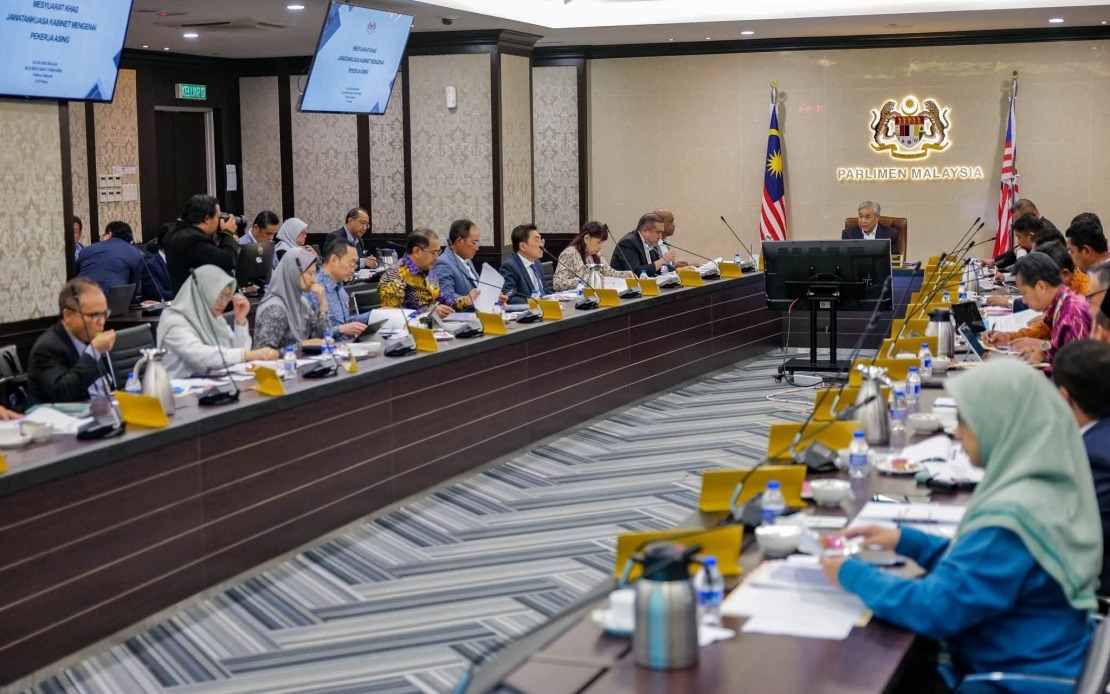
Malaysia's government has committed to a comprehensive overhaul of how it manages its foreign workforce, with Deputy Prime Minister Datuk Seri Dr Ahmad Zahid Hamidi confirming that cabinet discussions have yielded a series of structural reforms designed to tighten oversight and boost operational effectiveness across the sector. The restructuring initiative emerged from a special meeting of the Cabinet Committee on Foreign Workers convened at Parliament, where officials deliberated on mechanisms to strengthen coordination between agencies while ensuring the system remains responsive to Malaysia's economic requirements and labour market dynamics.
Central to the announced reforms is the repositioning of the One Stop Centre for Foreign Worker Management, which will now operate under the supervision of the Ministry of Human Resources rather than operating under its previous administrative framework. This consolidation represents an attempt to centralise decision-making authority and create clearer lines of accountability within the foreign worker management apparatus. By bringing this coordination hub under a single ministerial roof, policymakers expect to eliminate bureaucratic friction that has historically complicated the processing of applications and compliance verification for employers seeking to hire migrant labour.
The cabinet meeting addressed not only structural elements but also operational guidelines, including a reassessment of the membership composition and terms of reference governing the Cabinet Committee on Foreign Workers itself. These adjustments suggest that the government recognises the need for fresh perspectives and potentially broader stakeholder input in shaping labour migration policy. Such recalibration typically reflects lessons learned from previous management challenges or emerging gaps identified through consultations with industry bodies and law enforcement agencies tasked with regulating the sector.
Ahmad Zahid articulated the government's dual objective as balancing three sometimes-competing priorities: establishing an efficient and trustworthy foreign worker management regime, meeting the legitimate labour requirements of Malaysian industries, and safeguarding national security interests. This formulation acknowledges a persistent tension within Malaysia's labour migration policy—the need to attract and retain talent in sectors facing chronic skills shortages while simultaneously preventing security risks and protecting local job prospects. The deputy premier's emphasis on integrity within the system points to past concerns regarding corruption, document falsification, and inadequate vetting procedures that have occasionally allowed unsuitable individuals to enter the workforce.
Looking beyond administrative reorganisation, the government signalled its intention to adopt a more strategic and selective approach when evaluating applications from employers requesting foreign workers. Rather than responding reactively to labour demands, authorities will now conduct deeper analysis of actual sectoral needs, examining whether particular roles truly require imported talent or whether local workers could fill vacancies with appropriate training and incentives. This methodological shift could have significant implications for industries such as manufacturing, construction, domestic work, and agriculture that have historically depended on migrant labour to maintain production levels and competitiveness.
Simultaneously, Malaysian policymakers reiterated their commitment to reducing structural dependence on foreign workers through a multi-faceted strategy encompassing several complementary approaches. The government intends to boost local workforce participation by making domestic employment more attractive through competitive wages, improved working conditions, and clearer career pathways. Strengthening the skilled workforce represents another pillar, with the government indicating continued investment in vocational training and tertiary education programmes that equip Malaysians for positions currently filled by migrants. Additionally, accelerating industrial automation features prominently in the long-term vision, with officials recognising that mechanisation and digitisation can substitute for labour-intensive processes while enhancing productivity and Malaysian workers' exposure to advanced technologies.
The announcement reflects broader regional and global conversations about labour migration, xenophobia, and economic vulnerability that have intensified as Southeast Asian nations reassess their reliance on cross-border worker movements. Malaysia, hosting one of Asia's largest migrant workforces, faces particular pressure to demonstrate that it can manage this population responsibly while protecting national interests. Recent years have witnessed periodic scandals involving worker exploitation, unsafe working conditions, and security incidents that have prompted calls from civil society, trade unions, and international organisations for stricter governance and enforcement.
For Malaysian businesses dependent on foreign labour, the restructuring announcement presents both opportunities and uncertainties. Streamlined administrative processes through the One Stop Centre could simplify hiring procedures and reduce compliance costs. However, more stringent needs assessments and efforts to limit foreign worker approvals may constrain expansion plans in labour-intensive sectors. Companies in construction, manufacturing, and services will likely need to invest more heavily in workforce development, wage improvements, and automation technologies to adapt to an environment where accessing migrant labour becomes progressively more difficult.
The emphasis on national security considerations within the foreign worker management framework signals official concern about the relationship between labour migration and broader challenges including human trafficking, document fraud, and infiltration by individuals with criminal backgrounds. These concerns are not unique to Malaysia but reflect global experiences where inadequate vetting and monitoring of migrant populations has occasionally contributed to security incidents. The decision to place greater emphasis on integrity suggests that future policy will incorporate enhanced background checks, biometric systems, and ongoing surveillance of the foreign workforce to identify and remove those posing risks.
Industry stakeholders and observers will be monitoring the implementation phase closely, particularly how effectively the restructured system balances the government's stated objectives. The success of the One Stop Centre under Human Resources Ministry stewardship will largely depend on whether it receives adequate funding, staffing, and technological infrastructure to process applications efficiently while conducting thorough vetting. Additionally, coordination challenges between the Human Resources Ministry and other agencies involved in foreign worker management—including immigration, security, labour, and local authorities—will need to be resolved through clear protocols and regular communication mechanisms.
The broader policy direction articulated by Ahmad Zahid reflects an acknowledgment that Malaysia cannot indefinitely maintain its current trajectory of foreign worker dependency. Demographic changes, rising labour costs, and evolving international standards for worker protections create incentives for Malaysian enterprises to embrace alternatives to unlimited access to cheap migrant labour. The government's promotion of automation and skills development suggests that officials envision a transformed labour market where Malaysians occupy predominantly skilled positions while routine tasks are increasingly mechanised, reducing the need for large migrant populations.
For workers themselves—both Malaysian citizens and migrants already in the country—these structural changes carry significant implications. Strengthened enforcement and oversight, while theoretically protecting vulnerable workers from exploitation, may also lead to increased deportations and restricted mobility. Conversely, improved integrity in hiring practices could benefit ethical employers and shield jobs for Malaysian workers from unfair competition by employers willing to breach regulations. The longer-term success of this restructuring will ultimately be judged on whether it delivers on the government's triple objective of efficiency, security, and fairness while supporting Malaysia's economic competitiveness in an increasingly challenging regional environment.

