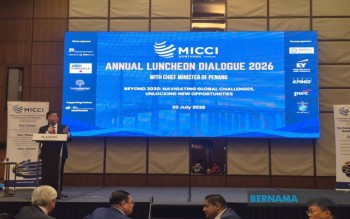
The Malaysian International Chamber of Commerce and Industry has issued a forceful call to its membership to substantially increase spending on workforce development and cutting-edge innovation, warning that failure to do so will leave businesses vulnerable as technological forces fundamentally alter the competitive landscape. Speaking at the MICCI Northern Branch Annual Luncheon Dialogue 2026 in George Town, Datuk Brian Tan Guan Hooi stressed that the intersection of artificial intelligence, automation and digitalisation represents both a critical threat and a significant opportunity for enterprises seeking to maintain their market position in an increasingly unpredictable global environment.
The technological revolution underway is not simply displacing existing workers and roles; rather, it is simultaneously creating entirely new industries and generating higher-value employment opportunities that did not previously exist. However, companies cannot passively wait for these opportunities to materialise. Instead, they must proactively position themselves by ensuring their workforce possesses not merely formal educational credentials, but a broader constellation of capabilities that modern employers demand. Technical proficiency remains essential, but equally important are creativity, effective communication abilities and a demonstrated willingness to engage in continuous learning throughout one's career.
Tan emphasised that educational institutions and training programmes must maintain a sharp focus on industry requirements rather than operating in isolation from business realities. The disconnect between what educational systems produce and what employers actually need represents a persistent challenge across Southeast Asia, where skills gaps frequently impede economic development and business expansion. By fostering genuine dialogue between academia and industry, Malaysia can ensure that young people entering the workforce arrive equipped not only with theoretical knowledge but with the practical capabilities that employers desperately seek.
The MICCI chairman's remarks carry particular resonance for Malaysian enterprises competing in regional and global markets. Many Malaysian companies, particularly in manufacturing, services and technology sectors, already face intense pressure from lower-cost competitors in neighbouring countries. Technological advancement offers a potential path to higher productivity and greater value creation, but only for organisations willing to invest substantially in their people. Those that resist this transition risk gradual irrelevance as competitors elsewhere adopt automation and artificial intelligence more aggressively.
Beyond immediate workforce considerations, Tan advocated that businesses adopt a fundamentally different mindset regarding their strategic planning horizon. The temptation to focus exclusively on navigating near-term challenges and fluctuating market conditions is understandable, yet ultimately counterproductive. Instead, successful enterprises must simultaneously strengthen their long-term competitive foundations by embracing innovation systematically, committing meaningful resources to human capital development and building organisational flexibility to respond to rapid technological shifts. This dual focus requires a level of strategic discipline that many organisations struggle to maintain, particularly when quarterly earnings pressures mount.
A particularly significant aspect of Tan's message concerns the future role of the private sector in driving economic progress. Rather than viewing government as a subordinate partner, businesses should recognise that genuine prosperity emerges from a genuinely collaborative relationship between public and private institutions. Government establishes the foundational policy framework, provides essential infrastructure, and creates the regulatory environment within which business operates. The private sector, in turn, brings capital investment, technological expertise, operational innovation and employment opportunities that generate widespread prosperity throughout society.
Tan explicitly cautioned that neither sector can successfully achieve its objectives in isolation. This observation carries particular weight for Malaysia, where occasional tensions between government and business interests sometimes undermine strategic initiatives. When public and private leaders approach their interactions with genuine commitment to constructive engagement rather than narrow self-interest, the entire economy benefits from more coherent policymaking and better-targeted support systems.
Continuous dialogue between industry associations like MICCI and government decision-makers has become essential as the pace of technological change accelerates. Policies formulated without adequate input from business practitioners risk becoming obsolete almost immediately or failing to address genuine competitive constraints. Infrastructure investments planned without consulting the enterprises that will utilise those facilities frequently prove misaligned with actual needs. Training and education programmes developed without industry participation struggle to produce graduates with relevant capabilities. Ongoing conversation allows policymakers to understand emerging challenges early and adjust course before entire sectors face disruption.
MICC's self-appointed role as a bridge between the private sector and government takes on fresh importance in this context. The organisation, which traces its history back to 1837 and celebrates its 189th anniversary this year, has accumulated nearly two centuries of experience in advocating for business interests while maintaining credibility with government. This institutional credibility positions MICCI to serve as an honest broker capable of translating between different institutional perspectives and contributing pragmatic solutions to shared challenges.
For Malaysian readers and business leaders specifically, Tan's message contains an implicit warning about complacency. The regional competitive environment has grown significantly more challenging over the past decade, with Thailand, Vietnam and Indonesia increasingly attracting foreign investment and developing indigenous technological capabilities. Malaysia's historical advantages in manufacturing and financial services cannot be taken for granted. Sustained prosperity requires continuous upgrading of capabilities, strategic foresight and a genuine commitment to developing the next generation of talent with the skills to thrive in an AI-augmented economy. Companies that treat talent development and innovation as discretionary expenses rather than strategic imperatives risk finding themselves progressively marginalised in their own markets.

