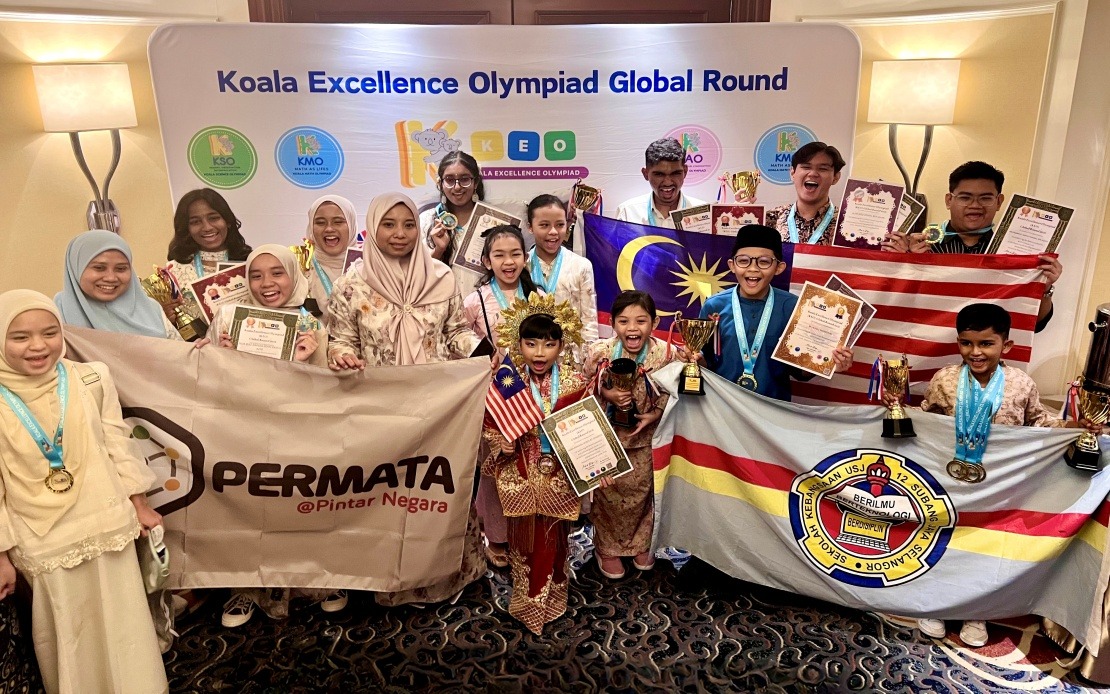
Malaysia's academic contingent has demonstrated considerable strength on the international stage, with seventeen students capturing nine overall accolades and a combined 22 medals at the Koala Excellence Olympiad 2026 held in Macau. The Malaysian delegation concluded its participation in the competition yesterday, returning home with a medal haul comprising five gold, six silver and eleven bronze awards across multiple disciplines. The achievement underscores the country's continued commitment to nurturing young talent and competing effectively in global scholastic forums.
The Malaysian Young Scientists Organisation (MYSO) coordinated the national team's participation in the event, which is organised jointly by the Koala Excellence Olympiad and the Miss Man International Group. Aidah Misran, who served as both MYSO coordinator and leader of the Malaysian contingent during the competition in Macau, confirmed the comprehensive results achieved by the participants. The competition itself drew students from various nations who competed across four distinct olympiad categories: English, Mathematics, Science and Arts, each designed to test and develop critical academic capabilities.
The makeup of Malaysia's representative team reflected a cross-section of the nation's educational institutions, demonstrating that excellence in academic olympiads is not confined to any single school or region. Four students came from Kolej PERMATA@Pintar Negara Universiti Kebangsaan Malaysia (UKM), while Sekolah Menengah Kebangsaan Ungku Aziz contributed six competitors. Two additional secondary-level participants came from Sekolah Sultan Alam Shah. The primary school segment was represented by three pupils from Sekolah Kebangsaan Convent (2) Bukit Nanas, with individual representatives from Sekolah Menengah Kebangsaan Convent Teluk Intan, Sekolah Kebangsaan USJ 12, Sekolah Kebangsaan Seri Hartamas and Sekolah Kebangsaan Convent Sentul 1, creating a geographically and institutionally diverse delegation.
Among the most celebrated individual performances was that of Mukridz Mardzuki, a Year Six pupil from Sekolah Kebangsaan Seri Hartamas, who achieved the pinnacle of recognition by securing the overall Science Olympiad championship within the primary school category. This result places him among Malaysia's most accomplished young scientists on the international platform and reflects both his personal dedication and the quality of science education being delivered within the nation's primary school system. Such individual excellence at international competitions serves an important signalling function for talent identification and educational programme evaluation.
The Science Olympiad produced several notable performances from the Malaysian contingent beyond the championship victory. Sarah Isabel Maryam Ahmad Suhael, representing Sekolah Kebangsaan Convent (2) Bukit Nanas, secured the runner-up position in the Science Olympiad for the primary school category, indicating consistent competitive strength at that level. In the secondary category, Alfie Rizq Danial Azlan from Sekolah Sultan Alam Shah claimed the Science Olympiad runner-up honour, demonstrating that Malaysia's scientific talent extends across both primary and secondary education levels.
Beyond the science disciplines, the Malaysian team achieved notable recognition in the English Olympiad competition. Ayra 'Adani Muhammad 'Aizat from Kolej PERMATA@Pintar Negara Universiti Kebangsaan Malaysia earned the runner-up spot in the overall English Olympiad category, affirming that Malaysian students possess competitive English-language capabilities on the international stage—a particularly important competency in an increasingly globalised economy where communication skills determine career trajectories.
The competition's structure, developed by Australian educational experts, deliberately emphasises problem-solving abilities, innovation and practical application rather than memorisation-based learning approaches. This pedagogical philosophy aligns closely with contemporary international education standards and the shifts occurring within Malaysia's own curriculum frameworks. The Koala Excellence Olympiad thus provides both a competitive platform and an indirect assessment mechanism for how well Malaysian educational institutions are preparing students for twenty-first century intellectual demands. By performing competitively within this framework, Malaysian students have validated the effectiveness of teaching methodologies being employed within their schools.
Five Malaysian participants achieved third-place awards across various categories. Marvyn Zef Mark Philip distinguished himself by securing two category victories, winning top honours in both Science and English olympiads, an achievement indicating versatility across different knowledge domains. Prem P earned a third-place finish in the Science category, Muhammad Khairul Mauidz Khairul Azman achieved the same ranking in Mathematics, and Shashini Aravinthan finished third in the English competition. These placements, whilst representing a tier below the championship positions, nonetheless reflect strong competitive performance and deserve recognition as components of Malaysia's overall success at the event.
The delegation's collective success carries implications beyond individual student achievement. For Malaysian parents and educators, these results provide tangible evidence that local educational institutions are producing students capable of competing effectively against international peers in rigorous academic environments. For policymakers, the performance data suggests that current investments in science education, English-language instruction and mathematics training are yielding measurable returns. The diversity of participating schools, ranging from institutions affiliated with universities to standalone primary schools, indicates that academic excellence is being cultivated across multiple institutional contexts within Malaysia.
For Southeast Asian perspectives, Malaysia's performance at international academic competitions like the Koala Excellence Olympiad contributes to regional competitiveness benchmarking. How ASEAN nations perform relative to one another and against global participants provides data for comparative analysis of education system effectiveness. Malaysia's seventeen-student delegation achieving nine overall awards positions the country as a reliable participant in the international academic olympiad ecosystem, though ongoing efforts to increase both the size and performance level of delegations could enhance regional standing further.
The Malaysian Young Scientists Organisation's coordination of the team's participation reflects an important institutional capacity for connecting domestic talent with international competitive platforms. Such intermediary organisations play a crucial role in identifying promising students, preparing them for international competition standards and facilitating their participation. As Malaysia continues to position itself as a knowledge economy requiring high-skilled talent, these networking functions become increasingly valuable for talent pipeline development.
Looking forward, the demonstrated competitiveness of Malaysian students at the Koala Excellence Olympiad 2026 offers encouragement for continued investment in academic enrichment programmes and olympiad preparation initiatives. The range of medals achieved across different disciplines and school types suggests that Malaysia possesses broader talent pools in STEM and English than might be immediately apparent from examining only national-level competitions. Future considerations for educational administrators might include examining how the success of this international delegation can be translated into strengthened domestic programmes that enable more students to reach comparable performance levels.

