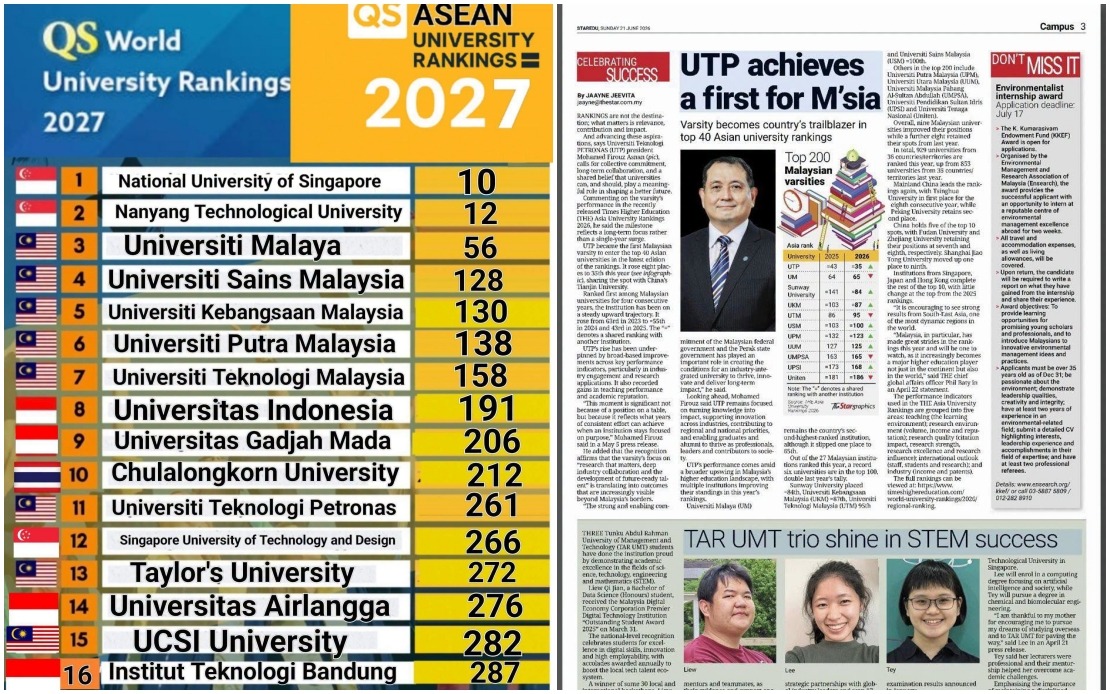
Malaysia's higher education sector has reinforced its position as a serious contender on the global academic stage, with a clutch of domestic universities achieving notable advances in the latest international rankings. The results reflect growing recognition of the quality and research capabilities embedded within the nation's university system, signalling that strategic investments in tertiary education are yielding measurable returns in international standing.
Higher Education Minister Datuk Seri Dr Zambry Abd Kadir highlighted the significance of these rankings as meaningful benchmarks of institutional quality and competitive strength, even as he cautioned that numerical rankings should not become universities' sole aspiration. Rather, they serve as reliable indicators of how Malaysian institutions compare with their counterparts across Asia and globally, offering prospective students, researchers and collaborators tangible evidence of academic standards and research output.
The standout achievement came from Universiti Teknologi Petronas, which broke through a significant ceiling by placing 35th in the Times Higher Education Asia University Rankings 2026—a jump from 43rd position the previous year. This milestone represents the first time a Malaysian university has secured a spot within Asia's top 40, marking a watershed moment for the nation's higher education ambitions and demonstrating that petroleum engineering and technology-focused institutions can compete at the highest regional levels.
The broader picture reveals sustained momentum across Malaysia's university ecosystem. Twenty-seven Malaysian institutions earned positions in this year's Times Higher Education Asia rankings, a strong showing that reflects diversity across the sector. More impressively, six universities placed within Asia's elite top 100, while eleven institutions secured slots in the top 200—demonstrating that excellence is not confined to a single flagship university but distributed across public and private institutions nationwide.
The list of performing institutions reads as a cross-section of Malaysia's higher education landscape. Universiti Malaya, the nation's oldest and most prestigious university, maintains its traditional leadership role. Alongside it, research-intensive institutions like Universiti Kebangsaan Malaysia, Universiti Teknologi Malaysia, and Universiti Sains Malaysia continue to build their international profiles. Meanwhile, newer entrants such as Universiti Teknologi Petronas, alongside established private institutions like Sunway University, demonstrate that Malaysia's university success story encompasses both veteran institutions and ambitious newcomers.
The achievements reflect what Zambry described as collective institutional effort—a combination of dedicated academics, productive researchers, ambitious students, engaged alumni networks, and partnerships with industry. This ecosystem approach to university excellence aligns with regional and global best practices, where universities increasingly function as connectors between knowledge production and practical application. The involvement of industry partners particularly matters in Malaysia's context, where many universities have developed significant research clusters in fields ranging from petroleum engineering to renewable energy and biotechnology.
For Malaysia's positioning in the competitive Southeast Asian education market, these rankings carry strategic weight. The region's universities are increasingly competing for top international talent, research funding, and student enrolments from across Asia. Singapore's universities dominate regional rankings, while Thai and Indonesian institutions have strengthened their positions in recent years. Malaysian universities' consistent upward movement suggests the country can sustain its appeal as a destination for serious academics and ambitious students seeking quality education at a competitive cost.
The timing of these achievements matters as well. Malaysia has positioned itself as a regional education hub, with policies encouraging student mobility and research collaboration. Universities in Kuala Lumpur, Petaling Jaya, Serdang and other education clusters have invested heavily in international partnerships, English-medium instruction, and research infrastructure. These rankings validate those investments and create positive momentum for future student recruitment, particularly from neighbouring countries seeking alternatives to expensive Western universities.
However, the rankings also highlight ongoing challenges. While six universities in Asia's top 100 represents progress, the concentration of Malaysia's highest-ranked institutions—with most clustering in the 50-200 range—suggests there remains a significant gap to close before matching the dominance of top-tier Asian competitors. Building on current momentum will require sustained funding, strategic hiring of world-class researchers, and continued modernisation of research facilities and libraries.
The minister's statement framing these rankings as evidence of Malaysia's emergence as a hub of excellence in education, research and innovation carries implicit messaging for government policy and funding decisions. It positions higher education investment not merely as a social service but as economic strategy—creating knowledge workers, attracting research talent, and building the intellectual foundations for an innovation-driven economy. For Malaysia's broader development ambitions, a robust, internationally competitive university system represents essential infrastructure.
Moving forward, the challenge for Malaysian universities lies in translating current momentum into sustained competitive advantage. International rankings, while imperfect measures, do reflect genuine differences in research output, citation impact, and institutional reputation. Malaysian universities must continue attracting top academic talent, securing competitive research funding, and fostering the collaborative international networks that produce breakthrough discoveries and attract global attention.
%22%2F%3E%3C%2Fpattern%3E%3C%2Fdefs%3E%3Crect%20width%3D%22100%25%22%20height%3D%22100%25%22%20fill%3D%22url(%23ph3ozefg)%22%2F%3E%3Crect%20width%3D%22100%25%22%20height%3D%22100%25%22%20fill%3D%22url(%23ph3ozefp)%22%2F%3E%3Ctext%20x%3D%2250%25%22%20y%3D%2250%25%22%20text-anchor%3D%22middle%22%20dominant-baseline%3D%22central%22%20fill%3D%22rgba(255%2C255%2C255%2C0.95)%22%20font-family%3D%22Georgia%2C%20'Times%20New%20Roman'%2C%20serif%22%20font-weight%3D%22700%22%20font-size%3D%22320%22%20letter-spacing%3D%22-0.02em%22%3EIran%3C%2Ftext%3E%3C%2Fsvg%3E)
%22%2F%3E%3C%2Fpattern%3E%3C%2Fdefs%3E%3Crect%20width%3D%22100%25%22%20height%3D%22100%25%22%20fill%3D%22url(%23ph4hqahg)%22%2F%3E%3Crect%20width%3D%22100%25%22%20height%3D%22100%25%22%20fill%3D%22url(%23ph4hqahp)%22%2F%3E%3Ctext%20x%3D%2250%25%22%20y%3D%2250%25%22%20text-anchor%3D%22middle%22%20dominant-baseline%3D%22central%22%20fill%3D%22rgba(255%2C255%2C255%2C0.95)%22%20font-family%3D%22Georgia%2C%20'Times%20New%20Roman'%2C%20serif%22%20font-weight%3D%22700%22%20font-size%3D%22272%22%20letter-spacing%3D%22-0.02em%22%3ETrump%3C%2Ftext%3E%3C%2Fsvg%3E)
%22%2F%3E%3C%2Fpattern%3E%3C%2Fdefs%3E%3Crect%20width%3D%22100%25%22%20height%3D%22100%25%22%20fill%3D%22url(%23ph2adawg)%22%2F%3E%3Crect%20width%3D%22100%25%22%20height%3D%22100%25%22%20fill%3D%22url(%23ph2adawp)%22%2F%3E%3Ctext%20x%3D%2250%25%22%20y%3D%2250%25%22%20text-anchor%3D%22middle%22%20dominant-baseline%3D%22central%22%20fill%3D%22rgba(255%2C255%2C255%2C0.95)%22%20font-family%3D%22Georgia%2C%20'Times%20New%20Roman'%2C%20serif%22%20font-weight%3D%22700%22%20font-size%3D%22320%22%20letter-spacing%3D%22-0.02em%22%3EIran%3C%2Ftext%3E%3C%2Fsvg%3E)