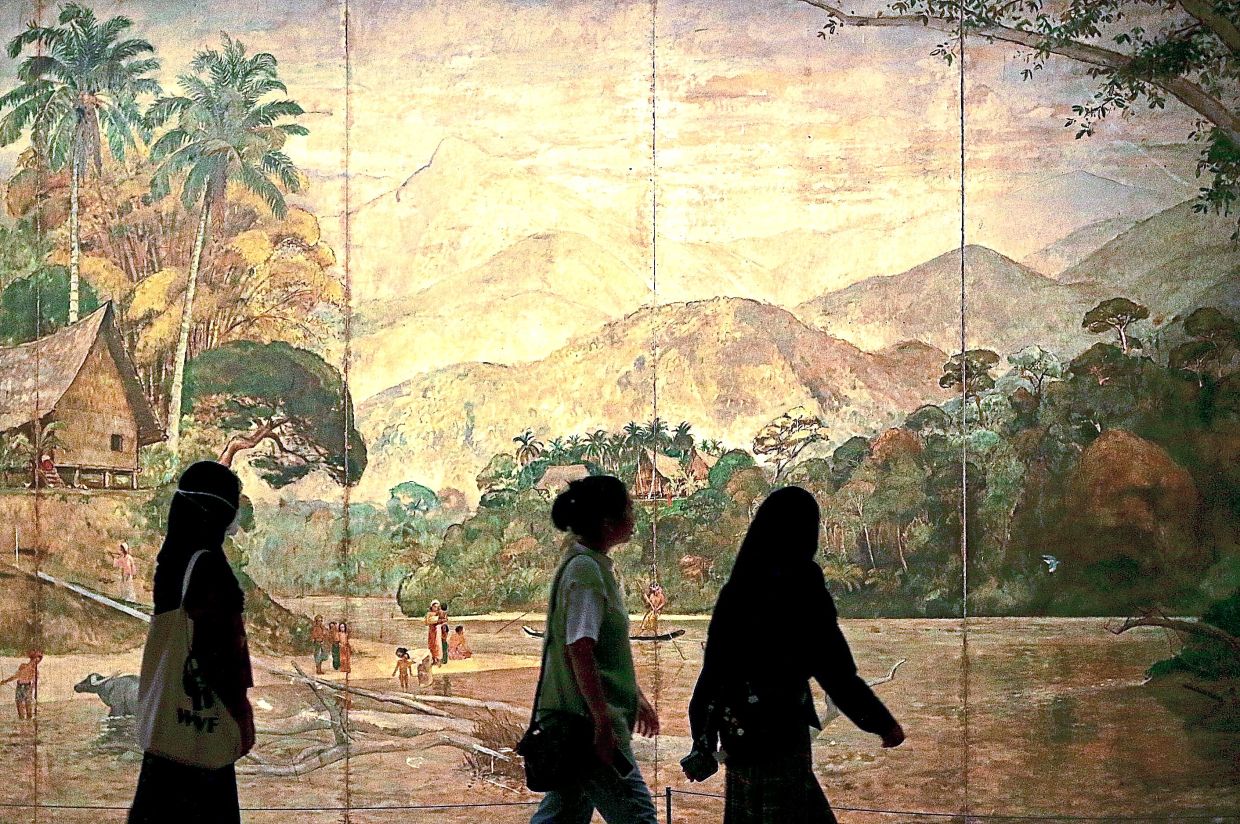
The National Art Gallery faces an invisible but relentless adversary: Malaysia's tropical climate. Humid air and powerful equatorial sunlight combine to create conditions that gradually erode the material integrity of priceless artworks, a challenge that curators and conservators have begun addressing through regional collaboration and preventive research tailored to local environmental realities.
Tan Hui Koon, senior chief curator of the Collection and Conservation section at the National Art Gallery, framed the issue in unambiguous terms during a recent discussion at the institution. The environmental pressures of Malaysia's geography do not simply pose an aesthetic concern—they represent a fundamental threat to the survival of artworks for future generations. Unlike institutions in temperate climates, Malaysian galleries must contend with moisture levels and light intensity that conventional Western conservation models were never designed to manage.
The mechanics of tropical deterioration are scientifically well-understood but difficult to counteract. Organic materials—textiles, canvas, wood—act like biological organisms themselves, continuously absorbing and releasing moisture in response to ambient humidity levels. This perpetual cycle of expansion and contraction eventually fractures the delicate structure of artworks, warping frames, lifting paint layers, and compromising the very materials that define a work's historical authenticity. What appears to be a stable artwork on the gallery wall may be undergoing microscopic damage that, over years and decades, accumulates into irreversible loss.
Tan employed a telling metaphor when discussing protective measures: art objects require protection comparable to sunscreen for human skin. The gallery now employs tinted and museum-standard glass that filters ultraviolet light, a standard practice globally but one that takes on heightened importance in Malaysia's intense solar environment. Yet physical barriers, while essential, represent only one component of a comprehensive conservation strategy. The real innovation lies in shifting institutional focus toward prevention rather than restoration—understanding that once material has been lost to decay, no conservation technique can fully restore an artwork to its original condition.
This philosophical reorientation underpins the preventive conservation model that the National Art Gallery has adopted. Rather than waiting for visible damage and then attempting repairs, curators now emphasise environmental control, careful handling protocols, and appropriate storage conditions. The distinction matters enormously: a successfully conserved artwork maintains its structural and material integrity, allowing it to be displayed and appreciated, whereas a restored artwork, no matter how skillfully repaired, can never truly return to its pristine state. For Malaysia's collections—many of which document the nation's cultural heritage and artistic evolution—the implications are profound.
These practical and philosophical challenges converge at the seventh Asia-Pacific Tropical Climate Conservation Art Research Network conference, which the National Art Gallery will host from December 7 to 9 across Kuala Lumpur and Ipoh, Perak. The gathering represents a significant moment for regional expertise-sharing, drawing conservation specialists from Malaysia, Thailand, Singapore, Australia and the Philippines to examine how artworks—particularly Western paintings, which present unique challenges in tropical settings—respond to non-temperate climates. This cross-border engagement reflects recognition that Southeast Asian institutions face similar preservation crises that Western conservation literature has historically overlooked.
A distinctive feature of this year's conference involves bridging academic expertise with local knowledge systems. Rather than defaulting to Western conservation paradigms developed for European climate conditions, participants will explore disaster response methods and conservation approaches specifically adapted to individual Southeast Asian countries' geographical contexts. This shift acknowledges that tropical conservation requires regional solutions, informed by decades of local institutional experience, rather than imported models that may prove ineffective or inappropriate. The conference programme includes field visits to heritage sites in Lenggong through collaboration with the Islamic Arts Museum Malaysia, the Department of National Heritage, and People of Remarkable Talents, grounding theoretical discussions in tangible examples.
Tan highlighted the conference's emphasis on intergenerational knowledge transfer as equally important as technological innovation. Conservation as a discipline increasingly demands interdisciplinary expertise—combining art history, chemistry, physics, materials science and digital technology. Developing the next generation of Malaysian conservators requires mentorship networks and institutional mechanisms for sharing experience. The research network, by facilitating dialogue among established experts and emerging professionals, creates pathways for knowledge transfer that formal education alone cannot provide. This dimension proves especially valuable given Malaysia's developing conservation infrastructure relative to established European institutions.
The conference agenda reflects the complexity of modern conservation challenges. Climate change, which is intensifying rainfall and temperature fluctuations across the region, will receive focused attention. Disaster management protocols—increasingly relevant given Southeast Asia's vulnerability to flooding and extreme weather—will be discussed alongside emerging technologies including artificial intelligence applications in condition assessment and materials research innovations. These themes interconnect: understanding how materials respond to tropical conditions informs both disaster preparedness and longer-term climate adaptation strategies for galleries and museums.
Tan observed that the research network also facilitates institutional collaboration on resource-sharing, a practical necessity given the expense of conservation equipment and expertise. Malaysian museums and galleries often operate with constrained budgets, making pooled resources and shared facilities more efficient than individual institutional investment. By strengthening these networks, the conference creates efficiencies that extend conservation capabilities across the region's cultural institutions.
The 2008 inaugural conference established this network as a response to gaps in global conservation knowledge specifically addressing tropical climates. Fifteen years later, the National Art Gallery's hosting of the seventh iteration reflects Malaysia's growing prominence in regional conservation discourse. Tan characterised the conference as an opportunity to document how conservation practice in Malaysia has evolved and professionalised, while simultaneously positioning Malaysian expertise on the international stage. This positioning carries economic and cultural significance: as Malaysia develops its reputation for conservation excellence adapted to tropical conditions, the nation becomes a reference point for other developing countries addressing similar climate challenges.
Ultimately, the gallery's struggle to protect its collections against tropical climate conditions illustrates a broader Southeast Asian challenge: developing heritage preservation infrastructure suited to regional realities rather than inherited models. The conference represents a conscious effort to build this regional capacity, ensuring that Malaysia's artistic and cultural treasures survive for future generations while contributing distinctive expertise to global conservation knowledge.

