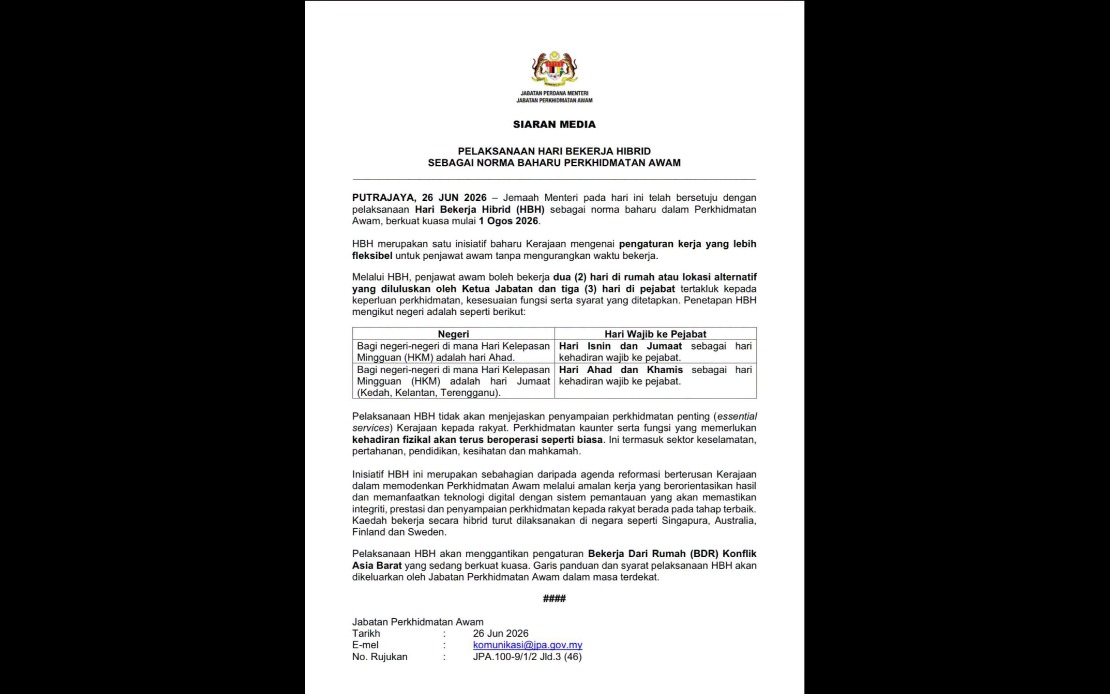
Malaysia's government has taken a significant step in modernising its public sector workforce, with the Cabinet formally approving a hybrid work arrangement that will reshape how civil servants structure their week. The Public Service Department announced on June 26 that the Hybrid Work Day framework will become the new standard across the Malaysian public service from August 1, marking a deliberate shift away from the flexible home-working patterns that became commonplace during and after the pandemic.
Under the new system, civil servants will split their working week between home and office environments. Employees are permitted to work remotely for two days each week from their homes or from alternative locations that have received approval from their respective departmental heads. In return, they must spend three days physically present at their offices. This arrangement does not involve any reduction in total working hours—civil servants will continue to fulfil their standard contractual obligations, but with greater flexibility in where those hours are completed.
The framework's implementation is not universal but instead tailors requirements based on operational realities. The Public Service Department emphasised that service requirements, functional suitability, and established working conditions will determine how the hybrid model applies to different roles and departments. This pragmatic approach acknowledges that certain government functions cannot easily transition to remote work and require consistent physical presence to maintain service standards.
Safeguarding public service delivery has been a central concern in designing the new arrangement. The government has explicitly committed to ensuring that essential services continue without interruption. Departments providing frontline counter services, security and defence operations, education, healthcare, and judicial functions will maintain their normal operational patterns, with arrangements adapted to ensure critical functions receive adequate on-site staffing at all times.
The administrative mechanics of the system vary depending on which weekly rest day states observe. For the majority of Malaysia, where Saturday and Sunday constitute the weekend, Mondays and Fridays have been designated as mandatory office attendance days. This structure ensures that at least partial office presence bookends each week, potentially facilitating better coordination and in-person meetings. However, three states with different religious observance practices required adapted scheduling. Kedah, Kelantan, and Terengganu, which observe Friday as their weekly holiday, will instead mandate Sunday and Thursday as compulsory office days.
The hybrid work initiative represents far more than a simple operational adjustment for the Malaysian civil service. Officials have positioned it within the government's broader public sector modernisation agenda, one that emphasises results-driven management and accelerated digital transformation. By allowing flexibility in work location while maintaining accountability for outcomes, the government signals that it increasingly values performance metrics over traditional presenteeism in evaluating civil servant productivity.
Malaysia is not pioneering this approach independently. The Public Service Department cited the experience of several advanced economies that have already successfully adopted hybrid arrangements, including Singapore, Australia, Finland, and Sweden. This international benchmarking suggests the Malaysian government has reviewed how comparable countries balance flexibility with service delivery, lending credibility to the implementation strategy. The fact that wealthy, high-performing civil services in developed nations have embraced similar models may help counter any resistance from traditionalist quarters within Malaysia's bureaucratic structure.
Implementation safeguards form another pillar of the strategy. The department has committed to establishing monitoring mechanisms designed to track integrity, performance standards, and service delivery quality throughout the transition and beyond. This surveillance framework addresses legitimate concerns that remote work could enable reduced diligence or create coordination challenges, particularly in departments where seamless information flow is essential for proper functioning.
The Public Service Department has deliberately withheld full implementation details, announcing that comprehensive guidelines and specific operational conditions will be released at a later date. This phased disclosure approach allows time for departmental consultation, system preparation, and stakeholder feedback before the August 1 deadline. It also signals that the framework is not rigid but subject to refinement based on input from the diverse departments that comprise Malaysia's public sector.
For Malaysian businesses and citizens interacting with government services, the transition carries both potential benefits and risks. Improved work-life balance for civil servants could translate into better morale and retention, ultimately enhancing service quality. Conversely, coordination gaps during transition periods might temporarily complicate certain administrative processes. The government's explicit reassurance about service continuity suggests officials have conducted sufficient impact analysis to feel confident about the change.
The timing of this announcement in late June, with implementation two months hence, provides a reasonable window for planning but limited time for comprehensive system overhauls. Departments will need to quickly assess their operational requirements, identify which roles can function effectively in hybrid models, and establish clear policies for staff scheduling to ensure adequate coverage during office days.
Regionally, Malaysia's move reflects a broader trend across Southeast Asia of governments and large employers reconsidering rigid office-based working patterns. As competition for talent intensifies and employees increasingly expect flexible work options, public sectors across the region are adapting to remain competitive employers. Malaysia's formal adoption of hybrid work in its civil service could influence private sector practice and set expectations for future employment arrangements.
The success of this initiative will likely hinge on implementation execution and the willingness of department leaders to grant genuine flexibility rather than creating cumbersome approval processes that undermine the arrangement's intent. Clear communication to all affected civil servants about expectations, eligibility, and procedures will be critical to ensuring smooth transition and broad acceptance of the new norm.

