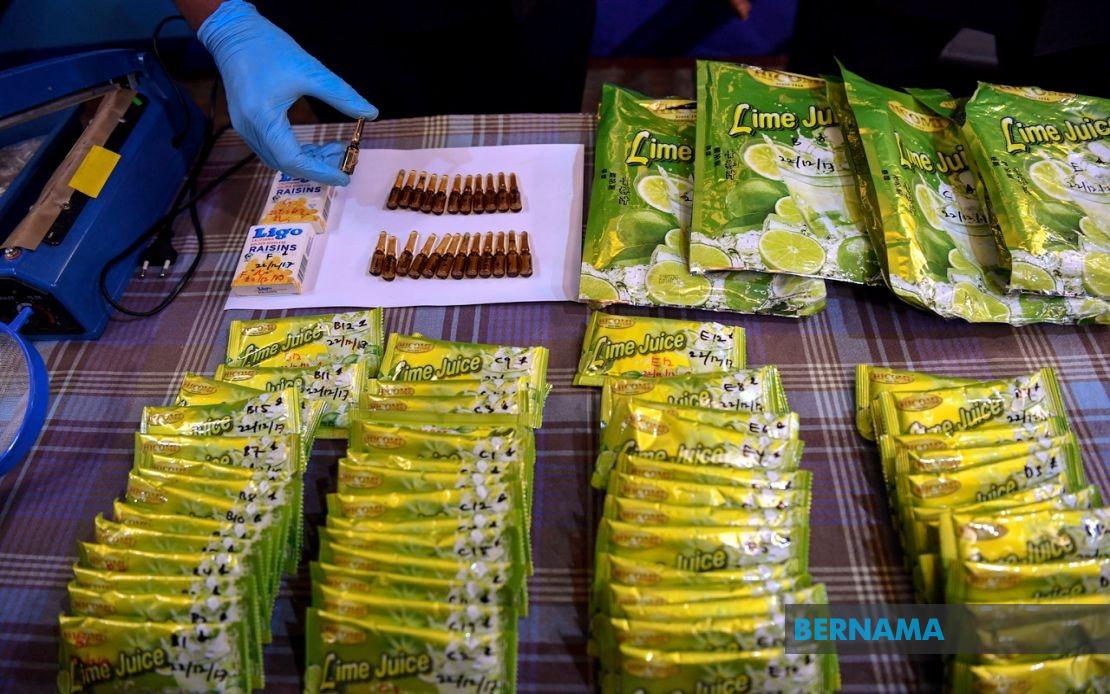
The Home Ministry has declared war on a rising tide of synthetic narcotics sweeping across Malaysia, warning that methamphetamine, illicitly-manufactured psychoactive tablets known as 'piu-piu', and the potent opioid fentanyl are creating an unprecedented public health and security challenge. Home Minister Datuk Seri Saifuddin Nasution Ismail highlighted the severity of the threat during a parliamentary response, emphasising that these substances carry extreme addiction potential, pose fatal overdose risks, and are fueling concurrent waves of crime and societal breakdown across communities from urban centres to isolated rural settlements.
The scale of the problem has become difficult to ignore. Police statistics reveal that between 2023 and June 2026, authorities arrested 238,704 individuals nationwide in connection with synthetic drug offences—a figure that underscores both the pervasiveness of the trade and the growing enforcement burden placed on law enforcement agencies. This upward trajectory suggests that traditional drug markets are being supplemented, and in some areas supplanted, by newer synthetic compounds that are cheaper to produce, easier to transport, and significantly more profitable for traffickers than conventional heroin or cocaine.
In response, the Royal Malaysia Police (PDRM) has launched coordinated operations named Op Tapis and Op Tapis Khas, extending enforcement activities across disparate terrain ranging from dense urban neighbourhoods to sparsely populated areas where monitoring has historically been limited. The operations operate within a multi-agency framework that includes the National Anti-Drugs Agency (AADK) and the Royal Malaysian Customs Department (JKDM), recognising that combating drug trafficking requires coordinated intelligence-sharing and resource pooling across institutional boundaries. This collaborative model represents a tactical shift toward treating drug enforcement as a holistic national challenge rather than isolated incidents handled by individual departments.
Technological advancement has become central to enforcement strategy. Authorities are deploying drones and surveillance cameras to detect trafficking corridors and distribution points, tools that extend the effective reach of police into areas where foot patrols alone would prove insufficient. These innovations allow for real-time monitoring of suspected drug movements and provide evidentiary documentation that can withstand legal scrutiny, a critical consideration given Malaysia's strict burden-of-proof requirements in drug prosecutions.
Legislative reform is also underway. The Dangerous Drugs Act 1952, which has served as the backbone of Malaysia's drug enforcement architecture for seven decades, is being examined for amendments to formally classify emerging New Psychoactive Substances (NPS) and synthetic opioid analogues. Currently, law enforcement must sometimes rely on chemical classification loopholes or charging under existing schedules when new compounds hit the market, a regulatory lag that traffickers exploit by tweaking molecular structures to remain nominally outside legal definitions. Updating the Act would close these gaps and provide clearer prosecutorial pathways.
Preventive work complements enforcement. Between 2023 and June 2026, authorities conducted 1,144 community-based drug awareness programmes nationwide, targeting prevention through education rather than relying exclusively on arrest and incarceration. This dual-track approach recognises that enforcement alone cannot address demand-side drivers of drug consumption, particularly among youth populations susceptible to addiction. Community policing initiatives aim to build intelligence networks within neighbourhoods while simultaneously reducing the social isolation that often accompanies stigmatisation of drug users.
Sarawak, a state with significant geographical challenges and a substantial rural population, exemplifies both the enforcement challenge and the authorities' response. Between January and June 7 this year, police made 7,097 arrests across the state, comprising 342 suspected traffickers, 1,314 individuals apprehended for drug possession, and 5,441 users. These figures reveal that Sarawak's drug problem extends across the entire supply chain, from major traffickers down to street-level dealers and end-users, suggesting systemic vulnerability at multiple enforcement points.
Material disruption of trafficking networks is yielding tangible results. During the same six-month period in Sarawak, authorities seized 418.01 kilogrammes of drugs valued at RM53.73 million, a substantial quantity that represents both direct removal of narcotics from circulation and significant financial loss to criminal organisations. Beyond seizures of the drugs themselves, authorities confiscated syndicate assets worth RM1.95 million, a financial pressure that increases the operational costs of maintaining trafficking infrastructure. Additionally, 13 individuals were detained under the Dangerous Drugs (Special Preventive Measures) Act 1985, allowing preventive custody of high-risk offenders, while 131 hardcore addicts faced action under Section 39C of the Dangerous Drugs Act 1952, which targets repeat offenders for mandatory rehabilitation.
Scientific capacity is being strengthened to maintain enforcement pace. Forensic laboratory enhancements enable profiling of emerging synthetic drug trends, particularly the growing landscape of fentanyl analogues and novel synthetic opioids that regularly appear in seizures. Faster identification and chemical profiling allows authorities to track emerging threats, adapt enforcement priorities, and provide intelligence to neighbouring regional partners grappling with similar substances. This scientific dimension is critical because synthetic drug markets evolve rapidly; without laboratory capacity to identify new compounds promptly, enforcement agencies risk pursuing substances that have already been replaced by newer variants in criminal distribution networks.
The Malaysian situation reflects broader Southeast Asian challenges. Synthetic drugs, particularly methamphetamine and fentanyl, have become the dominant narcotics concern across the region, increasingly replacing plant-based drugs that dominated markets in previous decades. The shift reflects globalisation of pharmaceutical expertise, easier precursor chemical sourcing from Asia-Pacific suppliers, and trafficking networks that have adapted to regional enforcement patterns. Malaysia's response—combining legislative modernisation, inter-agency coordination, technological deployment, and community engagement—offers a model that other regional governments are studying and selectively adopting.
Challenges remain formidable. Rural and remote areas continue to present enforcement difficulties due to geographic isolation and limited police presence. The internet and encrypted communications platforms have expanded supply chains beyond traditional geographical constraints, allowing dealers to operate with reduced risk of interception. Synthetic drugs' potency means that even small quantities represent substantial profit, making the trade economically resilient despite enforcement pressure. The social drivers of addiction—poverty, limited economic opportunity, and community disintegration—persist independently of drug supply, ensuring that demand reduction remains incomplete regardless of enforcement success.

