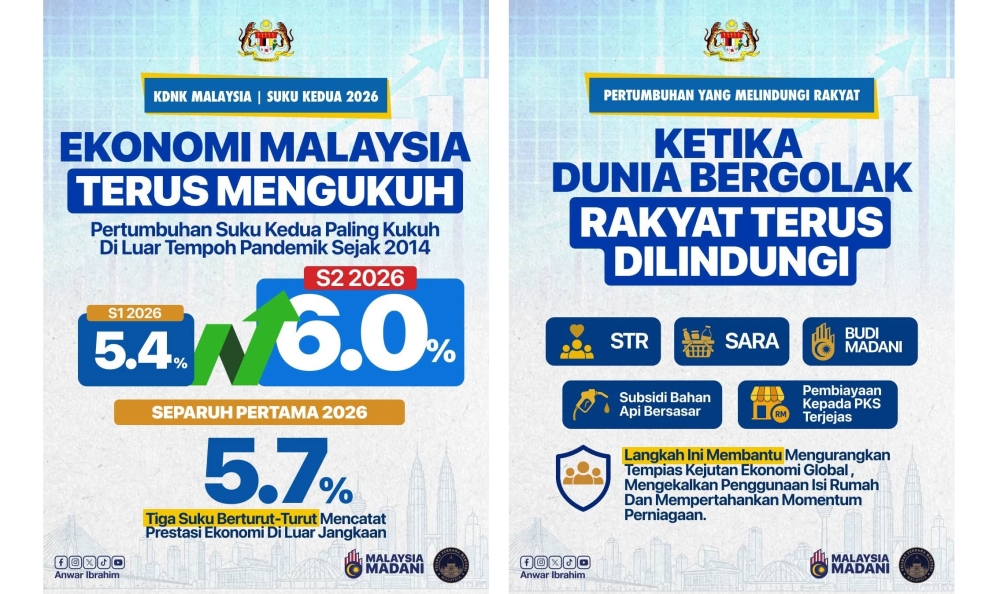
Malaysia's economy demonstrated resilience in the second quarter with growth rates outpacing analyst expectations, according to Prime Minister Datuk Seri Anwar Ibrahim's comments today in Kuala Lumpur. The stronger expansion reflects an economy navigating complex global conditions while maintaining domestic momentum, a development the government views as evidence of effective policy management during a period of significant international economic headwinds.
The Prime Minister's remarks underscore the government's dual-track economic strategy: pursuing expansion objectives while simultaneously protecting ordinary Malaysians from the worst effects of surging global prices. This balancing act has become central to the administration's economic messaging, as inflation remains a persistent concern for households across Southeast Asia, with Malaysia facing particular vulnerability as an import-dependent nation.
Anwar's emphasis on shielding households from inflation reflects widespread anxiety among middle-income and lower-income earners who have seen purchasing power erode in recent years. The government has implemented various targeted measures, including fuel subsidies, price controls on essential goods, and cash assistance programmes, to manage the cost-of-living pressures facing ordinary Malaysians. These interventions have become politically important as the administration seeks to maintain public confidence in its economic stewardship.
The better-than-anticipated Q2 performance carries significance beyond headline statistics, signalling that Malaysia's economic structure remains capable of generating growth even amid global uncertainty. Stronger expansion typically translates into improved employment prospects and increased business confidence, factors that can gradually ease pressures on household finances when wage growth accelerates. The growth trajectory also provides fiscal space for the government to maintain or expand support programmes without immediately exacerbating budget constraints.
Regionally, Malaysia's economic performance matters for broader Southeast Asian stability. As the third-largest economy in ASEAN, Malaysia's growth patterns influence investor sentiment across the bloc and signal whether the region can maintain expansion despite global challenges. Neighbouring economies closely watch Malaysian indicators for clues about regional demand trends, commodity prices, and the effectiveness of inflation management strategies across comparable middle-income countries.
However, the tension between pursuit of expansion and inflation management remains unresolved. While the government celebrates growth numbers, inflationary pressures continue squeezing household budgets in areas beyond direct government control, such as rent, services, and food items subject to market dynamics. The sustainability of the government's support measures depends partly on maintaining adequate fiscal resources while managing long-term debt obligations, a challenge that intensifies if global conditions deteriorate further.
The Q2 results become particularly significant when viewed against Malaysia's recent economic history. The nation experienced pandemic-related disruptions, supply chain complications, and post-recovery adjustments that created volatility in growth patterns. The stronger-than-expected expansion suggests these temporary headwinds are receding, though risks remain from global interest rate adjustments, potential recession in developed markets, and continued commodity price volatility that affects both export revenues and import costs.
Government policy responses have evolved significantly since the early pandemic period. Rather than broad-based stimulus, the current approach emphasizes targeted interventions designed to protect vulnerable groups while maintaining macroeconomic discipline. This reflects lessons learned about inflation's long-term costs and the challenges of unwinding extraordinary fiscal support. The administration appears conscious that household protection must occur within frameworks that preserve currency stability and investor confidence in Malaysia's economic management.
Looking ahead, the government faces mounting pressure to demonstrate that stronger growth can persist without generating unsustainable inflation. This requires careful management of aggregate demand, continued investment in productive capacity, and coordination with monetary policy set by Bank Negara Malaysia. The central bank's recent interest rate decisions reflect this balancing act, attempting to restrain inflation without choking off economic expansion or creating financial stability risks through excessive borrowing.
The political dimensions of economic performance should not be underestimated. Malaysia's government derives legitimacy partly from delivering economic results and managing household wellbeing. Stronger growth figures provide ammunition for the administration's political messaging, particularly ahead of potential future elections. Conversely, sustained inflation or contracting household incomes would undermine confidence and provide opposition parties with potent campaign material centred on cost-of-living concerns.
International comparisons reveal that Malaysia's inflation management has been reasonably successful compared to several peers, though some regional neighbours have navigated price pressures more effectively through different policy combinations. Learning from these experiences while adapting strategies to Malaysia's specific circumstances remains an ongoing challenge for policymakers seeking optimal outcomes across multiple economic objectives.
The government's continued emphasis on insulating households from global inflation indicates recognition that growth figures alone cannot sustain political support if ordinary Malaysians experience deteriorating living standards. This sophisticated understanding of economics' human dimension shapes policy priorities and explains why inflation management remains central to government communications about economic performance, alongside celebration of GDP expansion and employment metrics.

