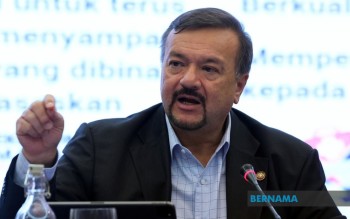
Malaysia's economy is demonstrating remarkable resilience as it navigates an increasingly turbulent international environment, recording accelerating growth rates that position the nation ahead of many regional peers. Finance Minister II Datuk Seri Amir Hamzah Azizan disclosed that the country achieved 5.6 per cent average growth in the first half of 2025, with quarterly performance strengthening from 5.4 per cent in the first quarter to an estimated 5.8 per cent in the second quarter, signalling momentum that defies widespread predictions of regional slowdown.
The trajectory reflects a marked departure from the modest but steady expansion seen in preceding years. After recording 5.2 per cent growth in 2024, Malaysia maintained that same rate through the full year 2025 before accelerating in the first half of this year. The data becomes especially significant when considering the external headwinds confronting the economy. International trade disputes, persistent geopolitical instability in West Asia, and currency volatility across emerging markets have all posed substantial risks to countries with Malaysia's openness to global commerce. Yet these figures suggest the domestic economy has absorbed these shocks more effectively than many observers anticipated, pointing to structural improvements beneath the headline numbers.
The government attributes much of this stability and growth to the implementation of the MADANI Economy Framework, a comprehensive policy architecture designed to shift Malaysia toward higher-value activities and more inclusive prosperity. Rather than relying primarily on external demand and commodity exports, the framework emphasises creating conditions for domestic innovation, talent retention, and entrepreneurial dynamism. Officials contend that numerous initiatives launched under this umbrella are now bearing fruit in measurable economic outcomes, though the framework's full potential remains in the early stages of realisation.
Central to this strategy is the GEAR-uP programme, which has channelled government resources and directed private capital toward priority sectors since its launch in 2024. The initiative commits RM120 billion in domestic direct investment spanning the period 2024 to 2028, representing a substantial commitment to building capabilities and infrastructure within Malaysia rather than seeking short-term gains through imported goods and services. By anchoring major investment decisions within a coordinated framework, policymakers aim to create synergies across industries and build clusters of excellence that can compete internationally.
Government-linked investment companies and government-linked companies function as primary instruments for deploying this capital and catalysing broader private sector participation. These entities leverage their scale, patient capital, and access to strategic information to identify high-potential opportunities that purely commercial investors might otherwise overlook or undervalue. In doing so, GLICs and GLCs serve not merely as investors but as anchors capable of attracting global capital, expertise, and talent to specific sectors and regions within Malaysia. This approach reflects a deliberate attempt to move beyond simply accumulating foreign direct investment toward cultivating sustained competitive advantages in priority domains.
The role of talent acquisition and knowledge transfer occupies particular prominence in this economic vision. Officials emphasise that capital alone proves insufficient for sustained development. The capacity to attract and nurture skilled workers, both domestically and through selective immigration of specialised professionals, fundamentally shapes whether investments translate into genuine economic upgrading or merely inflate asset prices without generating productive capacity. By positioning Malaysia as an attractive destination for talent alongside being a source of investment capital, the government seeks to build an innovation ecosystem rather than settling for a middle-income trap of low-wage manufacturing and routine services.
This multifaceted approach contrasts sharply with historical development models that often relied on passive integration into global supply chains through foreign direct investment in labour-intensive sectors. The MADANI framework consciously attempts to make Malaysia an active participant in value creation rather than a venue for cost arbitrage. When capital enters accompanied by knowledge, networks, and commitment to long-term skill development, the economic benefits extend beyond immediate profit extraction to encompass permanent improvements in national capabilities and living standards.
The geopolitical context lends particular urgency to this reorientation. Escalating tensions between major trading blocs, including the United States, China, and European competitors, have rendered traditional trade-dependent development pathways increasingly risky. Countries that built entire industries around serving as intermediaries in global supply chains now face disruption as trading partners pursue autarky and friendshoring strategies. Malaysia's emphasis on strengthening domestic demand, developing local expertise, and creating integrated value chains within the region positions the nation to weather these systemic shifts more effectively than competitors locked into brittle external dependencies.
Furthermore, the West Asian conflicts that have disrupted shipping routes and energy markets throughout 2024 and into 2025 underscore how geopolitical instability can amplify economic vulnerability. By reducing reliance on uninterrupted access to distant markets and building stronger regional connections, Malaysia can insulate itself against such shocks. The GEAR-uP programme's emphasis on domestic investment aligns logically with this imperative to build more self-sufficient economic foundations.
For Malaysian citizens and businesses, these macroeconomic trends carry direct implications. Sustained growth at five to six per cent annually, if coupled with inclusive policy design, can translate into rising real wages, expanded employment opportunities, and improved public services. However, realising this potential requires that investment genuinely creates productive employment rather than inflating select asset classes. The government's emphasis on talent development and technological upgrading suggests awareness of this distinction, though execution remains critical.
Regionally, Malaysia's outperformance amid global uncertainty positions it as a relative safe harbour for investors and a potential hub for companies seeking to diversify away from single-country exposure. The country's stable political environment, sophisticated financial system, and strategic geographic location between major markets all become more valuable as global conditions deteriorate. This creates opportunity for Malaysia to attract enterprises and capital flows from less stable neighbours and to strengthen its role in regional value chains.
Looking ahead, Finance Minister Amir Hamzah expressed confidence that the current trajectory represents sustainable progress rather than a temporary cyclical upturn. The government's framing suggests conviction that the structural reforms embedded in the MADANI framework address fundamental constraints on Malaysian development rather than merely responding to temporary favourable conditions. If sustained, this expansion would bring Malaysia substantively closer to achieved developed-country status, marking a significant milestone in the nation's economic evolution.
The months immediately ahead will prove instructive in testing whether this optimism is warranted. Second-quarter growth estimates of 5.8 per cent require validation, and the trajectory through the remainder of 2025 will determine whether acceleration continues or moderates toward the five per cent range. Global conditions, particularly the direction of US trade policy and the stability of financial markets, will substantially influence outcomes beyond government control. Nevertheless, the data disclosed thus far indicates Malaysia has constructed sufficient domestic momentum to maintain credible growth even as external conditions remain unsettled.

