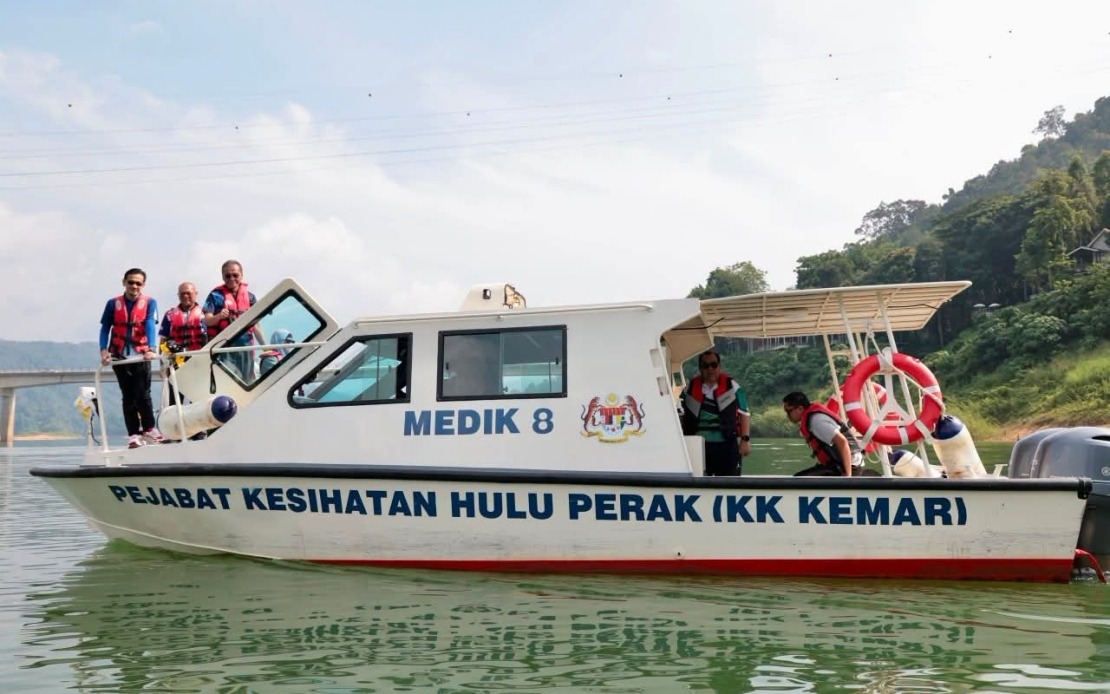
The Ministry of Health has expanded its river-based healthcare delivery infrastructure in Hulu Perak by commissioning a dedicated medical boat, recognising that waterways remain the lifeline for indigenous communities isolated by dense rainforest and challenging terrain. The launch of Medic Boat 8, which took place at the Belum Rainforest Resort jetty in Gerik, represents a deliberate investment in closing healthcare access gaps that have long characterised service delivery to the Orang Asli population in Malaysia's interior regions.
Health Minister Datuk Seri Dr Dzulkefly Ahmad highlighted that the new vessel, costing RM350,000, would serve the Kemar Resettlement Scheme where approximately 4,500 Orang Asli residents have limited alternative transport options beyond waterways. The 12-passenger multipurpose boat significantly expands the existing Ministry fleet, which previously operated six vessels across these remote waterways. This expansion acknowledges both the scale of the population dependent on aquatic routes and the critical nature of rapid medical response in areas where road access is non-existent or severely restricted.
The Minister's emphasis on the limitations of infrastructure without committed personnel underscores a broader challenge in rural and indigenous healthcare provision across Malaysia and the region. Modern medical equipment and dedicated vessels are merely tools; their effectiveness depends entirely on healthcare workers willing to navigate unpredictable river conditions and adverse weather to reach patients. The commitment from doctors, nurses, and specialised boat operators who regularly undertake these journeys despite substantial operational difficulties remains the cornerstone of service delivery in these communities.
This initiative aligns with the Malaysia MADANI framework, which positions equitable healthcare access as a fundamental principle rather than a secondary objective. The government's positioning suggests that geographic remoteness and environmental challenges should not determine whether citizens receive timely medical intervention. For the Orang Asli population, historically marginalised in development planning and resource allocation, the boat service represents tangible government commitment to bridging longstanding health disparities.
The waterway-dependent geography of Hulu Perak creates unique operational challenges that land-based healthcare systems cannot address. During monsoon seasons and periods of elevated water levels, these rivers become the only viable transport corridors for both emergency evacuations and routine healthcare delivery. Medical emergencies in interior settlements would otherwise face hours or days of delay before patients could reach primary care facilities, potentially resulting in preventable deaths or severe complications from treatable conditions.
The expansion of the boat fleet also addresses capacity constraints that have historically limited emergency response times. With a larger fleet, the Ministry can maintain more consistent service schedules, reduce waiting times for non-emergency patient transport, and ensure that emergency calls receive faster response. This becomes particularly critical for obstetric emergencies, acute infections, and trauma cases where the golden hours between incident and treatment can determine survival and long-term health outcomes.
The Kemar Resettlement Scheme itself represents a specific policy approach to Orang Asli development, where communities have been relocated from traditional territories to planned settlements. While resettlement schemes aim to improve access to government services, they simultaneously create new logistical challenges for health delivery. The concentration of 4,500 residents in Gerik's interior requires sustained investment in service infrastructure to ensure that relocation promises of improved access translate into operational reality.
From a regional perspective, Malaysia's approach to indigenous healthcare delivery through dedicated water transport offers lessons relevant across Southeast Asia, where numerous indigenous communities inhabit remote river systems in Thailand, Laos, Cambodia, and Indonesia. The Ministry's investment demonstrates that technological solutions tailored to geographic realities—rather than generic models imported from urban healthcare systems—can meaningfully improve service outcomes where terrain and transport constraints have historically limited reach.
The political messaging around this initiative also reflects broader governance priorities. By publicly committing resources to indigenous healthcare and attributing the service to Malaysia MADANI principles, the government signals responsiveness to long-marginalised communities. For Orang Asli populations who have experienced historical neglect in healthcare provision, educational access, and economic opportunity, tangible investments in emergency transport capability carry symbolic weight beyond the immediate operational value.
Sustaining these services requires consistent budgetary commitment and workforce stability, particularly in recruiting and retaining boat operators and medical personnel willing to work in these challenging conditions. Rural health worker shortages persist across Malaysia despite various incentive schemes, and the remote posting combined with operational hazards makes attracting and retaining qualified staff an ongoing challenge. The Minister's public acknowledgment of worker dedication may partly serve to underscore the challenges of recruitment and retention in this sector.
Looking forward, the success of this expanded boat service will depend on several interconnected factors: regular maintenance schedules in an environment with significant corrosion and wear challenges, fuel supply logistics to remote jetties, coordination between emergency response protocols in interior settlements and the regional hospital system, and training of community health volunteers who can provide first response care before boat evacuation becomes necessary. Each element requires sustained attention beyond the initial investment announcement.
The boat service expansion also raises questions about complementary infrastructure—whether the interior settlements have adequate basic facilities for stabilising patients before transport, whether radio or mobile communication systems reliably connect distant communities to dispatch systems, and whether the regional hospitals receiving patients evacuated by boat have capacity to manage the volume and complexity of cases. Effective healthcare systems function as integrated networks rather than isolated interventions.
Ultimately, the Ministry's investment acknowledges that access to healthcare remains genuinely unequal across Malaysia's geography, and that indigenous communities warrant specific, tailored solutions. As Malaysia continues developing its healthcare infrastructure, this model of matching delivery systems to environmental realities rather than forcing communities to adapt to standardised approaches represents pragmatic policy-making responsive to actual population needs.

