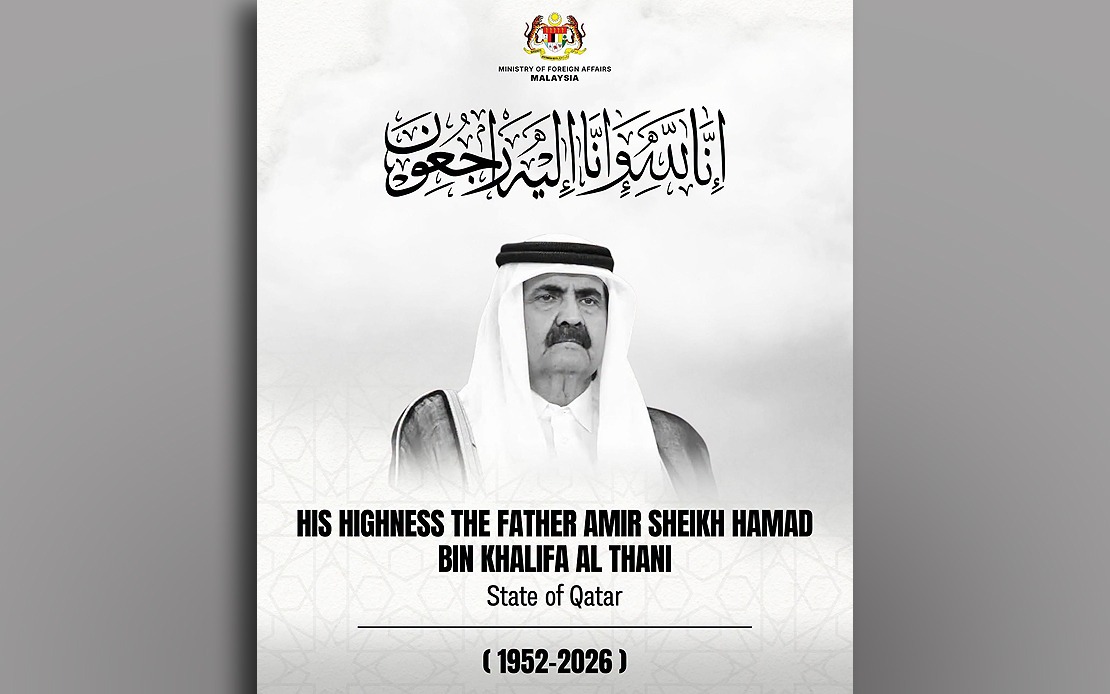
Malaysia's Higher Education Minister Datuk Seri Dr Zambry Abdul Kadir is representing the Malaysian government at Qatar's official state mourning ceremony for the late Father Amir Sheikh Hamad bin Khalifa Al Thani, attending condolence proceedings from July 13 to 14. The delegation's presence underscores the bilateral ties between Malaysia and Qatar, one of the region's most influential Gulf states, during this significant period of national mourning in Doha.
The current Amir of Qatar, Sheikh Tamim bin Hamad Al Thani, is receiving condolences from international leaders, members of the ruling Al Thani family, government officials and citizens at Lusail Palace throughout July 13 to 15. The scale of the state funeral reflects Sheikh Hamad bin Khalifa Al Thani's prominent historical role in transforming Qatar into a major regional and global player over several decades of governance. The presence of delegations from numerous countries underscores the late leader's international significance and the broad respect commanded across the Gulf Cooperation Council nations and beyond.
The Malaysian Foreign Ministry released a formal statement expressing profound sorrow over the passing and emphasizing Malaysia's solidarity with Qatar during this period of national reflection. The diplomatic language employed in official communications demonstrates the depth of Malaysia-Qatar relations, which extend across economic, educational, and cultural dimensions. As a fellow Muslim-majority nation with substantial Islamic institutional ties, Malaysia's participation in the mourning ceremonies carries particular significance within the broader Islamic world.
Qatar has declared four consecutive days of official national mourning commencing from July 12, during which government operations across the country have been significantly curtailed. All federal ministries, government departments, and public sector institutions have suspended normal business activities as the nation observes a period of collective grieving. This comprehensive shutdown of government services reflects the magnitude of the occasion and the deep reverence accorded to the former Father Amir in Qatar's contemporary history and national identity.
The late Sheikh Hamad bin Khalifa Al Thani's legacy extends far beyond Qatar's borders, as his decisions fundamentally shaped the state's emergence as a major economic and geopolitical force. During his tenure, Qatar underwent remarkable transformation, establishing itself as a centre of Islamic finance, hosting the 2022 FIFA World Cup, and expanding its influence across regional diplomatic channels. His stewardship established institutional frameworks that continue to guide Qatar's development strategy and international positioning, making his passing a watershed moment for the Gulf nation.
Sheikh Tamim bin Hamad Al Thani, who succeeded his father in 2013, has continued modernization efforts while maintaining traditional governance principles. The transition marked a generational shift in leadership while preserving continuity in Qatar's strategic objectives and long-term vision. The current Amir's receipt of international condolences at Lusail Palace represents both a moment of institutional continuity and a broader recognition of Qatar's established position within global hierarchies of statecraft and international relations.
Malaysia's diplomatic representation at such significant state occasions reflects the importance both nations attach to their bilateral relationship. Beyond ceremonial participation, Malaysia's presence signals economic and strategic alignment with Qatar, particularly given Malaysian investments in Qatari enterprises and Qatar's substantial holdings in Malaysian economic ventures. Educational exchanges, involving thousands of Malaysian students attending Qatari institutions, further deepen the human dimension of bilateral ties.
The mourning ceremonies serve as a gathering point for international figures to acknowledge Qatar's regional significance and reaffirm diplomatic relationships. For Malaysia, participation in these proceedings reinforces its standing as a serious regional player capable of maintaining substantive relationships across the Islamic world and the Gulf region specifically. The diplomatic protocol surrounding such occasions demonstrates how ceremonial moments function as essential mechanisms for maintaining and strengthening state-to-state relationships beyond formal treaties or economic arrangements.
For Southeast Asian observers, Qatar's demonstrated capacity to command international diplomatic attention reflects broader patterns of Gulf state influence expansion into Asian markets and political spheres. Malaysia's engagement with Qatar positions the nation advantageously within these shifting regional dynamics, ensuring continued access to Gulf investment capital and maintaining leverage within Organization of Islamic Cooperation forums where both nations hold significant standing. The careful calibration of diplomatic responses to events in Qatar underscores how Malaysian policymakers view engagement with the Gulf as strategically essential for national interests across multiple dimensions including energy security, financial services, and Islamic institutional leadership.

