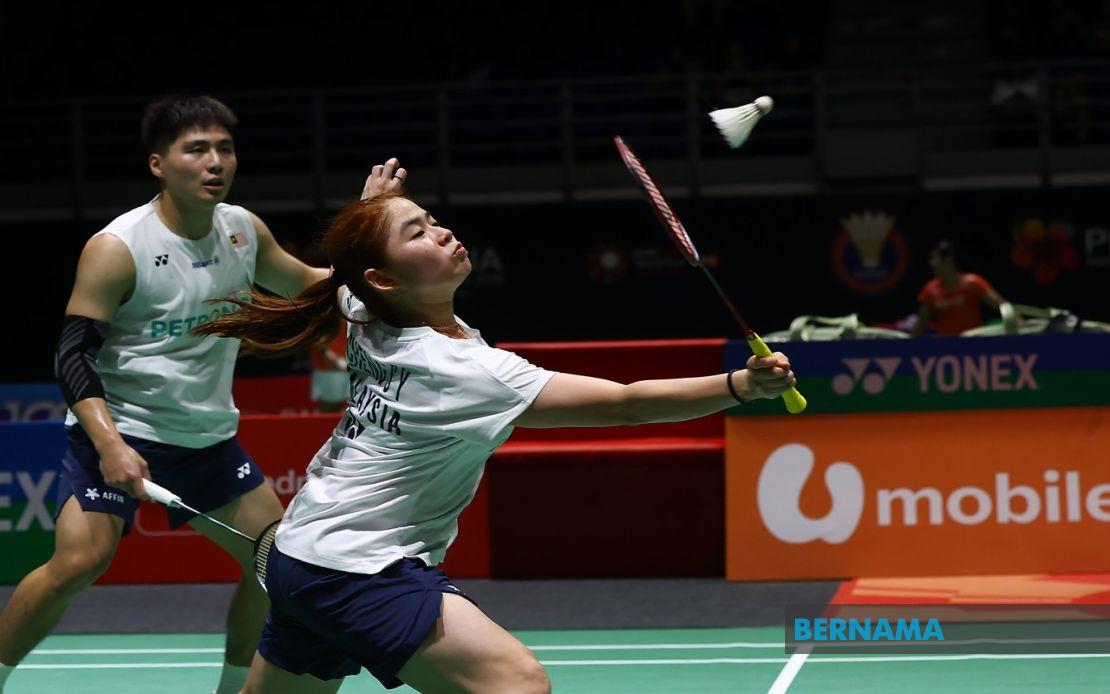
Malaysia's Japan Open 2026 campaign came to a close in Tokyo on Thursday following semi-final defeats for the nation's last two remaining pairs, bringing an end to what had been a challenging but respectable showing at the prestigious badminton tournament.
The mixed doubles pairing of Jimmy Wong and Cheng Su Yin saw their impressive run through the competition halted by Hong Kong's Tang Chun Man and Tse Ying Suet. The unseeded Malaysian duo, who had captured attention with a series of upsets against higher-ranked opponents, ultimately succumbed 17-21, 21-18, 21-15 in a tightly contested 69-minute affair. The loss marked the end of an encouraging campaign that had demonstrated their growing capability to compete effectively against established international pairings.
Despite the disappointment of the defeat, Wong and Cheng Su Yin's performance throughout the tournament provided significant encouragement for Malaysian badminton enthusiasts. The pair's ability to navigate seeded opponents and challenge top-ranked combinations showcased the emerging talent within Malaysia's mixed doubles ranks. Their semi-final showing, while falling short of the ultimate objective, reinforced that they possess the technical and tactical qualities needed to perform consistently at the sport's highest levels.
In the men's doubles category, Goh Sze Fei and Nur Izzuddin Rumsani confronted an even more formidable obstacle in South Korea's Kim Won Ho and Seo Seung Jae, the world's top-ranked men's doubles partnership. The Malaysian duo fought gamely throughout their 58-minute encounter but ultimately found themselves outmatched by the Korean side's superior experience and consistency at the elite level.
The match revealed the challenges that Malaysian pairs face when meeting the game's absolute elite. Goh and Nur Izzuddin began poorly, surrendering the opening game 12-21 as they struggled to establish rhythm and find answers to South Korea's aggressive court positioning and net dominance. However, the Malaysians demonstrated their competitive character by mounting a strong comeback in the second game, which they claimed 21-11 to level the match and force a decisive third game.
Unfortunately, the momentum gained from their second-game recovery proved insufficient against the world champions. In the deciding game, South Korea's Kim Won Ho and Seo Seung Jae regained control of the match's tempo, ultimately securing a 21-13 victory to advance to the final. The result added another chapter to a rivalry between the two teams that has increasingly favored the South Koreans, who now hold a three-wins-to-two advantage from their five meetings.
This latest meeting against South Korea's top pair highlights the persistent challenge Malaysian men's doubles teams face in bridging the gap to the world's very best. While Goh and Nur Izzuddin have demonstrated they belong in the sport's elite conversation, consistent victories against the top-ranked teams remain elusive. The loss underscores the competitive depth required to win major tournaments on the international stage, where virtually every opponent at the semi-final stage represents a formidable technical and physical challenge.
For Malaysian badminton, the Japan Open campaign offers both lessons and encouragement as the sport's governing body and athletes look toward upcoming competitions. The performances of both pairs suggest that the nation continues to develop talent across multiple categories, though the gulf between Malaysia's current standing and the sport's absolute elite remains notable. The semi-final exits, while disappointing, represent the reality of international badminton competition at present, where even talented and hardworking Malaysian combinations must overcome significant obstacles to advance beyond the latter stages of major tournaments.
Looking ahead, the experiences gained at the Japan Open will likely prove valuable for both pairs as they prepare for future competitions. The exposure gained against world-class opponents, the tactical insights obtained from facing top pairings, and the confidence built through competing at this level all contribute to the development of Malaysia's badminton pipeline. Continued investment in player development and strategic planning will be essential if Malaysia hopes to enhance its medal prospects at coming tournaments and gradually narrow the competitive gap with the sport's dominant nations.

