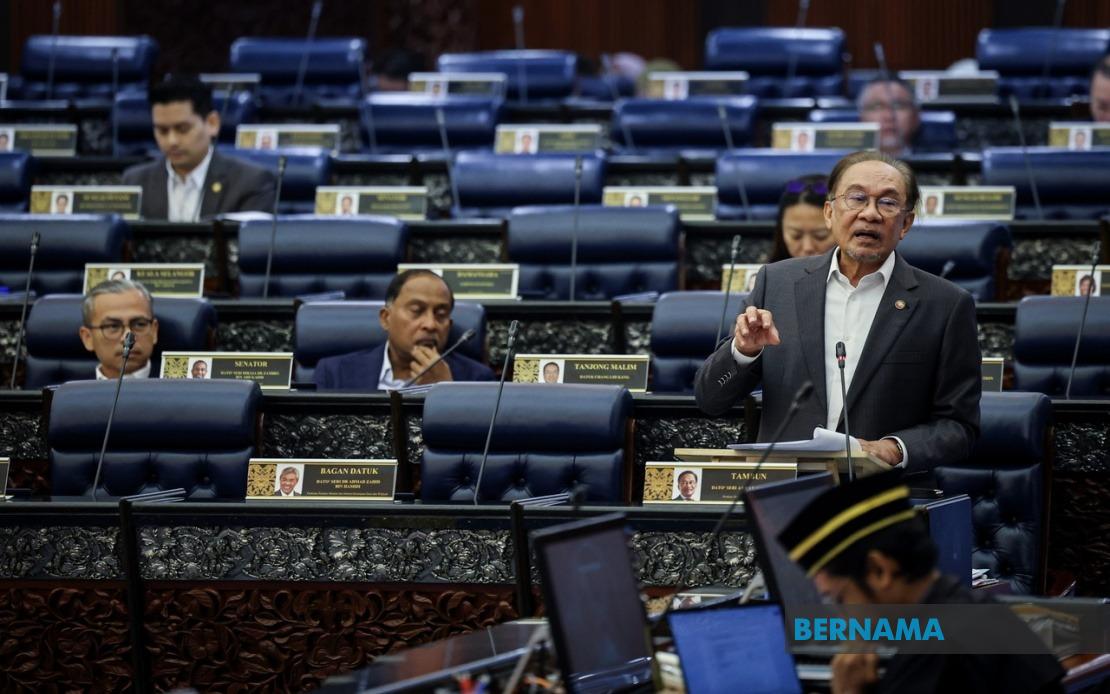
Malaysia's deteriorating performance in international press freedom rankings reflects a deliberate government policy to enforce restrictions on specific categories of content, Prime Minister Datuk Seri Anwar Ibrahim clarified during parliamentary proceedings on July 7. The country dropped to 95th place in this year's World Press Freedom Index, down from 88th position the previous year—a shift that has drawn international scrutiny and raised questions about the state of media independence in Southeast Asia's third-largest economy.
Anwar framed the enforcement actions as targeted interventions rather than blanket suppression of journalistic activity. The government, he explained, distinguishes between legitimate political criticism and content that transgresses specific red lines: matters touching on religion, race, and the royal institution, collectively known as the 3R framework. This categorisation reflects longstanding constitutional protections and established conventions within Malaysian governance, particularly the position agreed upon by the Conference of Rulers, which maintains close oversight of content that could be construed as insulting to the monarchy or inflammatory regarding communal relations.
Two specific cases illustrated the enforcement pattern. Sin Chew Daily faced action over publication of an inaccurate illustration of the Jalur Gemilang, Malaysia's national flag, while Sinar Harian encountered consequences related to the publication of the Inspector-General of Police's biography. These interventions, though limited in number, had outsized impact on Malaysia's international assessment. Anwar acknowledged that the international media community, particularly organisations that compile global press freedom indices, interpreted such enforcement particularly seriously when directed at established news organisations with significant readership and influence.
The Prime Minister's explanation reveals the tension between Malaysia's domestic legal and cultural framework and international standards for press freedom. What Malaysian authorities regard as appropriate safeguarding of national symbols and social harmony—issues enshrined in the Federal Constitution and revered by the institution of royalty—translates in international assessments as government restriction of media activity. Anwar noted that other countries may not share Malaysia's sensitivity toward flags or royal institutions, suggesting a fundamental disconnect in how different societies weight competing values.
Crucially, Anwar drew a distinction between enforcement for content breaching 3R boundaries and suppression of political dissent. The government, he asserted, takes no action against material that is merely factually inaccurate or politically critical. Instead, when inaccuracies arise, the administration opts for public clarification and parliamentary explanation rather than legal proceedings. This approach reflects an attempt to balance accountability with media freedom, though critics argue the distinction between these categories remains subjective and vulnerable to inconsistent application.
The government has sought to strengthen protections for satirical and critical expression through legislative amendment. Section 233 of the Communications and Multimedia Act 1998 underwent revision to ensure that satirical remarks directed at the Prime Minister and other political leaders no longer constitute criminal offences. This reform signals governmental intent to insulate legitimate political commentary from legal jeopardy, potentially widening the space for media criticism of leadership and policy without fear of prosecution.
Beyond direct government enforcement, Anwar identified an external factor complicating Malaysia's ranking: the removal of online content by social media platforms acting on user complaints rather than government directive. This dynamic introduces a layer of complexity often overlooked in press freedom discussions. The Prime Minister himself experienced this phenomenon when his own posts concerning Hamas were removed by platforms in apparent contradiction to government position. Such removals, occurring independently of Malaysian government action, still register in international assessments as constraints on information flow, even though the Malaysian state bears no direct responsibility.
The relationship between Malaysian authorities and international platforms further constrains government influence. Requests from the Malaysian Communications and Multimedia Commission (MCMC) to remove or restrict content are not automatically honoured by social media operators, whose final decisions remain vested in the platform companies themselves. This technological reality means that Malaysia's ranking reflects not only actions taken by the government but also cumulative effects of private corporate moderation decisions, algorithmic filtering, and global content policies applied universally across markets.
Reporters Without Borders, the organisation compiling the World Press Freedom Index, assesses multiple dimensions beyond direct government censorship. The index incorporates political environment, legal framework, economic conditions, socio-cultural context, and security considerations. Malaysia's multifaceted assessment encompasses factors the government influences indirectly or cannot control at all. The index thus captures a holistic picture of conditions affecting journalism rather than measuring only governmental censorship, a distinction that complicates straightforward interpretation of ranking movements.
For Malaysian readers and regional observers, the implications extend beyond statistical ranking. The enforcement pattern demonstrates the government's intention to maintain established constitutional protections and social conventions while permitting critical journalism on policy and leadership. The 3R framework remains a fixed parameter of Malaysian governance unlikely to shift regardless of international pressure. Simultaneously, the gap between Malaysia's ranking and the experiences of journalists suggests that enforcement, though selective and policy-driven, carries measurable consequences for the country's international reputation.
The broader Southeast Asian context illuminates Malaysia's position. Regional governments navigate comparable tensions between constitutional protections, social stability concerns, and international press freedom expectations. Malaysia's transparent articulation of its enforcement rationale—unlike some neighbours—reflects relative confidence in explaining rather than simply imposing restrictions. Yet the declining ranking underscores the costs of maintaining these boundaries within an international assessment framework that prioritises unrestricted information flow as a primary virtue.

