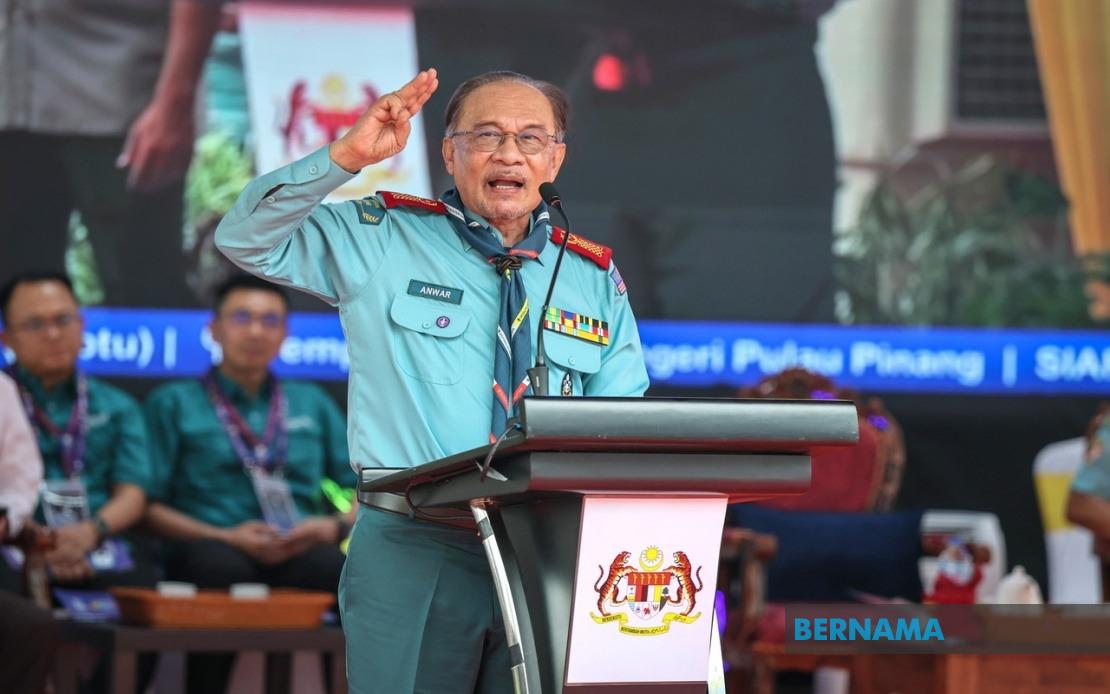
Prime Minister Datuk Seri Anwar Ibrahim has articulated a vision of national development that transcends conventional metrics of economic performance and technological advancement, arguing instead that sustainable progress demands a generation anchored in moral conviction and social responsibility. Speaking at the 15th Malaysian Scouts Jamboree (MYJAM15) at the Penang State Stadium, Anwar contended that defining a nation's success through infrastructure and innovation alone misses a fundamental pillar—the character and integrity of its people. His remarks underscore a growing recognition among Malaysian policymakers that material prosperity, without corresponding development of human values, leaves societies vulnerable to social fragmentation and ethical decline.
The Prime Minister's observations carry particular resonance given Malaysia's position as a rapidly industrialising economy grappling with the dual pressures of digital transformation and social cohesion. Anwar emphasised that the younger generation must be equipped not merely with technical skills but with a robust ethical framework—one that emphasises service to family, community, and nation. This framing positions education as a holistic endeavour rather than a purely utilitarian exercise, suggesting that schools and universities bear responsibility for cultivating citizens capable of navigating complex moral questions, not merely solving technical problems. The distinction matters because it reflects an understanding that economic advancement without corresponding civic commitment can produce societies where individual gain supersedes collective welfare.
Central to Anwar's argument is the proposition that knowledge acquisition carries inherent moral weight. He articulated the philosophy that education exists fundamentally to transform individuals into conscientious members of society—people capable of serving their parents, communities, and nation with integrity. This traditional understanding of education's purpose, rooted in values-centred pedagogy, contrasts with contemporary models emphasising purely skills-based learning outcomes. For Malaysian educators and policymakers, this presents both a philosophical challenge and a practical one: how to integrate character formation into curricula already stretched by demands for STEM competencies and digital literacy. The implicit argument is that without this integration, Malaysia risks producing economically competent but morally adrift individuals.
The timing of these remarks at MYJAM15 is particularly significant. The jamboree, bringing together more than 5,450 scouts from Malaysia and 11 other countries including South Korea, Indonesia, Singapore, and Sri Lanka, embodies precisely the values Anwar champions—discipline, service, unity, and patriotic commitment. That the event represents Penang's first hosting since 1966, a gap of six decades, underscores the symbolic importance Malaysia's leadership assigns to youth development programmes. The international dimension is equally noteworthy; by emphasising scouting as a platform for transmitting values across borders, the government signals that ethical and civic education need not be parochial or isolationist, but can flourish through cross-cultural exchange.
Anwar directly addressed the tension between tradition and technological disruption that defines contemporary youth experience in Malaysia and across Southeast Asia. He warned that rapid advancement in information technology and artificial intelligence, whilst presenting unprecedented opportunities, simultaneously threatens to erode cultural moorings and inherited values that provide identity and stability. This concern reflects anxieties widely shared among parents, educators, and social commentators across the region—that digital natives, whilst digitally fluent, may lack anchoring in cultural narratives and ethical traditions that historically guided decision-making. His exhortation to the younger generation to maintain cultural roots whilst embracing technological change articulates a nuanced position: progress need not entail wholesale abandonment of heritage.
The emphasis on unity in diversity carries particular salience in Malaysia's multicultural context. Anwar's assertion that tomorrow's leaders must foster harmony across communal lines speaks to a fundamental governance challenge—ensuring that as Malaysia advances economically and technologically, it does not fracture along ethnic, religious, or ideological lines. This requires deliberate cultivation of mutual respect and shared national purpose, qualities that formal education systems can nurture but cannot guarantee. By invoking this imperative specifically in relation to the younger generation, Anwar positions it as a prerequisite for future stability and prosperity. For a nation with Malaysia's demographic complexity and historical communal tensions, this represents a consequential statement about what education must accomplish beyond knowledge transfer.
Looking toward Malaysia's 2026 National Day celebrations, Anwar called upon young people to strengthen their patriotic commitment and prepare themselves to confront emerging challenges. This forward-looking perspective acknowledges that the nation faces tests ahead—whether pandemic-related, economic, environmental, or social in nature—and that meeting such tests demands a population possessed of both capability and character. Patriotism, in his formulation, extends beyond ceremonial flag-waving to encompass genuine willingness to sacrifice personal interest for collective benefit. For Malaysian youth navigating significant economic transitions, job market disruptions, and climate-related pressures, this appeal to duty and shared purpose attempts to reframe their role from passive recipients of government policy to active stakeholders in national destiny.
The broader implications of Anwar's message extend throughout Southeast Asia. As regional nations similarly confront rapid technological change, globalisation, and generational shifts in values, the tension between development measured in GDP terms and development measured in human character becomes increasingly acute. Malaysia's positioning of values-centred education as central to national strategy may influence policy conversations across the Association of Southeast Asian Nations (ASEAN), where member states grapple with similar challenges. Should Malaysia demonstrate that explicit integration of civic and moral education enhances rather than impedes economic competitiveness, it could catalyse regional movement toward more holistic educational models.
For Malaysian institutions of higher learning and secondary schools, Anwar's remarks carry implicit policy directives. Universities and colleges cannot delegate character formation entirely to student clubs and extracurricular activities; it must be woven through academic curricula and institutional culture. This proves challenging given resource constraints and the dominance of international rankings systems that measure research output and employability rather than ethical development. Nevertheless, Anwar's elevation of this concern at the highest level of government signals that accountability frameworks increasingly will incorporate measures of whether graduates emerge as morally conscientious citizens.
The Prime Minister's vision ultimately rests on an assumption that education can and should shape not merely what people know but who they become. This assumption, whilst philosophically defensible, requires sustained commitment and systemic change. Teachers must be adequately trained and supported to model the values they impart; educational content must be deliberately designed to prompt moral reflection; and school environments must create space for students to practice virtues like service, honesty, and respect. The challenge for Malaysia's education system is converting Anwar's rhetorical vision into operational reality—translating aspirational statements about character formation into concrete classroom practices, assessment methodologies, and institutional structures. Success in this endeavour will substantially shape whether Malaysia's next generation of leaders possesses the wisdom to manage the nation's material prosperity responsibly.

