Sudden cardiac arrest remains a silent killer in Malaysia, striking without warning and claiming lives with alarming regularity. The tragedy deepens when survival rates languish between just 0.5 and 8.5 per cent—figures that reflect not a lack of medical expertise but rather a dangerous gap between the moment of crisis and access to life-saving tools. Sunway Medical Centre Velocity (SMCV) is now confronting this stark reality head-on through an ambitious initiative to flood Kuala Lumpur's busiest public spaces with Automated External Defibrillators (AEDs), transforming how the city responds to cardiac emergencies.
The mathematics of cardiac arrest are brutal and unforgiving. Every minute without cardiopulmonary resuscitation (CPR) dramatically reduces a victim's chances of survival, with critical windows slamming shut after eight to ten minutes. Yet across Malaysia, precious seconds are routinely lost not because help is unavailable, but because defibrillators sit in hospital storage while someone collapses in a shopping mall, an MRT station, or an office tower. This gap between equipment and emergency is what SMCV's corporate social responsibility programme aims to eliminate through strategic placement and public education.
The initiative represents a substantial evolution of SMCV's earlier "Save A Number, Save A Life" campaign, expanding from awareness-raising into concrete infrastructure deployment. The hospital has identified fourteen strategic locations across Kuala Lumpur for AED installation, deliberately selecting sites where foot traffic is heaviest and cardiac emergencies statistically most likely to occur. These include the Tun Razak Exchange, MRT stations serving Bukit Bintang, Ampang Park, and Muzium Negara, the Aquaria KLCC entertainment complex, and several significant corporate landmarks including Menara Public Bank and its companion tower, Menara Public Bank 2. Additionally, the initiative reaches into civic spaces such as the National Heritage Building at Stadium Merdeka within the Merdeka 118 Precinct and the Public Bank-ITTC facility on Jalan Sultan Sulaiman.
What distinguishes this approach from merely scattering equipment is the attention to usability under pressure. Each AED unit will be accompanied by clearly visible standees designed for rapid identification during emergencies, removing even the small cognitive burden of locating the device when seconds matter most. QR code stickers linking to SMCV's medical guidance webpage will be affixed to standees and distributed to general practitioner clinics, creating a digital bridge between the physical device and essential instructional resources. This layered approach—physical accessibility, visual prominence, and digital support—reflects understanding that emergency readiness involves more than hardware alone.
Dr Wee Tong Ming, SMCV's Medical Director and Consultant Emergency Physician, articulates the clinical reality driving the initiative: cardiac emergencies destroy the myth that help automatically saves lives. "When an emergency occurs, lives are not lost due to lack of help, but because of delays in response and the lack of access to life-saving tools," he stated, capturing the gap between intention and outcome that claims thousands of Malaysian lives annually. His observation cuts to the heart of why public health infrastructure matters—because medicine delivered too late ceases to be medicine at all.
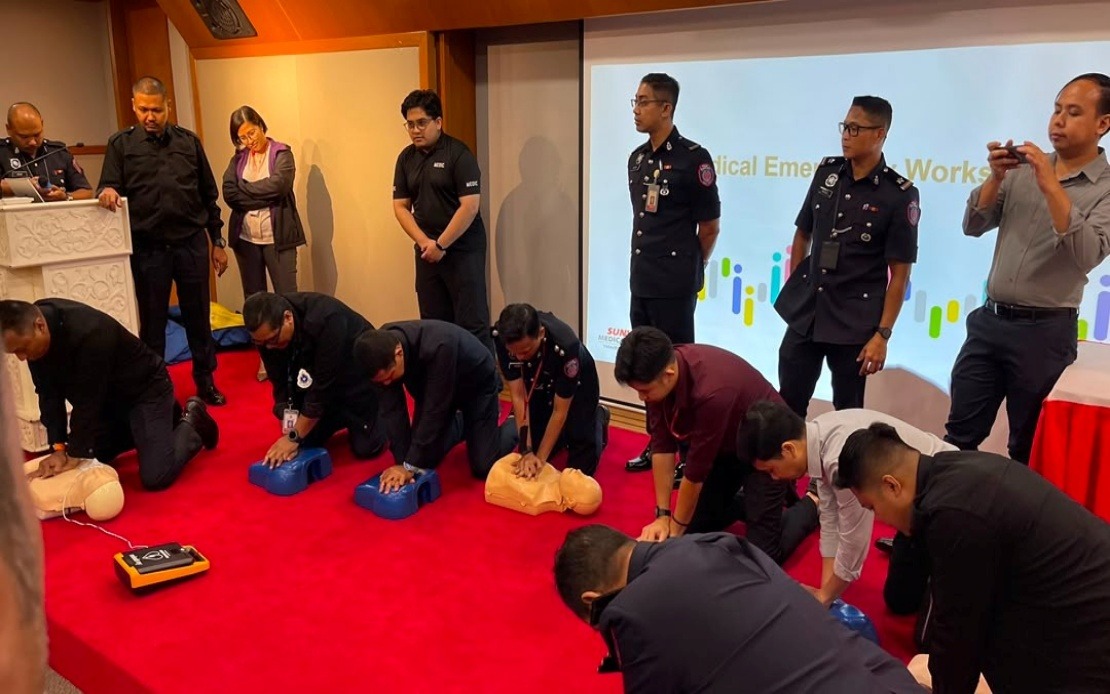
The hospital's leadership recognises, however, that placing a defibrillator on a street corner means nothing if the public lacks confidence in using it. Consequently, SMCV has integrated comprehensive training programmes into the initiative, conducting on-site instruction sessions and Accident and Emergency awareness talks designed to build public competency in recognising cardiac arrest symptoms, performing effective CPR, and operating AEDs safely. These educational components address what remains one of Malaysia's most significant barriers to survival: public hesitation rooted in uncertainty rather than unwillingness to help.
Susan Cheow, SMCV's Chief Executive Officer, frames the initiative within a broader philosophy of public empowerment. "No one should feel helpless" during a medical emergency, whether from ignorance or lack of tools, she emphasises. This commitment extends beyond the hospital's walls into the shared civic spaces where most cardiac arrests actually occur—not in controlled clinical environments but in the hurried corridors of commerce and transport. By strengthening both the physical infrastructure of emergency response and the public knowledge required to activate it, SMCV seeks to shift Malaysia's approach from reactive treatment to preventive readiness.
The timing of this initiative reflects mounting awareness within Malaysia's healthcare sector that survival from sudden cardiac arrest requires a chain of rapid interventions—immediate recognition, prompt CPR initiation, and swift defibrillation—often before ambulances arrive. In other developed nations, this "chain of survival" approach has substantially improved outcomes, yet Malaysia lags significantly. SMCV's expansion represents a recognition that closing this gap demands distributed, accessible infrastructure paired with confident, knowledgeable bystanders willing to act decisively in moments of crisis.
Beyond the immediate clinical benefits, the initiative carries deeper implications for how Malaysia conceptualises shared responsibility for public health. When defibrillators occupy visible spaces in commercial towers and transit stations, they send a signal that cardiac care extends beyond hospital boundaries into everyday community life. They acknowledge that a businessman in Bukit Bintang and a student using Muzium Negara MRT deserve the same chance at survival as someone metres from an emergency department. This democratisation of life-saving capability represents a philosophical shift toward treating health security as a collective concern rather than an individual stroke of fortune.
The initiative also positions SMCV within a competitive healthcare landscape, demonstrating that modern medical institutions derive competitive advantage not solely from treatment capabilities but from preventive engagement with communities. By becoming synonymous with cardiac emergency preparedness, SMCV builds public trust and establishes itself as an institution invested in outcomes beyond those occurring within its walls. This approach aligns with evolving expectations that healthcare providers bear responsibility for population health, not merely individual patient care.
For Malaysian policymakers and other healthcare administrators, SMCV's model offers a replicable framework applicable to other major Malaysian cities and other acute health threats. The combination of targeted infrastructure placement, public education, and digital support systems could address not only cardiac emergencies but other time-sensitive conditions where bystander intervention proves critical. Whether through expanded AED networks or similar initiatives addressing other health crises, the principle remains constant: survival depends on shrinking the gap between crisis and effective response.
The human stakes underlying this initiative cannot be overstated. Cardiac arrest strikes indiscriminately—affecting the young and old, the fit and infirm, those in air-conditioned offices and those in crowded public spaces. Each installation of an AED in Kuala Lumpur increases the probability that someone's parent, child, colleague, or friend receives the intervention necessary to survive the moment their heart stops beating. The initiative thus transcends corporate philanthropy; it represents a mathematical investment in preserving lives and families across the city.

