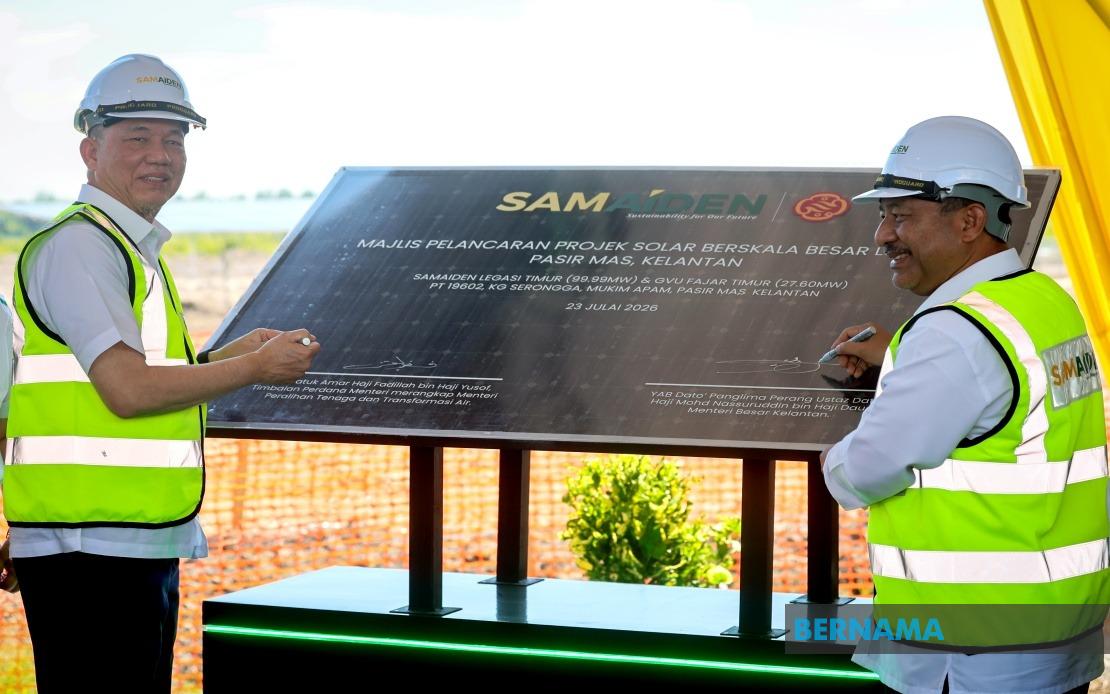
Malaysia's renewable energy sector is accelerating toward its 2030 targets, with installed capacity reaching nearly 32 per cent as of June this year, Deputy Prime Minister Datuk Seri Fadillah Yusof announced during the launch of a major solar project in Pasir Mas, Kelantan. The milestone demonstrates that the nation remains firmly aligned with its energy transition objectives, having already achieved 31 per cent renewable energy installed capacity by December 2025, surpassing earlier expectations and establishing strong momentum for further expansion in the coming years.
The Government's energy transition strategy operates within a clearly defined framework under the National Energy Transition Roadmap (NETR), which establishes three critical milestones: the achieved 31 per cent capacity by end of 2025, a 35 per cent target for 2030, and an ambitious 70 per cent goal for 2050. Fadillah, who holds the dual portfolio of Minister of Energy Transition and Water Transformation (PETRA), characterised the energy shift not merely as a policy preference but as an essential strategic imperative. This framing reflects growing recognition among Southeast Asian policymakers that renewable energy expansion directly influences energy independence, economic competitiveness, and climate commitment credibility on the world stage.
The government's approach emphasises balancing three interconnected principles: energy security, cost affordability, and environmental sustainability. Rather than pursuing aggressive renewable expansion at the expense of grid stability or consumer protection, Malaysia's pathway seeks to integrate clean energy sources while maintaining competitive pricing and reliable supply. This nuanced strategy proves particularly relevant for developing economies across the region, where rapid industrialisation and rising electricity demand create genuine tensions between growth imperatives and decarbonisation goals. By demonstrating that these objectives need not be mutually exclusive, Malaysia offers a practical template for peer nations wrestling with similar trade-offs.
The Large-Scale Solar Project (LSS5) launched in Kampung Serongga exemplifies private sector engagement with the national energy agenda. Fadillah highlighted the facility as evidence of investor confidence in Malaysia's energy policies and the collaborative framework binding federal and state governments with commercial partners. For Malaysian and regional investors, such projects signal that the government's renewable energy commitments extend beyond rhetorical positioning into concrete regulatory certainty and enabling infrastructure. The concentration of multiple large-scale solar initiatives across Malaysian states indicates that developers increasingly perceive genuine long-term commercial viability rather than viewing renewable projects as temporary ventures dependent on subsidies alone.
Kelantan emerges as a particularly promising frontier for renewable energy development, possessing extensive suitable land resources, demonstrated state government commitment, and increasing private sector interest. The state government's enthusiastic embrace of the LSS5 project, coupled with Menteri Besar Datuk Mohd Nassuruddin Daud's positioning of Kelantan as a sustainability-driven investment destination, reflects a broader recognition that renewable energy infrastructure now functions as a competitive advantage in regional economic competition. Kelantan's historical economic profile relied heavily on agricultural and traditional industries; the state's pivot toward green technology represents strategic economic diversification targeting higher-value sectors.
Beyond utility-scale solar facilities, the government actively promotes distributed solar adoption through the Solar ATAP Programme, which incentivises rooftop installations on residential properties, mosques, places of worship, and commercial establishments. This dual-track approach—combining centralised large-scale generation with dispersed household and institutional capacity—creates resilience within the energy system while democratising renewable energy benefits. For Malaysian households, particularly in cost-conscious segments, rooftop solar reduces dependency on grid electricity and provides protection against future tariff increases, making energy transition tangible at the household level rather than an abstract national-level concern.
The economic multiplier effects of renewable energy expansion merit careful attention for Malaysia's development strategy. Beyond direct electricity generation, solar projects create employment across manufacturing, installation, maintenance, and supply chains. The LSS5 initiative specifically promises job creation, local economic stimulus, support industry growth, and community benefits concentrated in Pasir Mas and Kelantan broadly. This localised benefit distribution proves crucial for political sustainability of energy transition policies, ensuring that renewable energy expansion generates visible improvements in communities where facilities operate. Without such tangible local returns, renewable energy infrastructure risks becoming perceived as externally imposed, potentially catalysing political resistance particularly in rural regions.
Investor confidence reflected in LSS5's launch gains significance when contexted within Southeast Asia's renewable energy landscape. Thailand, Vietnam, and Indonesia have all pursued ambitious solar and wind expansion programmes, creating intense competition for capital and experienced developers across the region. Malaysia's success in attracting high-quality investments demonstrates that the nation's regulatory environment, grid infrastructure, and policy certainty rank competitively. For Malaysian stakeholders, this positions the country advantageously for attracting sophisticated green technology companies seeking regional headquarters, manufacturing operations, and research facilities—economic opportunities extending well beyond electricity generation alone.
Kelantan's emergence as a renewable energy hub reflects strategic recognition that Malaysia's energy transition cannot succeed through concentration in industrial heartlands alone. Geographically distributed renewable capacity reduces transmission losses, builds local political coalitions supporting energy transition, and ensures that economic benefits from clean energy development accrue widely across the nation. The state's positioning itself as an investment destination anchored in sustainability and innovation signals that Malaysia's transition dialogue has transcended technocratic energy policy discussions to become integrated within broader economic development narratives emphasising competitiveness and attractiveness to quality investments.
Transitioning to 35 per cent renewable capacity by 2030 while maintaining cost affordability presents genuine technical and financial challenges that policymakers increasingly acknowledge. Integration of variable renewable sources requires investment in grid modernisation, energy storage systems, and demand-side management technologies. The government's emphasis on balanced, sustainable progression reflects awareness that premature acceleration without adequate infrastructure readiness could destabilise supply, spike costs, and generate public resistance. Malaysia's approach of setting intermediate targets and demonstrating consistent progress creates credibility that 2030 and 2050 goals represent achievable rather than aspirational figures.
For Malaysia's broader development pathway, the energy transition under NETR functions as a critical component of the Government's climate commitment and sustainable development strategy. By 2030, renewable energy will constitute approximately one-third of installed capacity, representing fundamental structural transformation within the electricity system. This progression positions Malaysia to meet climate obligations established under the Paris Agreement framework while simultaneously building resilience within energy supply chains increasingly vulnerable to geopolitical disruption and resource volatility. The renewable transition therefore serves multiple strategic objectives simultaneously: environmental responsibility, energy security, economic competitiveness, and technological modernisation.
Stakeholder coordination across federal institutions, state administrations, and private enterprise demonstrated through the LSS5 launch suggests that Malaysia's energy transition governance architecture functions effectively. However, maintaining this collaborative momentum as renewable penetration deepens will require addressing emerging challenges including grid interconnection standards, power purchase agreement frameworks, land-use coordination between agriculture and solar development, and equitable benefit distribution. The government's demonstrated commitment to transparency and investor-friendly ecosystems, as emphasised by Kelantan's leadership, provides foundation for navigating these inevitable complexities as renewable energy expansion accelerates through the coming decade.

