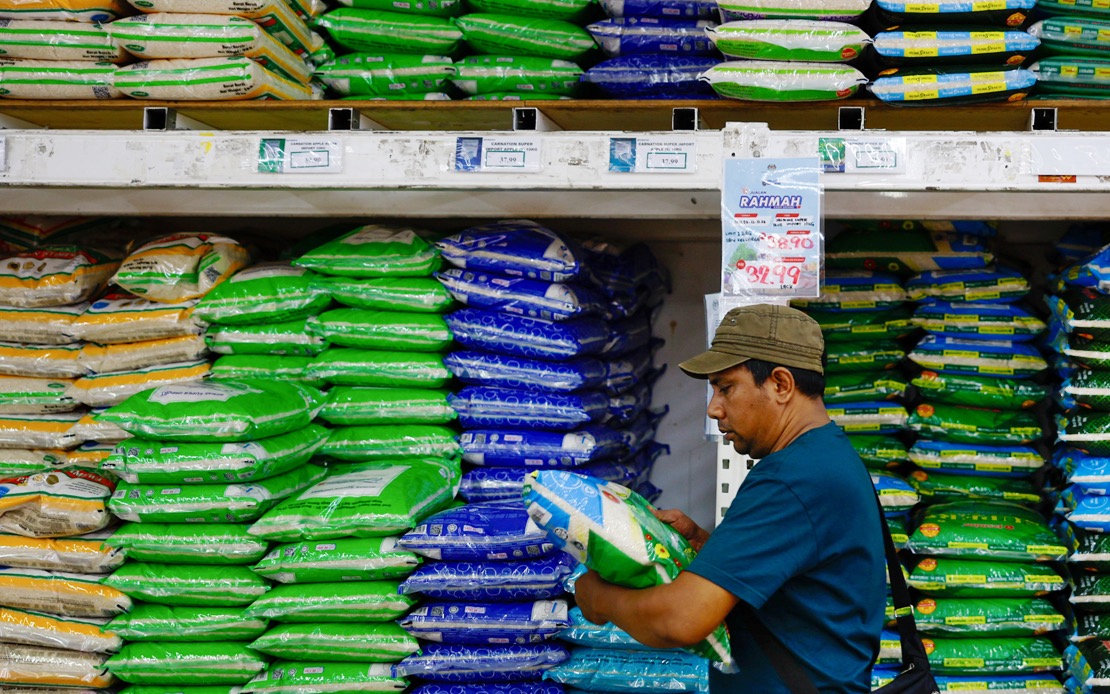
Malaysia's domestic rice reserves remain adequately stocked and stable despite mounting geopolitical tensions in West Asia, providing a crucial buffer for the country's food security. The Dewan Negara heard on August 4 that the nation holds 1.237 million tonnes of rice in reserves, a figure sufficient to sustain the population for at least half a year. This announcement comes as global supply chains face mounting uncertainty from regional conflicts, making such strategic food reserves increasingly vital for Southeast Asian economies dependent on international grain markets.
The reserve composition reflects a dual-pronged storage strategy designed to enhance resilience. Of the total stockpile, 200,000 tonnes represents the government-managed national rice buffer stock administered through Padiberas Nasional Berhad (BERNAS), Malaysia's primary grain procurement agency. The remaining 1.037 million tonnes comprises commercial stocks held by private sector participants in the supply chain. This layered approach ensures that Malaysia can respond swiftly to disruptions, drawing from strategic reserves while maintaining commercial inventory flows that sustain everyday market operations.
Deputy Agriculture and Food Security Minister Datuk Chan Foong Hin emphasised that this stockpile represents a proactive response to potential global supply crises emanating from international conflicts. The reserve level demonstrates government commitment to insulating Malaysian consumers from volatile global commodity markets, where rice prices have experienced significant fluctuations during periods of regional instability. By maintaining substantial buffers, the government effectively decouples domestic affordability from international price shocks, a lesson learned from previous global food crises that exposed vulnerabilities in import-dependent food systems.
Beyond sheer volume, Malaysia's food security strategy incorporates price stabilisation mechanisms that compound the protective effect of physical reserves. Government subsidies on locally produced white rice create a structural price advantage, ensuring that even when international markets experience inflationary surges, Malaysian consumers benefit from regulated domestic pricing. This intervention transforms rice from a commodity vulnerable to global speculation into a subsidised essential good, providing ordinary households with predictable food costs regardless of international market turmoil.
However, Malaysia recognises that maintaining adequate reserves alone cannot guarantee long-term food security without addressing underlying production deficiencies. The nation currently falls short of its ambitious target to achieve 80 per cent self-sufficiency in rice production by 2030, a goal made more pressing by declining domestic output trends and climate vulnerability. Recent years have witnessed production stagnation despite population growth, creating a structural gap that must be closed through technological innovation and expanded cultivation. The El Niño phenomenon represents an additional climatic threat, with its irregular precipitation patterns disrupting traditional rice-growing seasons across key producing regions.
To narrow this self-sufficiency gap, the Ministry of Agriculture and Food Security is implementing a comprehensive modernisation programme centred on climate-adaptive cultivation methods. The introduction of drought-resistant padi varieties, specifically MR 380, MR 381, and MR 382, addresses the vulnerability of traditional cultivars to water stress events. Alongside genetic adaptation, the ministry is promoting precision water management techniques including Alternate Wetting and Drying (AWD) and the System of Rice Intensification (SRI), methodologies that reduce water consumption while maintaining yields. These practices prove particularly valuable in Malaysia's monsoon-dependent agricultural system, where erratic rainfall patterns increasingly constrain traditional flooding methods.
The Muda Agricultural Development Authority (MADA) region has been designated as the focal point for intensified cultivation initiatives. A five-season rice cultivation project spanning two years demonstrates the government's commitment to maximising production from existing agricultural infrastructure. Concurrent upgrades to irrigation systems across MADA areas will unlock productivity potential, converting seasonal constraints into year-round cultivation opportunities. This geographic concentration strategy allows targeted resource allocation and enables comprehensive monitoring of new techniques before broader national rollout.
Recognising that technological advancement alone cannot succeed without addressing farmer economics, the government has implemented direct financial support measures targeting production costs. A temporary exemption from Sales and Service Tax on agricultural fertilisers—specifically rock phosphate and magnesium sulphate—will remain in effect from January 1, 2026, through December 31, 2027. This two-year relief period directly reduces input expenses for producers, translating into improved farm-level profitability during the critical implementation phase of new cultivation practices.
Additionally, padi farmer incentive schemes have been substantially enhanced to encourage broader adoption of improved methods. The ploughing incentive for the 2026 planting season has doubled from RM160 to RM300 per hectare, representing a significant income boost for cultivators. This increased rate carries an additional budgetary commitment of approximately RM40 million and will directly benefit nearly 200,000 farming households. The scale of beneficiary coverage—nearly two hundred thousand farmers—demonstrates government intent to transform rice production across the sector rather than implement merely symbolic adjustments.
These interconnected measures reflect a sophisticated understanding of Malaysia's food security challenges. The immediate stockpiling ensures stability against external shocks, whilst medium-term productivity initiatives construct permanent domestic capacity improvements. Simultaneously, economic support mechanisms address the profitability concerns that would otherwise discourage farmer participation in modernisation efforts. For Malaysian consumers and policymakers, this multi-layered approach offers reassurance that staple food availability remains secure even as regional conflicts create global supply uncertainties.
For Southeast Asia more broadly, Malaysia's experience illustrates the critical importance of strategic food reserves and domestic production capacity. As multiple nations in the region depend heavily on rice imports, the geopolitical tensions affecting global grain flows demonstrate the vulnerability inherent in food import dependency. Malaysia's targeted investment in self-sufficiency, combined with substantial reserve maintenance, positions the country more resilience than neighbours lacking equivalent policy frameworks. The model suggests that regional stability and food security increasingly intersect, making agricultural modernisation a strategic imperative beyond mere economic efficiency.

