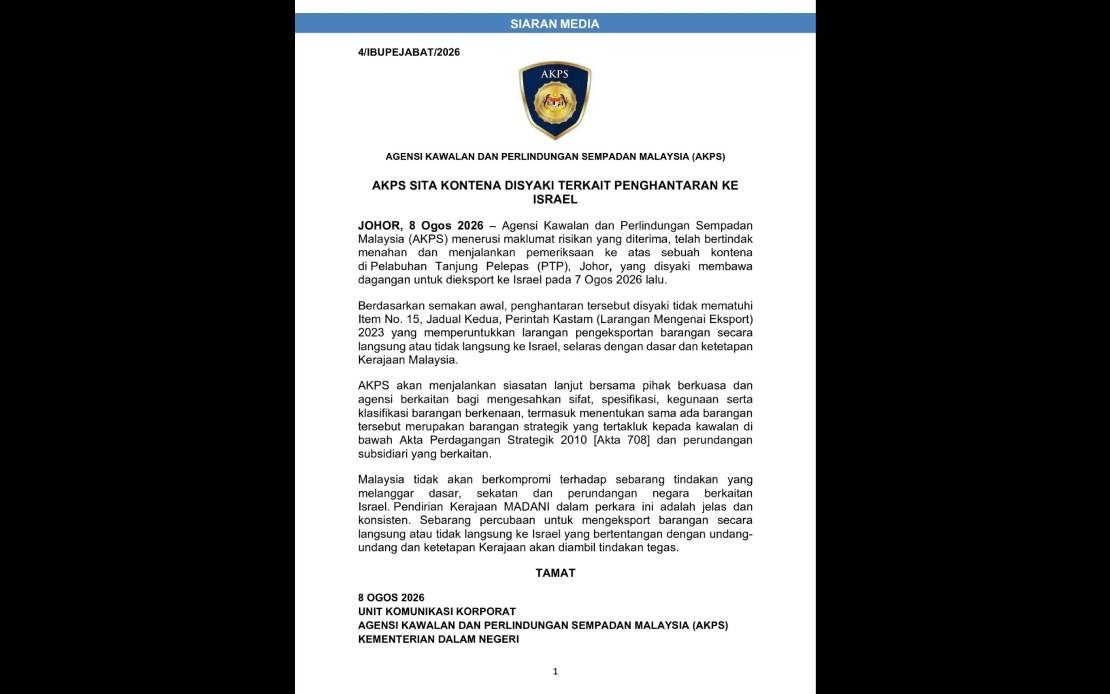
Prime Minister Datuk Seri Anwar Ibrahim has commended the Malaysian Border Control and Protection Agency (AKPS) for intercepting a shipment believed to contain strategic goods destined for Israel, underscoring the government's resolute position on the Israeli-Palestinian conflict. The container seizure at the Port of Tanjung Pelepas in Johor on August 7 represents concrete enforcement of Malaysia's declaration that it will not serve as a conduit for trade that could benefit the Israeli state.
In remarks posted on Facebook, Anwar framed the interception as evidence of Malaysia's practical commitment to preventing the country from becoming complicit in what the government characterises as atrocities perpetrated against Palestinians. The Prime Minister's public acknowledgement of the AKPS action signals that such enforcement operations carry symbolic weight within Malaysia's foreign policy calculus, particularly regarding its alignment with regional and international coalitions that oppose Israeli actions in the occupied territories.
The seizure occurs within the context of Malaysia's existing frameworks governing trade with Israel. The country has maintained a formal ban on Israeli vessels and ships carrying Israeli cargo from accessing Malaysian ports, a measure implemented in December 2023 that reflects broader government policy. This framework also encompasses the Customs (Prohibition of Exports) Order 2023, which specifically prohibits both direct and indirect exports of goods to Israel, establishing a legal architecture through which border authorities can detain and inspect suspicious shipments.
According to the AKPS statement, the detained container violated Item No. 15 of the Second Schedule of the Customs (Prohibition of Exports) Order 2023, the operative legal provision that underpins Malaysia's export restrictions on Israeli trade. The agency did not disclose the specific nature of the goods in question or their intended strategic applications, though the characterisation as strategic goods suggests materials with potential military or dual-use applications. The deliberate vagueness in official disclosures reflects standard practice in sensitive enforcement matters involving national security considerations.
Anwar explicitly connected Malaysia's enforcement action to its membership in The Hague Group, an informal coalition of nations that coordinate responses to Israeli policies and activities. By invoking this multilateral context, the Prime Minister positioned the seizure not as an isolated nationalist gesture but as Malaysia's contribution to a broader international effort to apply economic and diplomatic pressure on Israel. This framing is significant for Southeast Asian observers, as it demonstrates how smaller nations can participate in collective action while maintaining their independent foreign policy voices.
The government's rhetoric surrounding Palestinian rights and international law reflects Malaysia's long-standing diplomatic positioning in Middle Eastern affairs. Anwar's emphasis on principles of humanity, justice, and international law suggests that Malaysia intends to justify its trade restrictions not merely on political grounds but on the basis of universal legal norms. This rhetorical strategy allows the government to present its stance as principled rather than ideological, potentially broadening its appeal beyond domestic constituencies already sympathetic to Palestinian causes.
For Malaysian businesses and traders, the seizure serves as a practical reminder of the enforcement mechanisms backing government policy on Israeli trade. The incident indicates that customs authorities possess both the mandate and willingness to inspect shipments for evidence of Israeli connections, and that penalties for violations can include confiscation of goods. Traders engaged in international commerce, particularly those handling goods that might be classified as dual-use items, must exercise heightened diligence to ensure they do not inadvertently violate export prohibitions through indirect channels.
The timing and publicity of the seizure merit consideration within Malaysia's broader political context. By publicly celebrating the AKPS action and linking it to government policy, Anwar demonstrates his administration's commitment to implementing restrictions on Israeli trade at a moment when such positions retain substantial public support domestically. The announcement functions simultaneously as a policy reassurance to constituents concerned about Palestinian welfare and as a signal to international observers regarding Malaysia's steadfastness on this issue.
Regionally, Malaysia's enforcement actions carry implications for how Southeast Asian nations approach the Israeli-Palestinian conflict in practice rather than merely in rhetoric. While several regional governments have expressed solidarity with Palestinian causes through diplomatic channels, Malaysia's willingness to implement concrete trade restrictions through customs enforcement suggests a different level of commitment. This approach distinguishes Malaysia among ASEAN members and may influence how other nations calibrate their own policies regarding Israeli trade and engagement.
The border agency's capacity to detect and intercept suspect shipments raises questions about the sophistication of Malaysia's customs surveillance systems and the intelligence mechanisms through which authorities identify problematic containers. The successful interdiction suggests either advance information about the shipment's destination or systematic screening protocols designed to flag goods with potential Israeli connections. Either scenario implies that Malaysia has invested resources in monitoring export flows with particular attention to Israel-bound commerce.
Moving forward, the seizure establishes a precedent that strengthens the government's enforcement apparatus against Israeli trade. Future interdictions become more defensible legally and politically when prior examples demonstrate consistent application of the law. This precedent effect may encourage compliance among traders cognisant of enforcement risks, potentially reducing the incidence of attempted Israeli-related exports through Malaysian ports without requiring additional legal measures.
For Malaysian civil society and pro-Palestine advocacy groups, the AKPS action validates their calls for government enforcement of existing restrictions. By demonstrating that the 2023 ban and customs prohibitions are not merely symbolic but operationally enforced, the government addresses longstanding criticism that these policies lacked substantive implementation. The seized container thus becomes tangible evidence that Malaysia's professed commitment to preventing support for Israel extends beyond statements to concrete administrative action, reinforcing the government's credibility on this particular foreign policy dimension.

