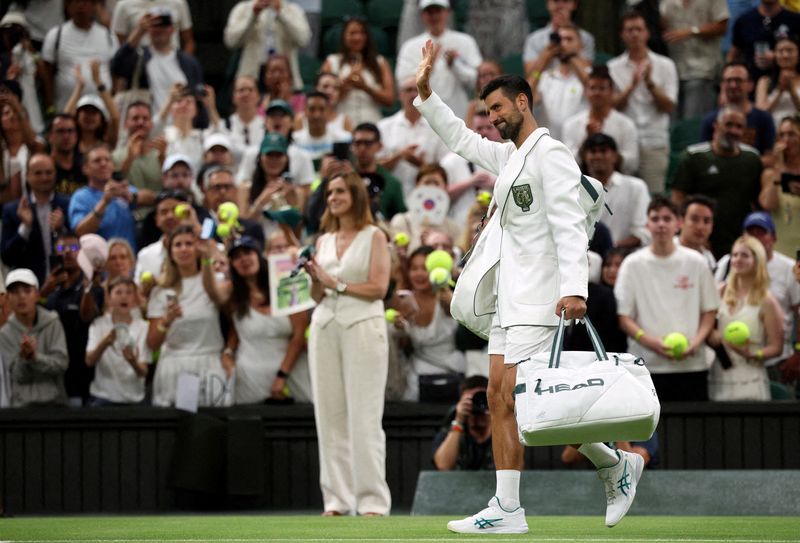
Fashion has become as much a part of Wimbledon's spectacle as the grass courts themselves, with male players now stepping into the spotlight alongside Naomi Osaka's celebrated kimono-inspired walkouts. The Japanese star's "Kill Bill" themed entrance captured global attention, but she is far from alone in turning the march to Centre Court into a runway moment. World number one Novak Djokovic has commanded attention in a custom Lacoste blazer and shorts combination, while American sixth seed Taylor Fritz has arrived in designer Hugo Boss regalia—a white cotton jacket, long trousers and silk scarf ensemble that transforms the conventional all-white dress code into high fashion.
For decades, Wimbledon's strict all-white requirement constrained the kind of creative expression seen at other Grand Slams where players wear technicolour outfits. Yet this very limitation has paradoxically created an opportunity for designers and athletes to collaborate on more sophisticated, elevated looks. Industry insiders suggest we are witnessing a turning point. Joelle Michaeloff, creative director at Wilson sports equipment, identifies this year's Wimbledon as a watershed moment where male competitors are finally matching the sartorial boldness their female counterparts have demonstrated for years. The shift reflects broader recognition within professional tennis that clothing serves as a powerful vehicle for personal identity and brand storytelling, extending well beyond match performance.
The historical context matters. Wimbledon has hosted iconic fashion moments dating back to Ted Tinling's revolutionary white bodysuit in 1985 and Roger Federer's elegant jacket worn in 2007. Yet Michaeloff observes that contemporary athletes draw inspiration from tennis royalty stretching back further still—to Arthur Ashe and other legends of the 1960s and 70s who understood that how players presented themselves carried cultural significance. The difference now lies in visibility and orchestration. Sponsors actively leverage Wimbledon walkouts as marketing opportunities, with social media amplifying these moments globally within seconds. Nike and Osaka's team coordinated video releases of her kimono entrance, while Hugo Boss publicly promoted Fritz's suit debut, demonstrating how brands now view the entrance itself as an integrated marketing campaign.
For Fritz particularly, the stakes of a fashion-forward entrance carry genuine risk. The American acknowledged the pressure frankly, noting that a stylish walkout followed by early elimination would appear ridiculous on the broadcast record. Fortunately, Fritz has navigated the third round without dropping a set, allowing him to confidently discard his designer trousers when they split open down the sides for easy removal before matches commence. This practical concern—that performance must validate the fashion statement—explains why Djokovic's demolition of Stefanos Tsitsipas shortly after his Lacoste arrival proved so satisfying for fashion enthusiasts. He even managed to banter with Rory McIlroy from Centre Court, joking that his blazer deserved comparison to the golfer's treasured Masters Green Jacket. Such moments generate enormous media coverage and amplify the brand partnerships underpinning these outfits.
The collaborative design process has evolved significantly. Some male players are now actively involved in shaping every element of their walkout attire, from fabric selection to neckline design and fit. Karen Khachanov exemplifies this engaged approach, insisting on discussing details with his design team while maintaining that aesthetic appeal must not compromise performance comfort. This represents a departure from the era when players simply wore what sponsors provided. Modern athletes increasingly view their appearance as an extension of their competitive identity, demanding input equivalent to what they exercise over racquet technology or court strategy.
Wilson's Michaeloff emphasises that the relationship between athlete and brand has fundamentally shifted. Rather than top-down sponsorship requirements, genuine collaboration now characterises the best partnerships. She notes that telling the story of personality and style, both during competition and in off-court moments, creates authentic narratives that resonate with audiences. This strategy has proven commercially effective, as evidenced by renewed interest in players' personal brands and merchandise associated with their signature looks.
Not every fashion experiment succeeds, however. Italian player Matteo Berrettini revealed that Wimbledon officials rejected his proposed walkout outfit, deeming it insufficiently white despite his efforts to navigate the regulations. Such rejections underscore that while attitudes toward male fashion expression have liberalised, the All England Club maintains strict parameters. This balance between encouraging style and preserving tradition remains central to Wimbledon's identity. The all-white dress code, rather than constraining fashion, has instead channeled creativity into refined, minimalist aesthetics that contrast sharply with the colourful extravagance displayed at Roland Garros or the US Open.
Fritz's observation that women players have historically dominated the walkout production is worth examining. The American acknowledged that female competitors have transformed entrances into choreographed spectacles for years, with outfit changes, multimedia presentations and narrative arcs. Male players are essentially catching up to innovation women pioneered. This timeline reveals something about professional tennis culture—that innovation in self-presentation historically flowed from female athletes while male competitors maintained conservative approaches. Osaka's recent success in elevating women's fashion statements to mainstream visibility may have finally demonstrated to male players the commercial and cultural value of embracing this arena.
Osaka herself continues setting the pace. The 14th seed, who has won four Grand Slam titles, has elevated fashion statements across all major tournaments this year. Beyond her Wimbledon kimonos, she wore a black Kevin Germanier skirt at the French Open and a layered yellow-and-gold Nike dress inspired by the Eiffel Tower glittering at night. Her jellyfish-inspired Australian Open walkout similarly captured global attention. Eleanor Thomas, collections lead at the All England Lawn Tennis Club and custodian of tennis' most significant clothing moments displayed in the Wimbledon Museum, unhesitatingly places Osaka's 2024 fashion output in the category of iconic championship moments. Such recognition from institutional custodians legitimises fashion as integral to Wimbledon history rather than peripheral embellishment.
The broader implications suggest that professional tennis is undergoing genuine cultural transformation. What began as female players using fashion to express identity and challenge conventions has evolved into industry-wide recognition that walkouts serve legitimate purposes—they humanise athletes, create memorable moments, strengthen brand partnerships and provide sponsors with valuable platform visibility. For Malaysian and Southeast Asian tennis fans, this trend matters because it signals how global sports are embracing individual expression and personality beyond pure athletic performance. As local players develop professional careers, understanding these fashion dimensions becomes relevant to building personal brands and navigating sponsorship opportunities in an increasingly visual, social-media-driven sports landscape. The evolution from Federer's solitary 2007 jacket to Djokovic and Fritz's coordinated designer debuts reveals how tennis culture continuously evolves, inviting each generation to redefine what it means to compete with style.

