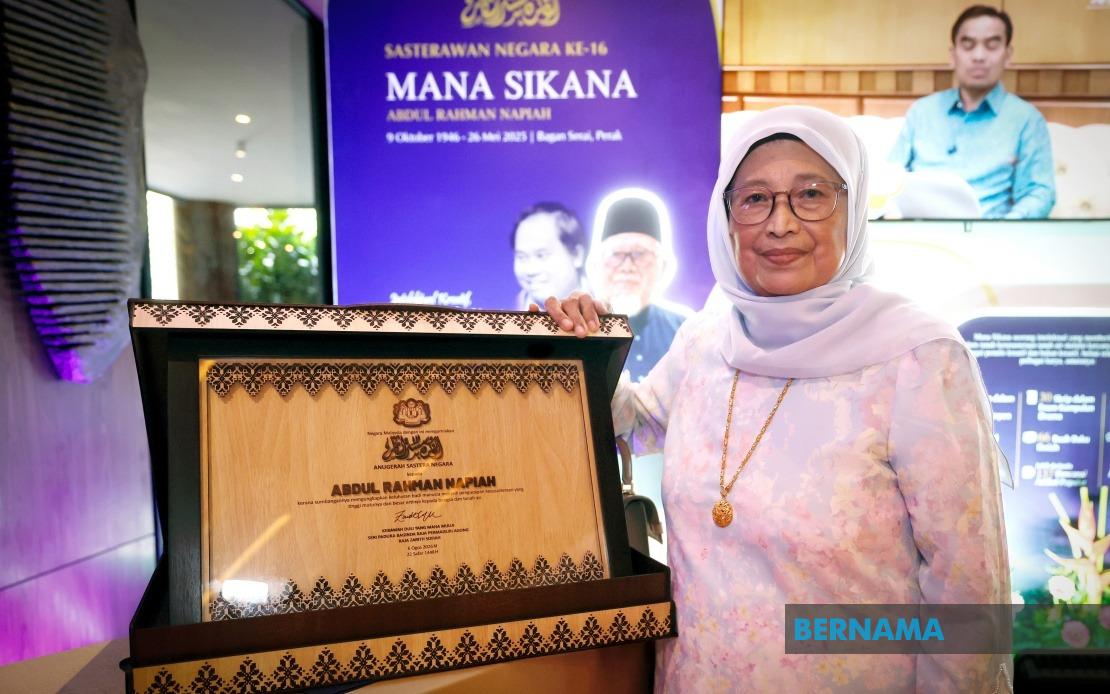
Malaysia has posthumously honoured one of its most influential literary figures, conferring the title of 16th National Laureate upon the late Dr Abdul Rahman Napiah, better known by his pen name Mana Sikana. The award, presented by Her Majesty Raja Zarith Sofia, Queen of Malaysia, was received by his widow, Salmah Ali, at a ceremony in Kuala Lumpur on August 6. The recognition marks the culmination of a literary career spanning more than six decades, during which Sikana established himself as a foundational figure in modern Malay letters.
Salmah Ali, 82, spoke with evident emotion as she accepted the prestigious award on behalf of her late husband, acknowledging both the honour and the bittersweet nature of the occasion. She reflected that this recognition represented the fulfilment of a long-cherished aspiration that Sikana had harboured throughout his remarkable career. In her remarks to assembled media, she revealed that her husband had been informed of the possibility of receiving the award before his death, lending poignancy to the ceremony. The timing proved tragically significant, as Sikana had passed away in May at the age of 80 following heart complications, just months before the honour was formally bestowed.
The trajectory of Sikana's recognition within literary circles had been established early, with Salmah noting that he had begun receiving literary accolades from his school days onward. His final public engagement exemplified his unwavering commitment to his craft; on the very day he suffered the health crisis that would ultimately claim his life, he had been presenting a working paper to Dewan Bahasa dan Pustaka, the institution responsible for preserving and promoting the Malay language. This dedication to advancing Malaysian letters extended far beyond his writing, encompassing television and radio production, academic mentorship, and institutional leadership across multiple countries.
During his time in Johor Bahru, Sikana had actively produced dramatic works for both Singaporean and Malaysian broadcasting platforms, demonstrating the cross-border influence of his creative output. His intellectual reach expanded significantly when he pursued advanced studies at Universiti Kebangsaan Malaysia, eventually ascending to the rank of professor. This academic standing allowed him to shape the next generation of writers and scholars, with his professional engagement extending into Indonesia, where he served as a visiting lecturer. His children and grandchildren, numbering four and twelve respectively, became the beneficiaries of his intimate knowledge of literature and the craft of writing, receiving direct transmission of his accumulated wisdom until his final days.
Education Minister Fadhlina Sidek, present at the ceremony, articulated the broader significance of Sikana's selection as National Laureate. She characterised the award as recognition of his instrumental role in fortifying Malaysian literature through multiple dimensions of scholarly and creative endeavour. His contributions spanned creative writing itself, the theoretical foundations of literary criticism, and the academic discourse that underpins serious engagement with literary works. This multifaceted approach to literature distinguished Sikana from contemporaries who might have confined themselves to a single dimension of literary practice. Rather, he embodied an integrated vision of how literature functions within a nation's cultural ecosystem, combining the practitioner's insight with the theorist's analytical framework.
Sikana's origins in Bagan Serai, Perak, on October 9, 1946, placed him within the generation that would come of age during the formative decades following Malaysian independence. He commenced his professional life in the classroom as a teacher, a foundation that proved instrumental in shaping his later approach to academic work. His career trajectory subsequently carried him through several of Malaysia's premier higher education institutions. Beyond Universiti Kebangsaan Malaysia, he held positions at Nanyang Technological University in Singapore and Universiti Pendidikan Sultan Idris, each appointment reflecting the esteem in which his scholarly contributions were held and his capacity to enhance institutional intellectual standing.
The National Laureate award itself carries profound significance within the Malaysian cultural pantheon, honouring individuals whose life work has demonstrably advanced national artistic and intellectual achievements. The conferment upon Sikana, though occurring after his death, underscores the enduring impact of his literary legacy. For Malaysian readers and writers, his body of work represents a crucial bridge between the literary experiments of the immediate post-independence era and contemporary approaches to Malay-language fiction and drama. His theoretical contributions to literary criticism provided frameworks through which subsequent generations could understand their own creative impulses and situate them within broader aesthetic movements.
The delayed recognition, while tinged with sadness for his widow, also reflects the considered nature of the National Laureate selection process. Such awards are not bestowed hastily but emerge from sustained assessment of an individual's cumulative contributions. In Sikana's case, this careful deliberation resulted in a determination that his influence warranted the nation's highest literary honour. For the broader Malaysian literary community, the award serves as affirmation that sustained dedication to the craft, coupled with intellectual rigour and educational commitment, remains valued within national discourse.
Salmah's expression of mixed emotions—pride and happiness tempered by profound sadness at attending the ceremony without her husband—captured a sentiment that resonates beyond the immediate family. Sikana's passing deprived the nation of a living elder statesman of letters at a moment when such voices remain invaluable for guiding younger writers and establishing standards of literary excellence. Nevertheless, his written legacy persists, accessible to readers and scholars alike, ensuring that the perspectives and aesthetic innovations he championed continue to shape Malaysian literature. The National Laureate designation, therefore, represents not merely acknowledgement of past achievements but an institutional commitment to preserving and promoting his intellectual contributions for future generations navigating Malaysia's evolving literary landscape.

