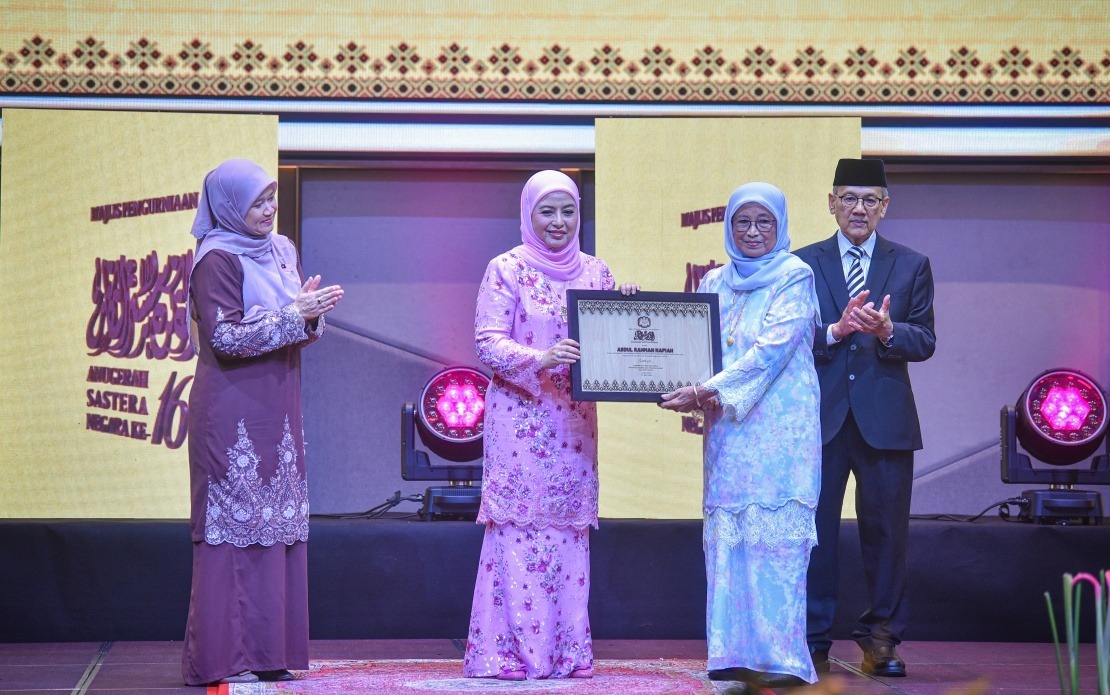
Malaysia's literary landscape has been marked by the posthumous elevation of Mana Sikana, the pen name of Dr Abdul Rahman Napiah, to the rank of 16th National Laureate. The honour, bestowed during an awards ceremony in Kuala Lumpur on August 6, represents the nation's most prestigious recognition for writers whose contributions have fundamentally shaped the country's cultural identity. Her Majesty Raja Zarith Sofia, Queen of Malaysia, conferred the accolade upon the widow of the late author, Salmah Ali, in a ceremony that underscored the enduring significance of Mana Sikana's six decades of literary work.
The National Laureate designation carries profound symbolic weight within Malaysia's cultural ecosystem, acknowledging not merely the volume of literary output but the depth and scope of influence a writer has exerted across generations. Education Minister Fadhlina Sidek, who chaired the selection panel, highlighted how Mana Sikana's extensive body of work transcended entertainment to function as a vehicle for fostering consciousness about Malaysia's multicultural fabric. Through his creative endeavours, he cultivated empathy amongst readers, encouraged cross-cultural understanding, and illuminated the human dimensions of lived experience within a diverse society. These qualities elevated his contributions beyond the purely aesthetic realm into the social and educational sphere.
During her speech, Minister Fadhlina articulated three dimensions through which Mana Sikana's influence reverberated across Malaysian literature. First, his innovation in creative writing methodologies expanded the technical possibilities available to subsequent authors, introducing fresh approaches to narrative construction and thematic exploration. Second, his work instilled a critical consciousness within literary practice itself, encouraging writers to engage intellectually with their craft rather than treating writing as a mechanical exercise. Third, and perhaps most transformatively, he dedicated himself to mentoring emerging voices through institutional channels—serving in academic capacities at universities where he shaped the sensibilities and methodologies of students who would themselves become contributors to Malaysian letters.
The breadth of Mana Sikana's scholarly influence becomes evident when examining his professional trajectory across multiple educational institutions. Born in Bagan Serai, Perak, on October 9, 1946, he initially embarked on a teaching career before transitioning into higher education. His academic appointments spanned Universiti Kebangsaan Malaysia, the regional hub for literary studies in Southeast Asia; Nanyang Technological University in Singapore, which provided him exposure to transnational intellectual currents; and Universiti Pendidikan Sultan Idris, where he contributed to the training of educators who would subsequently introduce literature to Malaysian schoolchildren. His doctoral credentials from UKM established him as a scholar whose work commanded serious intellectual engagement.
The accumulation of honours throughout his lifetime testified to the consistent recognition his peers and institutions afforded his contributions. Mana Sikana secured Malaysia's most significant literary accolades during his career, including the Malaysian Literary Prize, the Malaysian Perdana Literary Prize, the Perak Laureate Award, and the Darul Ridzuan Lifetime Literary Achievement Award. These successive recognitions, each emanating from different constituencies within the Malaysian literary establishment, demonstrate that his reputation rested upon a foundation of genuine critical consensus rather than the caprice of a single jury or institution. The National Laureate designation represented the culmination of a career trajectory marked by consistent excellence and institutional validation.
Mana Sikana's prolific output throughout his working life established him as one of Malaysian literature's most productive voices. His catalogue exceeded 100 published works, a figure that becomes even more impressive when one considers the intellectual demands of scholarly writing, academic instruction, and critical analysis that accompanied his creative production. Rather than viewing creative work and intellectual labour as competing claims on his energies, he synthesized these dimensions, allowing each to inform and elevate the other. His theoretical writings provided frameworks for understanding his own creative choices, while his novels and stories functioned as testing grounds for the literary principles he articulated in academic discourse.
The tangible rewards accompanying the National Laureate title translate his cultural contributions into concrete resources for perpetuating his legacy and supporting Malaysian literature more broadly. The award package encompasses a national letter of honour acknowledging his status, a cash payment of RM60,000 recognizing the financial dimensions of professional literary labour, and a publishing allocation of unprecedented scale. This allocation permits the distribution of up to 50,000 volumes or RM500,000 worth of his published works throughout Malaysia's institutional ecosystem—schools, public libraries, government departments, and administrative agencies. Through this mechanism, his writing achieves circulation far beyond commercial market forces, ensuring that students, researchers, and general readers throughout the nation encounter his work.
The decision to distribute the laureate's works systemically through public institutions reflects a sophisticated understanding of how literary culture is cultivated within a national context. Rather than allowing his books to remain confined to commercial retail channels where economics of scarcity and market segmentation determine access, the government directly places them into educational and civic spaces where they function as pedagogical resources and cultural documents. For Malaysian secondary school students encountering literature curricula, exposure to Mana Sikana's writing through school libraries creates formative encounters with a body of work that exemplifies the literary possibilities of Malaysian authorship. For university researchers, institutional libraries stocked with his complete catalogue facilitate deeper engagement with his contribution to literary history.
Mana Sikana's death in May 2025 at the age of eighty, following cardiac complications, occurred before the National Laureate designation could be publicly celebrated during his lifetime. The posthumous nature of the honour introduces a poignant dimension to the recognition—his widow receives acknowledgement of a lifetime's work on behalf of a deceased artist who cannot personally witness the nation's formal appreciation. Yet the decision to award the distinction posthumously also reflects the selection committee's conviction that Mana Sikana's legacy and impact remain matters of continuing significance, transcending the biographical moment of his death. The award ceremony becomes an occasion for assessing his lasting contribution rather than merely recording biographical fact.
For Malaysian readers and the literary community more broadly, the National Laureate designation carries implications extending beyond ceremonial recognition. It situates Mana Sikana's body of work as canonical—as central to any comprehensive understanding of Malaysian literary achievement in the late twentieth and early twenty-first centuries. Students of Malaysian literature will necessarily engage with his novels, poetry, critical writings, and scholarly interventions as they construct knowledge about how the nation's literary culture developed. The systematic distribution of his works ensures that this engagement occurs across educational levels and geographic regions, preventing his influence from concentrating exclusively among university-educated urban elites. The award validates the intellectual and emotional investments that Malaysian writers, critics, and readers have made in his work.
The recognition of Mana Sikana occurs within a broader Southeast Asian context where questions of literary tradition, national identity, and the role of writers in public intellectual life remain unresolved. Malaysia's decision to establish and maintain a National Laureate system itself constitutes a statement about cultural priorities—that literary achievement merits official recognition and public investment comparable to scientific discovery, athletic excellence, or military service. Mana Sikana's elevation to this status affirms that Malaysian literature possesses sufficient depth, sophistication, and significance to command governmental attention and resources. For readers and writers throughout Southeast Asia observing Malaysia's literary institutions, the honour extended to Mana Sikana's legacy provides a model for how emerging literary cultures might institutionalize recognition of their most significant voices.

