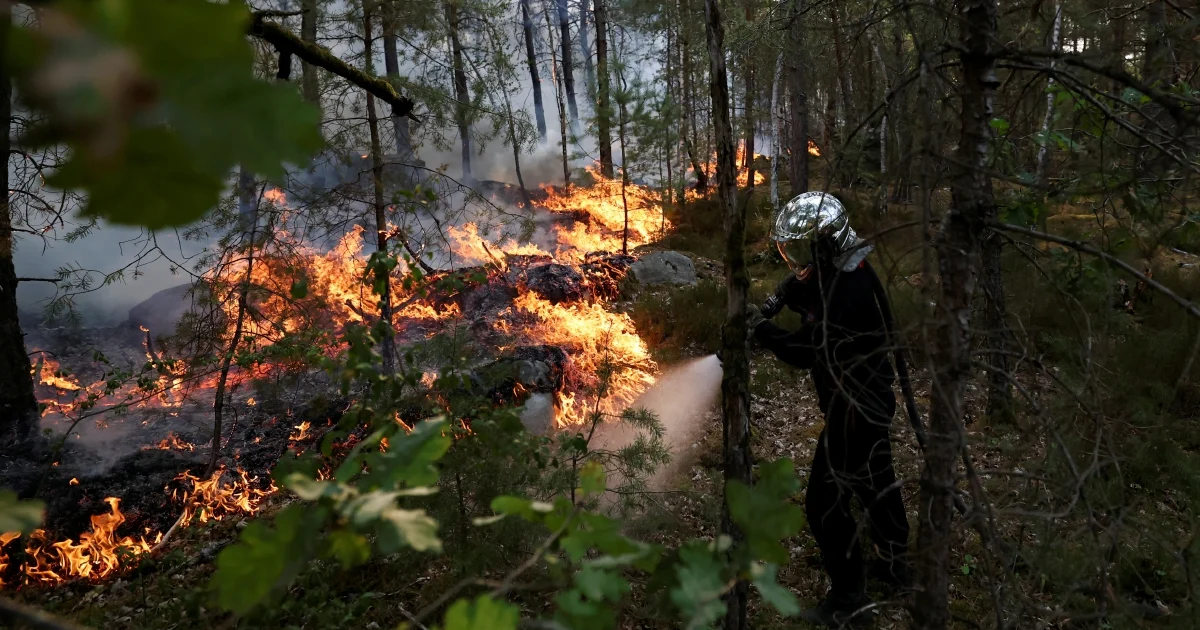
France confronted a significant ecological crisis on Monday as multiple wildfires engulfed more than 1,300 hectares of pristine forest in regions south of Paris. The scale of destruction represents a major environmental incident for the historically wooded landscape, prompting an intensive response from emergency services and regional authorities. The blazes brought into focus the vulnerability of Europe's natural heritage to large-scale fires, a concern that has intensified across the continent in recent years.
The investigation has taken a criminal turn, with French police apprehending two individuals suspected of deliberately setting the fires. The arrests underscore investigators' preliminary assessment that the incidents were not accidental but rather the result of human interference. Arson remains a persistent cause of forest fires across Europe, often driven by various motives ranging from malice to environmental sabotage, and the swift arrests suggest authorities identified suspects relatively quickly through eyewitness accounts or forensic evidence gathered at the scene.
The forest near Arbonne-la-Foret holds significant ecological and historical value for the Île-de-France region. Historic woodlands in this area have evolved over centuries and provide vital habitats for indigenous plant and animal species adapted to temperate European climates. The loss of such expansive vegetation represents not merely an immediate environmental blow but carries implications for long-term ecosystem recovery and the region's carbon sequestration capacity. Such forests function as critical lungs for the broader Paris metropolitan region, influencing local climate patterns and air quality.
Firefighting operations unfolded across multiple concurrent fire zones, requiring coordination between regional brigades and national emergency resources. The complexity of battling simultaneous fires across an extensive territory stretches response capabilities, particularly during summer months when dry conditions and elevated temperatures create ideal conditions for rapid fire propagation. Firefighters deployed both ground crews and aerial support, with water-dropping helicopters and specialized aircraft becoming standard components of France's arsenal against large-scale forest fires in recent decades.
The timing of these fires reflects a broader European pattern of escalating wildfire incidents. Climate change has extended fire seasons and intensified conditions that enable rapid fire spread, transforming what were once seasonal concerns into year-round threats. Southern European nations have long grappled with devastating fire seasons, but northerly countries including France have increasingly experienced comparable challenges. The normalisation of major forest fires in regions historically less affected represents a significant shift in environmental risk management for European policymakers and emergency planners.
For Malaysian and Southeast Asian observers, the Paris fires illustrate how developed nations with substantial resources and technological capacity still struggle with large-scale forest destruction. The arson dimension raises particular relevance in the Malaysian context, where intentional land clearing through burning remains a recurrent regional flashpoint, notably during periodic transboundary haze episodes affecting Indonesia, Malaysia, and Singapore. While the European context differs significantly from Southeast Asian agricultural and development pressures, both regions face common challenges in preventing deliberate fire-setting and managing environmental consequences.
The investigation into the arrests and determination of motive will shape public discourse around forest management and security in France. If arson is confirmed, authorities will likely reassess surveillance and prevention strategies in vulnerable forest areas. Enhanced monitoring, public awareness campaigns, and stricter penalties for fire-related offences typically follow major incidents. The political dimensions cannot be overlooked, as environmental protection has become increasingly salient in European electoral politics, and responses to such incidents influence public confidence in governmental stewardship.
Recovery from such extensive forest damage unfolds across multiple timescales. Immediate priorities involve extinguishing remaining flames and protecting nearby communities and infrastructure. Medium-term efforts focus on assessing damage extent and identifying surviving vegetation patches that might naturally regenerate. Long-term restoration typically requires decades and substantial investment, involving reforestation programmes, habitat rehabilitation, and monitoring to ensure ecosystem stabilisation. French forestry authorities possess experience managing recovery from previous major fires, though the frequency and scale of contemporary incidents suggest escalating challenges ahead.
The psychological and cultural dimensions of losing historic forest merit consideration alongside ecological metrics. Forests hold particular resonance in European identity and cultural narratives, featuring prominently in historical accounts and contemporary environmental consciousness. The destruction of landscapes carrying centuries of human and natural history resonates beyond quantifiable environmental metrics, influencing regional sentiment and community cohesion during recovery phases. Communities adjacent to the affected zones often participate in replanting initiatives and stewardship efforts, transforming tragedy into renewed collective commitment to restoration.
Governmental and international responses will likely emphasise wildfire prevention and preparedness enhancements. The European Union's revised Civil Protection Mechanism facilitates cross-border support, enabling rapid deployment of specialized units from neighbouring countries when domestic resources prove insufficient. Such frameworks acknowledge that contemporary wildfires transcend national boundaries through atmospheric transport of smoke and ash, making regional cooperation essential. International sharing of firefighting expertise and equipment represents an evolving dimension of European security architecture.
The broader context includes ongoing discussions about forest management philosophy across Europe. While some advocate for intensive management and harvesting to reduce fuel loads and fire risk, others champion preservation of wild, undisturbed forests despite increased fire danger. These competing perspectives reflect fundamental tensions between utilitarian resource management and preservation of natural landscapes. The outcome of such debates shapes investment priorities and land-use policies affecting forests throughout the continent.
As investigations proceed and firefighting operations conclude, the focus will shift toward understanding how such extensive damage occurred and what systemic vulnerabilities the incident exposed. Enhanced security measures, improved early detection systems, and community engagement strategies will likely feature in authorities' response frameworks. The Paris forest fires represent a stark reminder that even wealthy, technologically advanced nations remain vulnerable to environmental destruction when natural conditions align with human negligence or malevolence.

