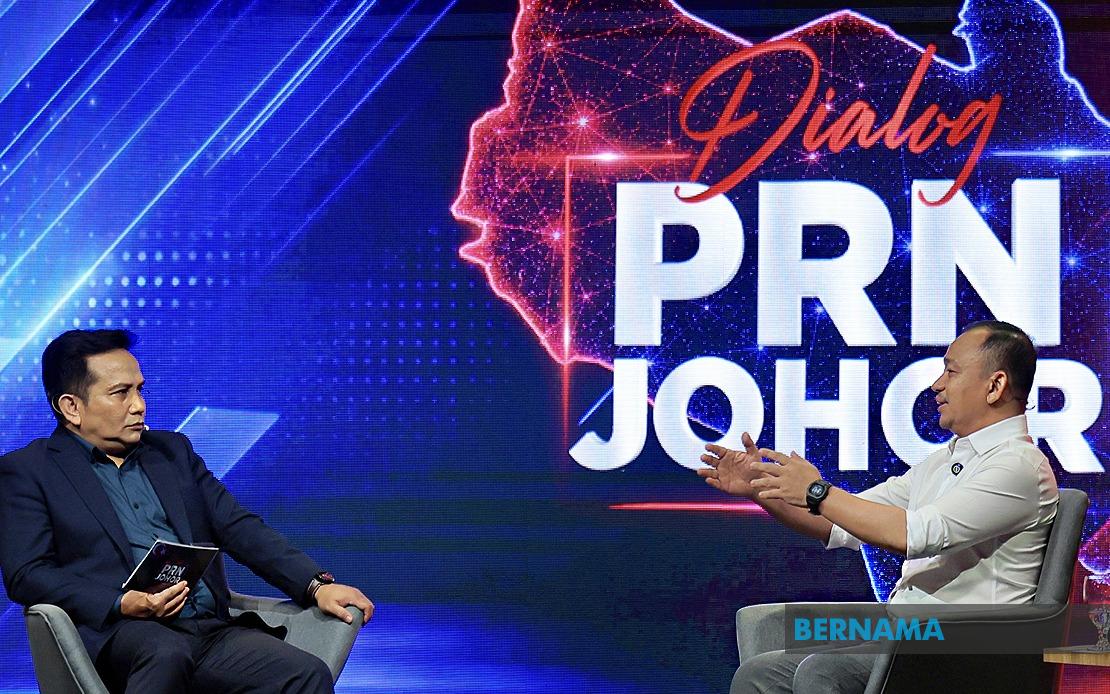
Dr Maszlee Malik, the Pakatan Harapan candidate contesting the Puteri Wangsa state seat, has called for Malaysian politics to mature beyond sentiment-driven campaigns, advocating instead for a culture grounded in evidence and reasoned debate. Speaking after participating in a state-level political dialogue here in Johor Bahru, the former education minister expressed optimism that such forums could catalyse a shift toward more substantive political engagement among voters and party machinery alike.
The dialogue, held at the Permata Sari Auditorium under the Johor State Broadcasting Department, was co-organised by Radio and Television Malaysia (RTM), Astro AWANI, and Sinar Harian. Communications Minister Datuk Fahmi Fadzil also participated in the session, underlining the coalition's commitment to elevating electoral discourse as the contest entered its final stages. These structured platforms for political discussion represent an attempt to differentiate campaigns from traditional partisan rallies by introducing moderation and fact-checking into the public sphere.
Maszlee's remarks reflect a broader concern among political observers about the quality of Malaysian electoral discourse. He emphasised that voters must be equipped to distinguish between claims supported by evidence and those rooted merely in populist sentiment. By framing informed decision-making as a civic virtue, the PH candidate positioned his coalition's outreach efforts as educational rather than purely transactional. This rhetorical strategy seeks to elevate the conversation above personality-driven politics, a persistent feature of Malaysian elections at federal and state levels.
The timing of such advocacy is significant given Malaysia's ongoing evolution as a multiparty democracy. Since 2018, electoral competition has intensified, prompting stakeholders across the spectrum to consider how political communication shapes voter behaviour and democratic legitimacy. Forums that bring together candidates from different parties under neutral moderation offer an alternative to the echo chambers of social media and partisan campaign messaging that dominate much of the pre-election period.
With three days remaining in the campaign before the July 11 polling date, PH's strategic focus has shifted toward mobilising voter turnout, particularly among those residing outside their constituencies. This pivot reflects recognition that electoral legitimacy is strengthened not merely by victory margins but by demonstrable participation levels. Maszlee underscored this point, noting that higher turnout translates into stronger public mandates for whichever government emerges from the election.
Early voting took place on the day of the dialogue, allowing certain groups including election workers, police, and military personnel to cast ballots ahead of the main poll. This staggered voting system, now routine in Malaysian elections, provides partial data on voter sentiment before the final count. For Johor, a state that has historically alternated between different political coalitions, early voting patterns often offer early signals of potential outcomes.
The emphasis on dialogue and evidence-based debate also speaks to international democratic standards and concerns about electoral integrity. Malaysian political leaders, particularly those in government, are increasingly conscious of comparative assessments of democratic health in Southeast Asia. By visibly championing reasoned political discourse, the Pakatan Harapan campaign positions itself as committed to standards that extend beyond winning elections to shaping the quality of democratic participation itself.
Yet challenges remain in translating such aspirations into practice. Despite good intentions, campaign dynamics often reward emotional resonance over analytical depth. Voters operating under time constraints and information asymmetries may still rely on heuristics and tribal affiliations rather than detailed policy analysis. The effectiveness of dialogue forums in influencing behaviour remains contested in political science literature, particularly in emerging democracies where media consumption patterns are fragmented and misinformation spreads rapidly.
The Johor state election, the sixteenth iteration of such contests in the state, provides a testing ground for whether such initiatives gain traction. As one of Malaysia's most competitive political battlegrounds, Johor attracts national attention and resources. The participation of a Communications Minister signals that federal leadership views this contest as emblematic of broader questions about Malaysia's political maturation and the nation's capacity to conduct elections that reflect both competitive intensity and democratic deliberation.
Looking forward, the outcomes in Johor will likely inform how political parties calibrate their engagement strategies in subsequent elections, whether at state or federal level. If dialogue initiatives correlate with improved voter satisfaction or higher turnout, other coalitions may adopt similar approaches. Conversely, if such forums are perceived as performative while traditional partisan messaging dominates campaign dynamics, their value as transformative vehicles may be questioned.
For Malaysian voters and observers concerned with democratic quality, Maszlee's advocacy for mature political culture represents one voice among many grappling with how to elevate electoral standards. Whether dialogue alone can shift entrenched patterns of political communication remains to be seen, but the effort itself signals recognition that elections are not merely mechanisms for power transfer but opportunities to reinforce or reshape democratic norms. The Johor election will provide data on whether such idealism can gain practical purchase in Malaysia's competitive political landscape.

