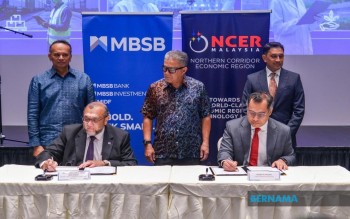
MBSB Bank Bhd has joined forces with the Northern Corridor Implementation Authority (NCIA) through a significant memorandum of understanding designed to unleash economic potential across the Northern Corridor Economic Region (NCER). The partnership, formalised at a ceremony in Petaling Jaya on July 17, makes available up to RM1 billion in tailored financing facilities aimed at propelling small and medium enterprises into new phases of growth and market expansion.
The collaboration marks a strategic alignment between Malaysia's banking sector and regional development infrastructure at a critical juncture for the nation's economic planning. MBSB Bank chairman Datuk Wan Kamaruzaman Wan Ahmad underscored the transformative potential of the arrangement, explaining that the financing envelope will empower businesses to scale operations, penetrate complex supply chain networks, and position themselves as drivers of sustainable economic momentum across the northern states. This approach reflects broader policy objectives to decentralise economic activity and strengthen regional development beyond the traditional Klang Valley and Iskandar corridors.
The NCER encompasses Perlis, Kedah, Penang and Perak—a geographical footprint that collectively represents one of Malaysia's most dynamic investment destinations. The region has consistently demonstrated resilience and growth momentum, attracting billions in domestic and foreign capital across diverse sectors. By channelling substantial financing through MBSB Bank, the NCIA effectively creates a dedicated conduit for capital deployment into enterprises that might otherwise struggle to access conventional lending at competitive terms. This structural innovation addresses a perennial challenge facing Malaysian SMEs: the availability of flexible, responsive funding mechanisms tailored to regional economic realities.
MBSB Bank group chief executive officer Rafe Haneef articulated a vision extending beyond simple credit provision. The arrangement incorporates partnerships with international banking institutions, notably Spain's Santander Group, to facilitate cross-border trade and export acceleration. This international dimension carries particular significance for Malaysian SMEs targeting markets across Southeast Asia, Europe, and beyond. By coupling domestic financing with established global banking networks, the partnership creates pathways for smaller enterprises to internationalise operations without bearing prohibitive transaction costs or navigating unfamiliar foreign banking environments alone.
The document was formally executed by MBSB Bank group chief commercial banking officer Noor Mohamed Amin and NCIA chief operating officer Hasri A Hassan, lending institutional weight to commitments on both sides. The signatures represent more than ceremonial acknowledgement; they crystallise operational frameworks through which capital will flow, credit decisions will be made, and businesses will be supported through expansion cycles. Such formality ensures that both parties maintain aligned incentives and accountability structures as the financing facility mobilises across multiple quarters and financial cycles.
NCIA chief executive Datuk Mohamad Haris Kader Sultan contextualised the partnership within Malaysia's 13th Malaysia Plan framework, emphasising that targeted collaborations have become instrumental for regional development. The NCER has deliberately positioned itself across strategic sectors identified as engines of future growth: electrical and electronics manufacturing, advanced production techniques, agricultural value chains, logistics infrastructure, digital economy enterprises, and green technology innovation. The RM1 billion financing facility effectively channels investment toward these identified priorities, creating alignment between regional development strategy and banking sector activity.
The electrical and electronics sector, which dominates northern industrial estates and has weathered global semiconductor cycles, stands to benefit substantially from improved financing access. Manufacturers seeking to upgrade facilities, invest in automation, or diversify into higher-value components face capital constraints that bank financing can address. Similarly, the agri-food segment—encompassing everything from fresh produce exporters to processed food manufacturers—requires working capital and equipment investment that this partnership can facilitate. The logistics dimension, increasingly critical as regional trade intensifies, requires modern warehousing, transportation networks, and technology infrastructure that growth-stage SMEs often struggle to finance independently.
The digital economy and green technology prioritisation reflects global economic trajectories and Malaysia's international commitments regarding sustainability. SMEs entering these domains frequently operate at the frontier of business models and technologies not yet fully understood by traditional credit assessment frameworks. By partnering with NCIA, which has developed deep sectoral expertise in the northern region, MBSB Bank gains institutional knowledge enabling more nuanced lending decisions. This collaborative intelligence dramatically improves the likelihood that capital reaches enterprises with genuine growth potential rather than becoming trapped in bureaucratic assessment processes.
From a Malaysian and regional perspective, the agreement carries implications extending beyond immediate financing figures. The NCER's success influences broader regional development patterns across Southeast Asia. Penang, in particular, functions as a critical technology and manufacturing hub competing with Thai and Indonesian clusters. By strengthening SME financing infrastructure, this partnership indirectly enhances Malaysia's competitive positioning across regional value chains. SMEs that secure funding and expand operations strengthen industrial ecosystem resilience and create employment that anchors labour forces in northern states rather than driving migration toward Kuala Lumpur.
The partnership also demonstrates how statutory development authorities and commercial banks can architect mutually beneficial arrangements. NCIA gains banking sector alignment behind its strategic priorities; MBSB Bank accesses a pipeline of vetted lending opportunities within a defined geographic region. This model offers a template potentially replicable across other Malaysian economic corridors and regional development zones, suggesting that the architecture established here may influence how development finance flows nationally.
Implementing the RM1 billion facility will require sustained operational coordination between institutions with distinct institutional cultures and objectives. MBSB Bank's commercial imperatives and NCIA's development mandate must remain aligned even as individual lending decisions diverge. Success hinges on establishing transparent criteria that balance social development outcomes with financial prudence, ensuring that capital deployment serves both purposes simultaneously rather than treating them as conflicting pressures.

