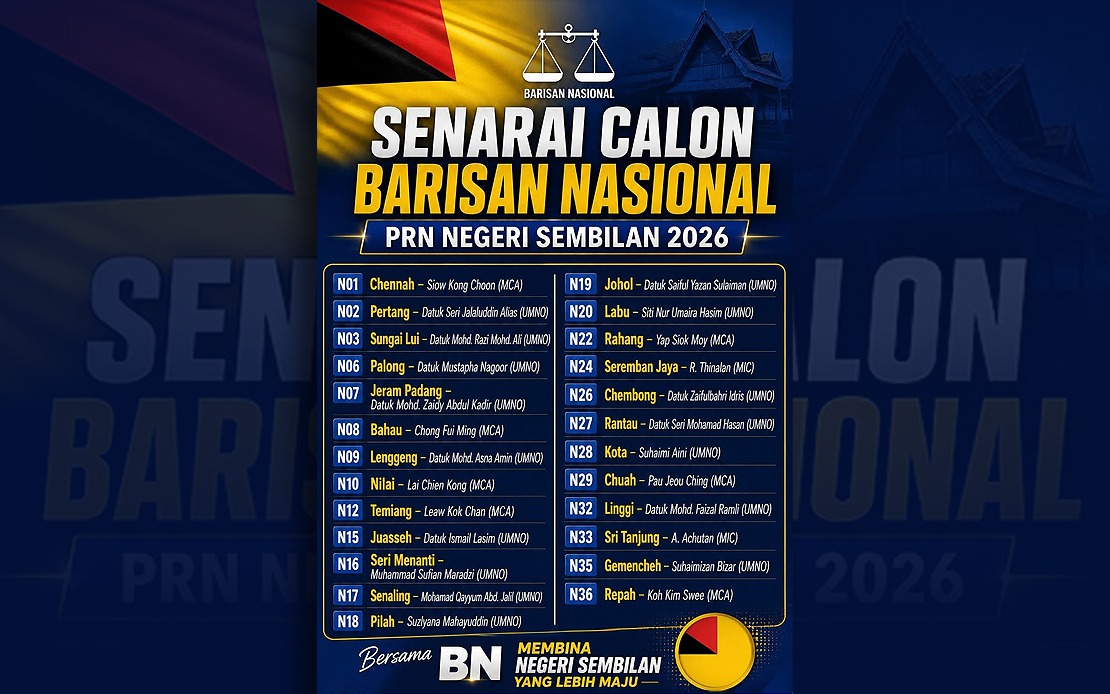
Barisan Nasional has finalised its seat allocation for the upcoming 16th Negeri Sembilan state election, with the Chinese-dominated MCA receiving seven State Legislative Assembly seats while the Indian-focused MIC will contest four constituencies. The announcement came from BN chairman Datuk Seri Dr Ahmad Zahid Hamidi, who also serves as Deputy Prime Minister, during a gathering of prospective candidates at Wisma UMNO Negeri Sembilan in the state capital.
The seat distribution framework adopted by the coalition reflects a calculated assessment of electoral prospects across the state's constituencies. According to Ahmad Zahid, the allocation process involved meticulous evaluation of each candidate's potential to secure victory in their respective areas, a methodology designed to optimise BN's overall performance in the ballot. This approach represents the coalition's strategic effort to position its strongest contenders in winnable seats while maintaining the balance of power-sharing arrangements among its component parties.
The Deputy Prime Minister emphasised that the vetting process extended beyond mere seat allocation. All prospective candidates were required to sign formal undertakings and pledge their allegiance directly to him in his capacity as BN chairman, a ceremonial but politically significant step that underscores party discipline and commitment to the coalition's shared objectives. Such protocols are standard practice in Malaysian electoral contests, whether state elections, by-elections, or general elections, serving to reinforce internal party cohesion ahead of public polling.
The timing of the Negeri Sembilan election reflects a broader pattern of state-level ballots being held ahead of the next federal general election. The Election Commission has established a structured timeline, designating July 18 as nomination day when all candidates will be formally registered. Early voting is scheduled for July 28, allowing specific voter categories to cast their ballots in advance, while the main polling day is set for August 1. Ahmad Zahid is positioned to announce the complete list of BN candidates at Stadium Tuanku Abdul Rahman Paroi later today, providing the public and media with full visibility of the coalition's slate.
The political context for this election carries considerable weight, particularly given the performance gaps evident in the previous state election. In the 15th Negeri Sembilan state poll, BN captured only 14 seats, substantially underperforming relative to its historical dominance in the state. Pakatan Harapan emerged as the leading force with 17 seats, securing control of the state government, while Perikatan Nasional claimed five seats, reflecting the fragmentation of the opposition vote. These results represented a significant shift in the political dynamics of Negeri Sembilan and signalled broader challenges facing the BN coalition at the state level.
For Malaysian observers and political analysts, the seat allocation itself offers insights into BN's strategic calculus for the comeback attempt. The allocation to MCA and MIC, combined with what would implicitly be a substantially larger UMNO contingent, reflects the traditional hierarchy within the coalition. MCA's seven seats represent a meaningful but secondary role compared to UMNO's likely dominance, while MIC's four seats underscore the limited but sustained role of the Indian component party within the federal coalition framework. These allocations must also be viewed against the backdrop of broader demographic and electoral trends in Negeri Sembilan.
The contest assumes additional significance for BN's national positioning. State elections serve as valuable barometers for public sentiment and provide opportunities for the coalition to demonstrate renewed organisational capacity and voter appeal. A strong performance in Negeri Sembilan could strengthen BN's hand ahead of the inevitable federal election cycle, while a disappointing result would amplify concerns about the coalition's viability in an increasingly competitive electoral environment. The coming weeks will test whether Ahmad Zahid's leadership and the coalition's seat-distribution strategy translate into tangible electoral gains.
From a broader Southeast Asian perspective, the Negeri Sembilan election illustrates the ongoing complexity of Malaysian coalition politics. Unlike two-party systems, Malaysia's multi-party framework requires constant negotiation among coalition partners to maintain unity while managing expectations around resource distribution and ministerial positions. The seat-sharing formula visible in this arrangement reflects decades of accumulated political conventions and pragmatic compromises designed to keep ethnically and ideologically diverse partners working together.
The campaign period ahead will reveal how effectively BN candidates can mobilise support in their respective constituencies. The gap between winning 14 seats in the previous election and the need to regain state control demonstrates the scale of the electoral task before the coalition. Negeri Sembilan voters will ultimately determine whether they favour returning BN to power or sustaining Pakatan Harapan's state government, with implications extending well beyond the state's borders.

