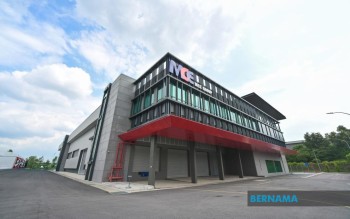
MCE Holdings Bhd launched its flagship MCE Auto Hub on July 7 at the UMW High Value Manufacturing Park in Serendah, a RM50 million investment that represents a watershed moment for Malaysia's automotive electronics ecosystem. The facility, spanning 5.52 hectares, received official recognition from Investment, Trade and Industry Minister Datuk Seri Johari Abdul Ghani, underscoring the strategic importance of the project to the nation's manufacturing ambitions. This inaugural phase signals the beginning of a much larger commitment, with MCE planning to deploy up to RM200 million across its operations to establish itself as a competitive tier-1 supplier capable of competing in increasingly demanding global markets.
The MCE Auto Hub addresses a critical gap in Malaysia's automotive value chain by consolidating design, engineering, manufacturing and research capabilities in a single advanced facility. The hub's operational launch effectively doubles the group's production capacity and equips it to handle the dual transition underway in the automotive sector—continuing to serve the internal combustion engine market while building sophisticated capabilities in electric vehicle electronics. This dual-track approach reflects the pragmatic reality that Malaysian suppliers must serve both established and emerging powertrains simultaneously over the next decade, avoiding the false choice between legacy and innovation.
MCE's journey from its 1990 beginnings as a supplier of remote alarms and central locking systems to its current position as a complex automotive electronics manufacturer illustrates how Malaysian companies can climb the value chain through sustained investment and technical development. The company now operates across multiple locations, with engineering teams distributed between Johor Bahru, Port Klang and the new Serendah hub, collectively supporting programmes spanning traditional vehicles and next-generation electric powertrains. This geographic spread allows MCE to serve customers across Malaysia, ASEAN and the United States, positioning the group at the intersection of regional growth and global supply chains.
The facility's design as an Industry 4.0-ready manufacturing environment signals MCE's commitment to adopting smart manufacturing practices that will become table stakes in automotive supply. Clean room production areas and precisely controlled manufacturing conditions are now essential for the advanced automotive electronics required in modern vehicles, whether powered by petrol engines or batteries. This infrastructure investment demonstrates that Malaysian manufacturers understand the technical rigour demanded by contemporary vehicle architectures and are willing to invest capital to meet those standards, a prerequisite for retaining and attracting higher-value contracts.
The employment expansion accompanying the hub's launch—bringing MCE's total workforce to 680 personnel, including 90 engineers—highlights how advanced manufacturing generates quality jobs requiring technical expertise. The concentration of engineering talent within the group strengthens its ability to lead complex programmes and develop proprietary solutions rather than simply executing outsourced specifications. For Malaysia's broader economic strategy, this represents the kind of high-productivity employment that can sustain middle-class incomes in an era when lower-cost manufacturing sites compete aggressively for basic assembly work. The ability to retain and attract automotive engineers to Malaysia depends partly on companies like MCE creating credible career pathways and interesting technical challenges.
MCE's positioning within Malaysia's automotive localisation agenda reveals how tier-1 suppliers can serve as anchors for broader ecosystem development. When companies of MCE's scale invest in capabilities, they create opportunities for smaller Malaysian semiconductor firms, electrical component suppliers and engineering consultancies to participate in automotive development projects. This ecosystem approach contrasts with the historical pattern where Malaysian automotive companies primarily assembled imported components with limited local content or design contribution. Stronger collaboration between vehicle manufacturers, tier-1 suppliers and specialist technology companies can gradually increase the proportion of Malaysian intellectual property embedded in vehicles, boosting both export value and domestic skill development.
The timing of MCE's investment reflects growing confidence in Malaysia's automotive future despite global supply chain uncertainties. The automotive sector remains a cornerstone of Malaysian manufacturing, and electric vehicle adoption represents both disruption and opportunity. Companies that have invested early in EV electronics capabilities position themselves to capture growing demand as vehicle electrification accelerates across ASEAN. MCE's simultaneous investment in ICE and EV capabilities acknowledges that the transition will unfold unevenly, with internal combustion engines remaining significant throughout the region for at least another decade while battery electric vehicles gradually gain market share.
Government support for MCE's expansion, evidenced by ministerial attendance and alignment with national manufacturing goals, reflects official recognition that tier-1 suppliers require sustained policy backing to upgrade capabilities. Tariff protection, investment incentives and participation in regional trade agreements all contribute to the environment in which companies like MCE make long-term capital commitments. Malaysia's success in retaining and developing automotive supply expertise depends on maintaining policies that encourage domestic companies to invest in design and engineering capabilities rather than locking them into low-value assembly roles. The MCE Auto Hub exemplifies the kind of infrastructure investment that governments should actively support through both direct incentives and the creation of enabling conditions.
The expansion also positions MCE to benefit from potential restructuring of global automotive supply chains. Geopolitical tensions, supply chain vulnerabilities exposed during recent semiconductor shortages, and the desire of major vehicle manufacturers to diversify sourcing have all increased interest in Southeast Asian manufacturing alternatives. Malaysia's established automotive ecosystem, skilled workforce and geographic position make it attractive for companies seeking to shift portions of their supply base away from single sources of dependence. MCE's expanded capabilities and facility capacity place the company in a stronger position to capture contracts as this diversification occurs, though competition from other ASEAN nations and China remains intense.
Looking forward, MCE's success will depend on translating manufacturing capacity into actual orders from major vehicle manufacturers. The facility's readiness and MCE's technical capabilities are necessary but not sufficient conditions for growth; the company must win competitive tenders against established suppliers and convince customers that its solutions offer value beyond cost advantage. This requires continuous innovation in product development, responsiveness to customer requirements and the kind of engineering excellence that the Serendah hub is designed to enable. For Malaysia's broader automotive aspirations, MCE's trajectory over the next three to five years will provide important signals about whether local companies can sustain competitiveness in the demanding automotive electronics sector.
The MCE Auto Hub's launch ultimately represents Malaysia's determination to move beyond assembly towards more sophisticated manufacturing and technology development. The automotive industry's transformation towards electrification and autonomous systems demands advanced electronics expertise that cannot be imported wholesale; companies must develop deep technical capabilities through investment and experience. MCE's commitment to this path, backed by government support and anchored in the new Serendah facility, suggests that segments of Malaysia's manufacturing base are capable of upgrading to higher-value activities. Whether this remains an isolated success story or represents the beginning of broader ecosystem transformation will depend on whether other Malaysian suppliers pursue similar strategies and whether supportive policies remain consistent across economic cycles.

