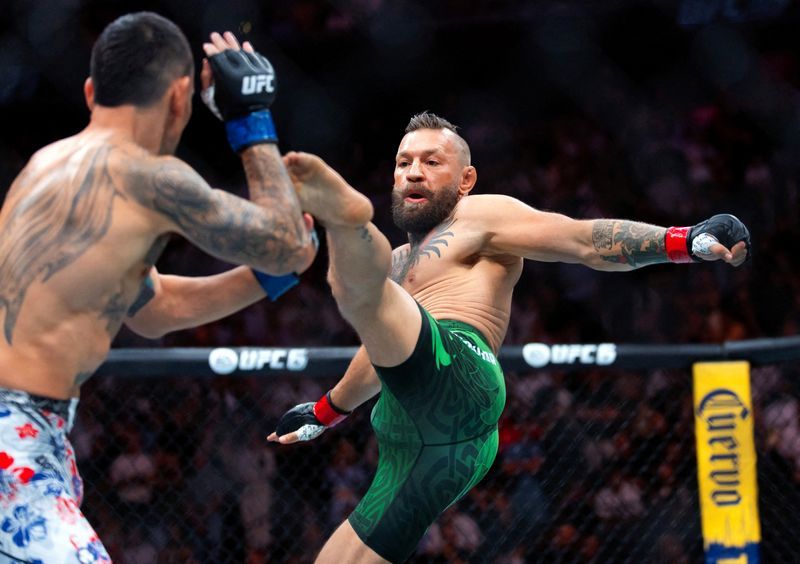
Conor McGregor's highly anticipated return to mixed martial arts competition lasted barely more than a minute. The Irish fighter suffered a serious knee injury in the opening moments of his bout with Max Holloway in Las Vegas on Saturday, forcing him to withdraw from the octagon just 69 seconds into what was meant to signal his comeback to the sport. Following the incident, McGregor confirmed on Monday that he would undergo surgical treatment and remain committed to fighting again, though the timeframe and nature of his recovery remain unclear.
The injury occurred in circumstances that highlighted the unpredictability of combat sports. As McGregor attempted a jump kick early in the first round, he landed awkwardly, immediately compromising his knee. Rather than continue grimacing through what was clearly significant pain, the 37-year-old Irish fighter signalled to the referee within seconds that he was unable to proceed. The abrupt termination of what had been billed as a significant comeback moment for one of the sport's most marketable figures disappointed fans who had waited years for his return.
On his Instagram account, McGregor framed his situation through a lens of philosophical resilience, posting that "all things work out for my good" and that "all things are possible for me because I am a believer." He outlined a recovery roadmap involving surgery, pre-rehabilitation work, and a gradual return to martial arts training, suggesting he views this as merely another obstacle in a career that has seen numerous setbacks. The fighter also referenced his contract status, hinting at the possibility of fulfilling remaining obligations with one final bout once he recovers sufficiently.
McGregor's latest injury represents the continuation of a troubling pattern that has disrupted his career over the past five years. In 2019, he suffered a severe leg fracture during a fight against Dustin Poirier, an injury that required extensive rehabilitation and contributed to a significant absence from competition. The legacy of that injury has seemingly persisted, with McGregor experiencing recurring lower-limb complications that have prevented him from maintaining consistent fight schedules.
Even in the lead-up to his Las Vegas appearance, misfortune had dogged his attempts to compete. A scheduled bout with Michael Chandler had been planned for June 2024, but was abandoned when McGregor sustained a broken toe during training camp. Such incidents during preparation have become disturbingly common for the fighter, suggesting either a pattern of training intensity that courts injury or a run of remarkably poor luck in the gym.
Beyond the physical challenges, McGregor has confronted significant obstacles outside the sport itself. In what became a lengthy civil legal proceeding in Ireland, a jury determined in 2024 that McGregor bore liability regarding allegations of sexual assault involving Nikita Hand stemming from an alleged 2018 incident. The legal matter consumed considerable attention and resources, adding emotional and reputational complications to his path back to the octagon.
Additionally, McGregor faced sanctions from anti-doping authorities that extended his competitive exile. In October 2024, he accepted an 18-month suspension imposed by Combat Sports Anti-Doping for what were characterized as "whereabouts failures." The enforcement action stemmed from three unsuccessful attempts by the organization to collect biological samples from McGregor during 2024, violations that resulted in the ban being backdated to September 2023. The suspension expired in March 2025, clearing the way for his return to competition, though the incident underscored the administrative complexities surrounding his status.
For Malaysian and Southeast Asian fight enthusiasts, McGregor remains a significant figure in global MMA discourse, despite his extended absence from active competition. His marketability and visibility extend far beyond traditional combat sports audiences, making his career developments consequential for the broader landscape of professional fighting. The region has developed its own robust MMA ecosystem, with fighters like Aung La N Sang and other Southeast Asian competitors competing at the highest levels, yet international stars like McGregor still command disproportionate attention and commercial value.
The immediate outlook for McGregor's recovery appears uncertain. The surgical intervention he will undergo may require a rehabilitation period extending into months, depending on the severity of the knee damage sustained on Saturday. For a fighter of his age, recovery from significant joint injuries typically demands careful management and gradual progression back to full training intensity. At 37, McGregor faces both the physical challenge of healing and the psychological reality that his career window continues narrowing.
Whether McGregor can successfully navigate this latest injury and fulfill his contractual obligations with another competitive fight remains an open question. His statement suggests genuine determination to return, but the cumulative effect of injuries, legal entanglements, and regulatory complications have created an increasingly complex path forward. For fans who have invested years in following his career and for the broader MMA community that has benefited from his commercial appeal, the coming months will reveal whether this latest setback represents merely another chapter in a remarkable career or a more definitive conclusion to his competitive ambitions.

