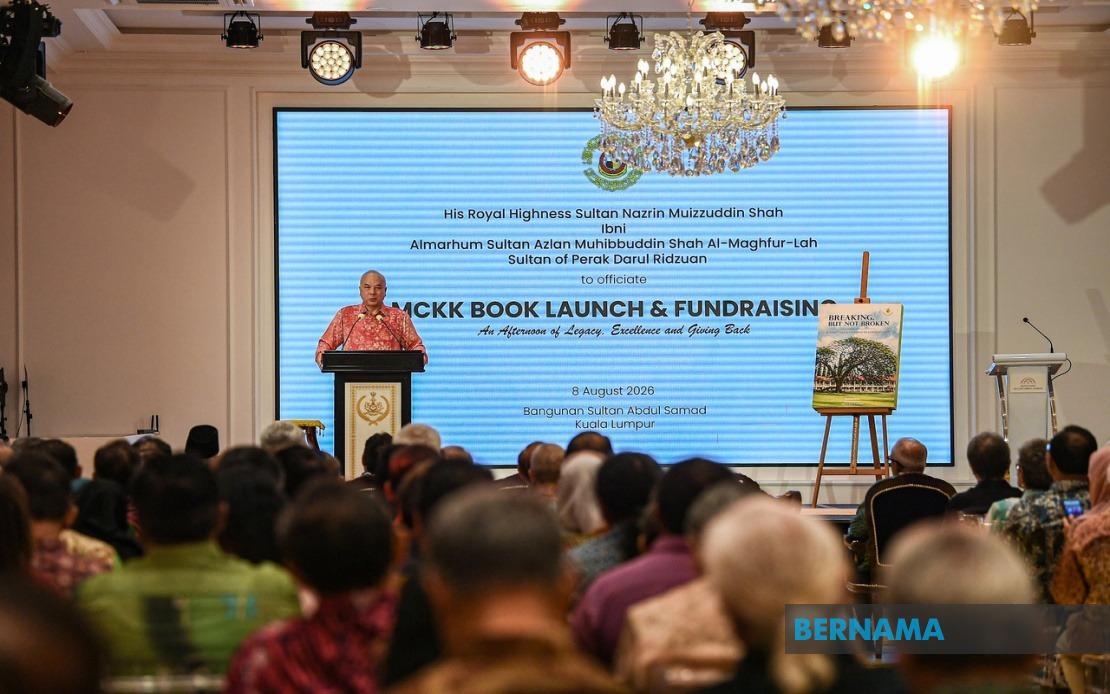
The Sultan of Perak, Sultan Nazrin Shah, has made a compelling case for why prestigious heritage schools must fundamentally reimagine their role if they are to remain relevant in an increasingly digital and unpredictable world. Speaking as Royal Patron of the MCKK Board of Governors, His Royal Highness emphasised that institutions such as the Malay College Kuala Kangsar possess the foundational strength to reclaim their position as engines of educational excellence—but only if they demonstrate the agility to adapt to profoundly transformed circumstances. The challenge is not merely to update curriculum content or invest in modern facilities, but to rethink the entire institutional approach to what it means to prepare young people for adulthood in an age shaped by artificial intelligence and accelerating technological disruption.
The broader context underscores the urgency of Sultan Nazrin's message. Malaysia's elite residential schools, long revered as "power schools" that produced generations of national leaders, policymakers and accomplished professionals, have experienced a marked erosion in their standing and effectiveness. Where these institutions once guaranteed transformative educational outcomes, their contemporary graduates now face criticism for deficiencies in command of language, analytical rigour and a sense of purpose beyond personal advancement. This decline is not attributable to any single failure but rather reflects the schools' struggle to maintain relevance when the economic and technological landscape has shifted beneath them. Sultan Nazrin's intervention signals that the monarchy recognises this institutional crisis as a matter warranting royal attention and strategic guidance.
Central to the Sultan's argument is the distinction between two complementary dimensions of education that must be cultivated simultaneously. The first is practical preparation—equipping students with technical capabilities and adaptive mindsets that enable them to navigate rapidly evolving employment markets and harness opportunities created by technological change. This represents the instrumental side of education, the skills employers seek and economies demand. Yet Sultan Nazrin insists with equal emphasis that schools must also nurture what he terms the more intangible qualities: ethical grounding, critical thought, cultural sensitivity and a genuine commitment to serving the broader community. These dimensions are not decorative or secondary; they constitute the difference between producing merely competent technicians and developing mature citizens capable of exercising wisdom and moral judgment in positions of influence.
The timing of this appeal carries particular weight for Southeast Asia's educational landscape. The region faces mounting competition for talent and investment as economies race to position themselves advantageously in a future increasingly mediated by artificial intelligence. Countries that can produce graduates combining technical sophistication with ethical reasoning and adaptive capability will attract multinational investment, retain high-value talent and maintain competitive advantage. Conversely, educational systems that fail to evolve risk becoming repositories of tradition rather than engines of innovation. For Malaysia specifically, the revitalisation of heritage schools carries broader implications: these institutions historically served as conduits for social mobility, pathways through which talented students from diverse backgrounds accessed the nation's elite professional classes. Their decline therefore represents not merely an institutional problem but a potential narrowing of opportunity and social dynamism.
Sultan Nazrin explicitly praised the authors of a recently launched book on MCKK's challenges—Ghazally Ismail, Ahmad Ibrahim and Hisham Badrul Hashim—for their unflinching analysis of the school's predicament. This commendation is significant because it signals that the Sultan welcomes candid, even uncomfortable assessment of institutional performance. The authors apparently extended their critique beyond MCKK to encompass the handful of other venerable residential schools occupying similar positions in Malaysia's educational hierarchy, documenting in detail how these once-formidable institutions have experienced a genuine loss of gravitational pull and reputational authority. By endorsing this critical examination, Sultan Nazrin demonstrated that reinvention requires honest reckoning with failure, not defensive nostalgia or institutional self-exoneration.
The financial dimensions of institutional renewal became apparent when MCKK Board of Governors chairman Tan Sri Dr Ahmad Tajuddin Ali presented an accounting of the MCKK Foundation's activities since its establishment in 2008. The Foundation has mobilised more than RM36 million in donations and contributions, demonstrating significant capacity to attract philanthropic support from both Malaysian and international sources. Of this total, approximately RM19 million has been deployed toward construction and expansion of physical infrastructure, including the IB Complex and the newly built Auditorium Tun Abdul Razak. An additional RM3.5 million has supported refurbishment and restoration of existing facilities—the Pavilion Hostel, preparatory school sanitation facilities, gymnasium structures, swimming pool and other essential amenities. This investment pattern reflects recognition that heritage schools cannot succeed with antiquated physical plant; students increasingly expect and require modern learning environments and recreational facilities comparable to international standards.
Beyond bricks and mortar, the Foundation has cultivated an endowment exceeding RM16 million, contributions that now generate sustainable investment income to support the school's operations indefinitely. This endowment strategy is educationally and institutionally significant because it insulates the school from year-to-year budgetary pressures and provides resources for initiatives that enhance rather than merely maintain educational quality. Notable contributors have included PETRONAS and Sultan Hassanal Bolkiah of Brunei Darussalam, indicating that MCKK retains sufficient prestige to attract support from major corporate entities and regional royalty. More than RM7 million in accumulated investment income has been redeployed toward scholarships and financial assistance for deserving students, leadership development programmes, participation in international academic competitions, professional development for teaching staff and preservation of the school's heritage buildings. This deployment strategy suggests that MCKK's leadership understands that educational excellence requires sustained investment not merely in physical infrastructure but in human capital development and the intergenerational transmission of institutional culture.
The scholarship and financial assistance component deserves particular emphasis when contextualising Sultan Nazrin's call for reinvention. Elite residential schools serve Malaysia's educational ecosystem most effectively when they remain accessible to talented students across socioeconomic backgrounds, not merely to families of privilege and connection. The Foundation's commitment to funding scholarships thus reflects a philosophy aligned with Sultan Nazrin's emphasis on schools' responsibility to cultivate diverse cohorts of capable, principled graduates. This inclusive approach also addresses a persistent criticism of Malaysian elite schools: that they have drifted toward becoming enclaves of the already-privileged rather than engines of meritocratic advancement. By maintaining robust scholarship programmes, MCKK signals commitment to renewing its historical role as an institution capable of identifying and nurturing exceptional talent regardless of family background.
The international dimensions of student engagement also feature prominently in the Foundation's resource allocation, with specific funding dedicated to participation in overseas academic conferences and competitions. This investment reflects understanding that contemporary educational excellence increasingly operates in global rather than merely national contexts. Malaysian students competing at international level develop comparative awareness, encounter peers from diverse educational traditions and establish networks that extend well beyond the nation's borders. Such exposure proves particularly valuable for students destined for professional roles requiring cross-border collaboration, international business acumen or sophisticated engagement with global governance structures. Sultan Nazrin's emphasis on preparing students for an AI-shaped future implicitly requires this global orientation; artificial intelligence development and deployment transcends national boundaries, and Malaysian professionals must understand how technological innovation emerges and diffuses internationally.
The challenge Sultan Nazrin has identified extends beyond institutional leadership at MCKK itself to encompass Malaysian policymaking more broadly. Educational transformation at elite residential schools cannot succeed in isolation from broader systemic reform across secondary and tertiary education. If MCKK and comparable institutions invest heavily in cultivating critical thinking, ethical reasoning and adaptability, yet students subsequently encounter tertiary institutions or employment contexts that reward rote memorisation, credential accumulation and conformity, the investment yields diminished returns. Conversely, if heritage schools attempt reinvention while the broader education system remains aligned toward standardised testing and narrow skill acquisition, these pioneering institutions risk marginalisation. Genuine systemic change therefore requires alignment across multiple levels of educational governance, from school-level curriculum design through tertiary institution admissions criteria to employer recruitment practices.
Sultan Nazrin's intervention also carries implicit recognition that Malaysia's economic future depends substantially on whether the nation can produce graduates capable of navigating technological disruption while maintaining ethical anchors. The AI age will inevitably displace certain categories of employment, concentrate wealth in some sectors while obsoleting others and create novel challenges around algorithmic transparency, data privacy and the social implications of automation. Malaysian professionals positioned to address these challenges—policymakers, technologists, business leaders, educators and civil society actors—will require precisely the combination of technical understanding and ethical sophistication that Sultan Nazrin emphasised. Heritage schools that successfully instil both dimensions in their graduates will strengthen Malaysia's capacity to manage the transition ahead responsibly. Those that fail to adapt risk producing graduates ill-equipped for the complexities they will encounter.
Ultimately, Sultan Nazrin's call for reinvention represents a measured but significant challenge to Malaysia's educational establishment. The Sultan has not suggested that heritage schools abandon their traditions or relinquish the values that historically defined their character. Rather, His Royal Highness has argued persuasively that tradition and transformation are not mutually exclusive; institutions can honour their past while radically reimagining their future. The MCKK Foundation's financial mobilisation and infrastructure investment demonstrate that such reinvention is materially feasible. What remains to be demonstrated is whether institutional leadership at MCKK and comparable schools possess the pedagogical creativity, intellectual courage and strategic patience required to genuinely recast educational approaches. The stakes extend well beyond any single institution; they encompass Malaysia's capacity to produce citizens equipped to thrive in an unpredictable future while maintaining the ethical and cultural rootedness that grounds resilient, flourishing societies.

