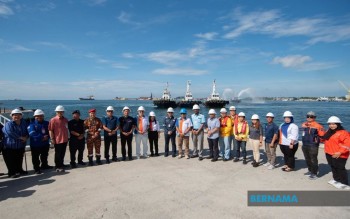
Megah Port Management Sdn Bhd (MPM) has officially rolled out its marine services operations at Labuan Port following a substantial capital commitment of RM23 million toward acquiring four purpose-built tugboats. The initiative represents a significant infrastructure investment aimed at strengthening port operations in one of Malaysia's most strategically important maritime hubs. The launch ceremony, held at Dermaga Merdeka Jetty, underscores the company's determination to establish world-class vessel management capabilities within the port's territorial waters.
Managing director Datuk Seri Patrick Tiong framed the tugboat acquisition as a cornerstone investment reflecting MPM's broader operational philosophy. The decision to deploy this specialized fleet addresses mandatory requirements outlined in the recently executed Operation, Facility and Management Continuation Agreement between MPM and the Labuan Port Authority. This contractual framework positions marine services—previously identified as a critical operational gap—as a non-negotiable component of the port's service delivery model. The timing reflects MPM's methodical approach to establishing foundational infrastructure before expanding capacity and service breadth.
The newly deployed tugboats will perform multiple essential functions within Labuan Port's defined operational boundaries. Primary duties include shepherding vessels during approach and departure phases, executing intricate berthing and unberthing maneuvers in congested waterways, and maintaining directional control during adverse meteorological or hydrodynamic conditions. The vessels function as dynamic anchors for maritime traffic management, effectively extending the port authority's ability to regulate complex vessel movements that would otherwise prove hazardous or operationally inefficient. This capability proves particularly valuable for managing larger commercial vessels navigating Labuan's confined waters, where precision and responsive control systems become critical success factors.
Beyond routine port operations, Tiong emphasized the tugboats' auxiliary applications in emergency and crisis scenarios. The fleet stands ready to provide immediate response capacity for firefighting operations, execute controlled vessel repositioning away from hazardous zones, and facilitate coordinated interventions involving Malaysian Maritime Enforcement Agency personnel and Marine Police Force officers. This multi-functional capacity transforms the tugboat fleet into a comprehensive maritime safety asset rather than a single-purpose operational tool. The emergency response dimension proves particularly significant given the hazardous cargo handled across several terminals within Labuan Port's boundaries, where rapid intervention capabilities can substantially reduce casualty risks and environmental contamination.
The marine services coverage encompasses four strategically significant operational zones within the broader Labuan Port complex. The DG Terminal, Petronas Chemicals Methanol Labuan Terminal, Asian Supply Base Fuel Terminal, and Shell Timur Terminal collectively represent the port's highest-value cargo throughput and most complex operational requirements. These terminals handle dangerous goods, petrochemical products, and specialized supply chain logistics that demand elevated safety protocols and responsive management infrastructure. By concentrating tugboat deployment across these facilities, MPM establishes a tiered safety architecture that prioritizes areas presenting the greatest operational risk and regulatory scrutiny.
The operational framework integrates coordinated engagement with multiple governmental and enforcement bodies, reflecting recognition that port safety extends beyond MPM's direct control. Tiong underscored the imperative for continuous liaison with maritime enforcement agencies, police maritime divisions, and security apparatus to ensure compliance with applicable maritime legislation and safety standards. This collaborative architecture acknowledges that effective port governance requires institutional alignment across regulatory agencies, operator management, and enforcement entities. The receptiveness to external guidance signals MPM's institutional maturity and its commitment to responsive management practices that prioritize systemic improvement over operational insularity.
For Malaysian maritime stakeholders and regional port operators, the Labuan initiative carries broader implications regarding infrastructure investment in specialized port services. Historically, tugboat and marine services across Southeast Asian ports have represented areas of underinvestment, with many operators deferring such expenditures despite safety and efficiency benefits. MPM's decisive capital commitment establishes a contrasting precedent, demonstrating that contemporary port management increasingly requires substantial investments in specialized vessels and operational capabilities. This approach aligns with global best practices observed in mature port jurisdictions, where integrated marine services form foundational operational infrastructure rather than optional enhancements.
The investment trajectory also reflects confidence in Labuan Port's growth trajectory and commercial viability. A RM23 million tugboat acquisition represents substantial capital deployment that presupposes sustained operational activity and expanding vessel traffic. This signals management's assessment that Labuan Port commands sufficient competitive positioning within regional port networks to justify infrastructure investments typically associated with higher-volume facilities. Given Malaysia's broader maritime strategy emphasizing port development and supply chain resilience, the Labuan expansion contributes to diversifying port capacity beyond Peninsular Malaysia's established facilities.
The emergency response demonstration component of the launch event merits particular attention, as it translated abstract operational capabilities into observable maritime safety protocols. Public demonstrations of emergency response capacity serve multiple constituencies: they reassure port users regarding safety infrastructure, communicate operational seriousness to regulatory bodies, and establish documented baseline performance standards against which future operations can be assessed. Such demonstrations represent prudent risk communication strategies that extend beyond regulatory compliance into proactive stakeholder confidence-building. For vessel operators and cargo interests, visible evidence of emergency response capacity influences port selection decisions and insurance assessment calculations.
Looking forward, the Labuan marine services initiative establishes a platform for potential service expansion as port volumes scale. The four-vessel fleet represents current operational requirements, but the modular nature of tugboat operations permits fleet expansion without fundamental infrastructure reconstruction. Should Labuan Port experience anticipated growth in vessel traffic—particularly within petrochemical and specialized cargo segments—corresponding expansion of marine services capacity would follow established protocols and proven operational frameworks. This developmental sequencing reflects pragmatic capital management while preserving flexibility for adaptive growth responses.
The initiative carries implications for maritime employment and workforce development within Labuan's regional economy. Establishing comprehensive marine services requires specialized personnel including experienced tugboat operators, maritime engineers, vessel maintenance technicians, and emergency response coordinators. The operational launch therefore generates direct employment opportunities within Labuan's maritime sector while creating potential for skills training programs that extend benefits across the broader workforce. Such employment dimensions, while often overlooked in port infrastructure announcements, constitute significant community-level impact streams that justify government investment in port development initiatives.
MPM's positioning of marine services as integral to port safety and sustainability establishes an important operational philosophy increasingly recognized across progressive port jurisdictions. Rather than viewing marine services as peripheral commercial offerings, contemporary port management conceptualizes such capabilities as foundational safety and efficiency infrastructure. This reframing elevates marine services from cost center status to strategic investment categorization, justifying capital outlays that would appear excessive under narrower operational calculus. As Labuan Port matures and regional competition for cargo intensifies, comprehensive marine services will likely emerge as a competitive differentiator that justifies premium port utilization fees and attracts quality cargo business.

