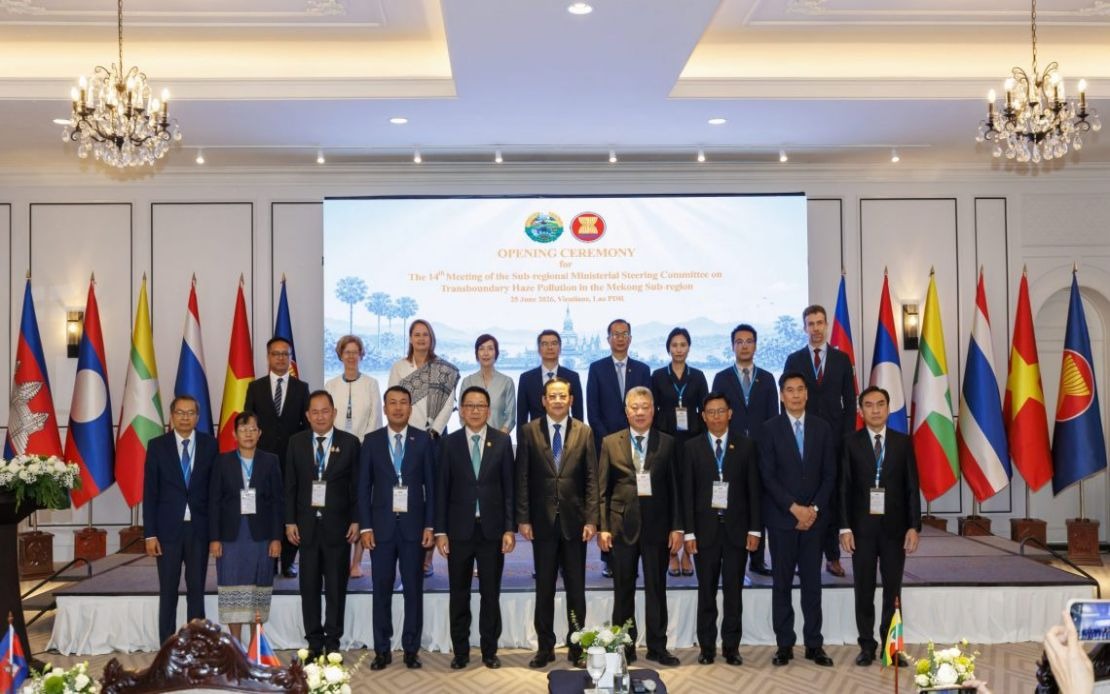
Environmental alarm bells are ringing across Southeast Asia as the Mekong region braces for a potential surge in forest fires and the transboundary haze that inevitably follows. At a ministerial summit held June 25 in Vientiane, Laos, ASEAN member states acknowledged the mounting threat posed by climbing temperatures and the arrival of El Niño conditions, which together create ideal conditions for large-scale wildfires. The 14th Meeting of the Sub-Regional Ministerial Steering Committee on Transboundary Haze Pollution in the Mekong Sub-Region revealed that hotspot detection has already risen approximately eight percent between December 2025 and May 2026 compared to the previous year, signalling intensifying fire activity across the subregion.
Lao Prime Minister Sonexay Siphandone delivered a stark warning about the compounding consequences of forest fires and air pollution spreading across borders. The phenomenon has historically ravaged biodiversity, harmed public health systems, and inflicted cascading economic damage throughout the Greater Mekong Subregion. This is not merely an environmental concern—it threatens livelihoods, disrupts commerce, and strains healthcare infrastructure across multiple nations simultaneously. The recognition of these transnational impacts underscores why regional cooperation has become essential rather than optional.
Temperatures across major urban centres from Bangkok to Ho Chi Minh City are reaching dangerous levels despite seasonal monsoon patterns that should theoretically bring cooler conditions. This anomaly, driven by climate change and strengthening El Niño effects, is creating a particularly volatile meteorological situation. Rather than providing relief, the rainy season has proven unpredictable, with limited precipitation in crucial areas. Weather scientists have flagged the possibility of a Super El Niño event materialising this year, which would further amplify heat stress and alter rainfall patterns across the subregion.
The Lao Ministry of Agriculture and Environment has issued detailed warnings about climate impacts expected throughout the rainy season. Forecasts suggest certain areas could experience sustained temperatures between 35 and 38 degrees Celsius, coupled with erratic precipitation patterns. Prolonged dry spells are anticipated alongside declining water levels in reservoirs and waterways, creating a perfect storm for drought conditions. Such scenarios directly threaten agricultural production and livestock operations—sectors upon which millions of rural families in the Mekong depend for survival.
The convergence of multiple climatic stressors creates cascading risks that policymakers cannot ignore. Elevated temperatures dry out vegetation and soil moisture, making forests and peatlands extraordinarily combustible. When rainfall becomes sporadic and insufficient, fire suppression becomes exponentially more difficult. Simultaneously, water shortages undermine irrigation systems vital for farming, while reduced river levels threaten hydroelectric power generation—a critical energy source for several ASEAN nations. The interconnected nature of these challenges means that fire prevention must be understood as integral to broader climate resilience strategies.
Transboundary haze represents a particularly acute manifestation of these problems because smoke and particulate matter cross national borders regardless of political boundaries. Citizens in Malaysia and Singapore have experienced debilitating haze events triggered by Indonesian wildfires; similarly, communities throughout the Mekong basin suffer when fires in upstream nations compromise air quality downstream. This geographical reality forces governments into uncomfortable interdependence, requiring trust and coordinated action even among nations with fraught diplomatic histories.
The ministerial meeting in Vientiane represented a significant commitment to address this shared crisis. ASEAN member states explicitly pledged to reduce fire hotspots and suppress transboundary haze pollution throughout the Mekong Sub-Region, particularly during vulnerable dry seasons. Such pledges require meaningful implementation through increased patrol capacity, community education programmes, early warning systems, and rapid-response fire suppression units positioned strategically across the region. Funding such initiatives demands substantial investment and political will sustained across electoral cycles.
For Malaysia and other Southeast Asian economies, the stakes extend beyond environmental and health concerns into economic territory. The tourism sector suffers when haze reduces visibility and deters visitors. Manufacturing productivity declines when workers experience respiratory illness or when supply chains dependent on cross-border transport face delays due to reduced visibility. Insurance costs rise, medical expenditure increases, and agricultural yields contract. The economic reckoning from a severe transboundary haze event could easily stretch into billions of ringgit across affected nations.
Prevention remains far more cost-effective than managing crisis response once fires ignite across vast forest tracts. Governments must strengthen forest management practices, protect peatlands through enhanced water management, support sustainable livelihoods for communities that historically relied on agricultural burning, and develop early detection systems using satellite technology and ground-based monitoring. Regional information-sharing mechanisms allow officials to track hotspot development and deploy resources preemptively rather than reactively.
The Mekong region's vulnerability reflects broader Southeast Asian climate challenges. As global temperatures rise, traditional seasonal patterns become increasingly unreliable, creating novel meteorological scenarios for which historical experience provides limited guidance. Policymakers must operate in conditions of genuine uncertainty, preparing for scenarios that seem increasingly extreme. This demands adaptive management strategies that can be adjusted as conditions evolve rather than rigid approaches assuming stable climatic baselines.
Climate action in the Mekong represents a test case for regional cooperation on shared environmental challenges. Success requires wealthy nations to support capacity-building in less resourced countries, technology transfer, and financing mechanisms that distribute costs equitably. The June 25 ministerial commitment suggests recognition of this imperative, though translating pledges into concrete field operations will determine whether the region averts another devastating haze episode or faces preventable crisis.

