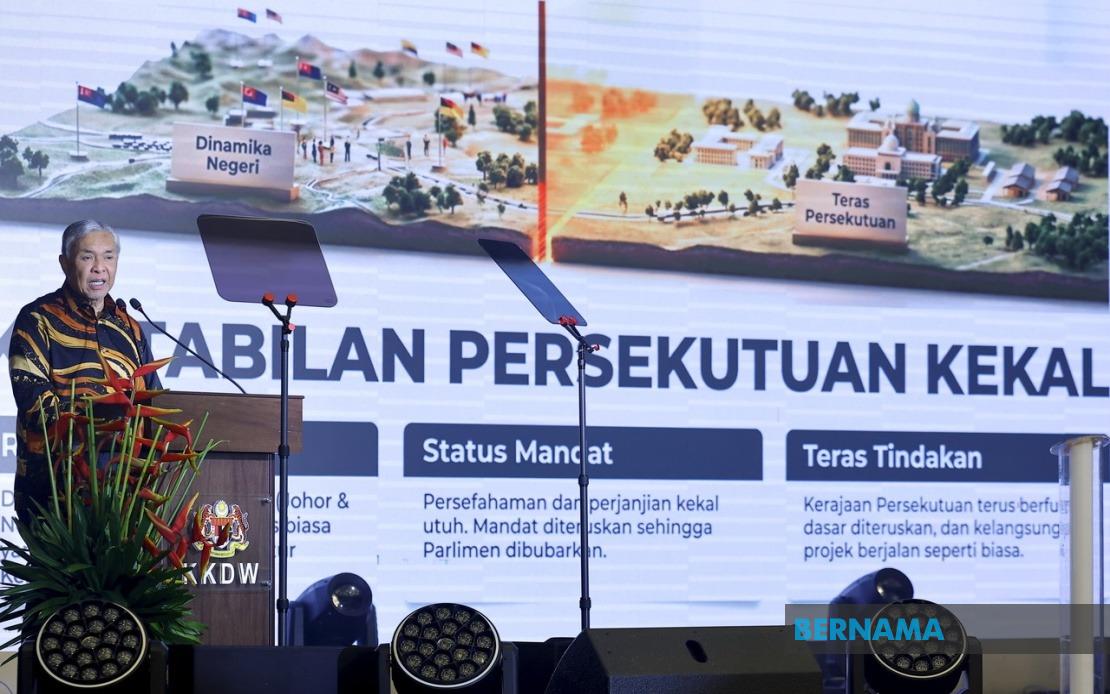
Barisan Nasional has declared ambitious plans to sweep all 21 state assembly seats in Melaka's forthcoming election, signalling the coalition's confidence in its incumbent position despite a shifting political landscape across Malaysia. The announcement came from BN chairman Datuk Seri Dr Ahmad Zahid Hamidi, who relayed the defensive strategy after a Rural and Regional Development Ministry gathering in Putrajaya on August 6.
Melaka Chief Minister Datuk Seri Ab Rauf Yusoh, who simultaneously holds the chairmanship of the state BN division, has personally conveyed the coalition's determination to retain every single seat currently under its control. This represents a show of unified resolve within the Melaka BN machinery, which has governed the state continuously except for a brief interruption in recent years. The complete defence posture signals that BN views its position in Melaka as sufficiently secure to pursue an all-seats strategy rather than focusing resources selectively.
However, the coalition's leadership has tempered expectations with pragmatism, acknowledging that political negotiations are inevitable before the 16th state election materialises. Ahmad Zahid emphasised that while Melaka's leadership remains receptive to exploring potential electoral arrangements with other political entities, any such agreements would require explicit endorsement from BN's central decision-making apparatus. This hierarchical approach ensures that individual state chapters cannot unilaterally commit the broader coalition to arrangements that might conflict with national-level interests or strategic priorities.
The statement reflects a broader pattern in Malaysian politics, where state-level electoral contests frequently become negotiating grounds for larger coalitional mathematics. With BN's current dominance in Melaka and its standing as the governing coalition at federal level, the party occupies a considerably stronger bargaining position than it held during the 2018 general election, when it suffered a historic defeat that saw the coalition ejected from federal power. The psychological and electoral recovery in Melaka represents a microcosm of BN's wider renaissance in peninsular politics following the 2023 general election.
The timing of this announcement, preceding the formal election schedule, allows BN to shape the political narrative around its confidence and readiness for electoral competition. By articulating an all-seats target, the coalition signals to its party members, grassroots supporters, and potential coalition partners that it views Melaka as settled political territory. This positioning also serves to discourage opposition parties from investing substantial resources in what they might perceive as unwinnable contests, thereby compressing electoral competition in advance of polling day.
Melaka's electoral significance within the Malaysian federation extends beyond its modest parliamentary representation. The state has served as a laboratory for various political arrangements, from its period under PKR leadership to its subsequent return to BN governance. The state's trajectory therefore carries implications for understanding voter behaviour in semi-urban and rural constituencies across the Klang Valley region and beyond. Any slippage in BN's performance here could signal broader vulnerability, conversely, a comprehensive victory would reinforce perceptions of declining opposition capacity outside urban strongholds.
The openness to potential arrangements with other parties warrants careful examination, given the coalition constellation in contemporary Malaysian politics. Possibilities might include electoral pacts with PAS, with which BN shares governance in several states, or potentially with independent candidates who carry local credibility. The reference to "understanding with other parties" remains deliberately vague, allowing negotiating space while maintaining the public posture that BN's 21-seat target represents its baseline expectation rather than a minimum threshold.
For Malaysian voters, particularly those in Melaka, this announcement represents an invitation to choose between continuity under BN stewardship and the uncertain prospect of change under fragmented opposition forces. The opposition landscape in Melaka remains considerably fragmented compared to the united front that challenged BN in 2022's state election, when Pakatan Harapan contested heavily. Any fractionalisation of opposition support benefits the incumbent, enabling BN to prevail in three-cornered contests with reduced vote shares.
The broader Southeast Asian context also matters for understanding this announcement. Within the region, Malaysia's governing coalitions remain relatively stable despite occasional perturbations, and BN's confidence in Melaka reflects this broader trend toward coalition consolidation. Should BN successfully execute its all-seats strategy in Melaka, it would represent a confidence-building moment for the coalition's national leadership as it heads toward subsequent electoral tests.
Abmad Zahid's careful formulation of BN's position—simultaneous ambition and flexibility—reflects the operating style of contemporary Malaysian coalitional politics, where leaders must simultaneously satisfy their base, manage internal coalition tensions, and maintain negotiating leverage with potential partners. The decision to commission the Melaka chief minister as the chief spokesperson for this ambition further underscores that electoral strategies in Malaysia remain substantially localised, with state leaders maintaining considerable autonomy over campaign direction within centrally-approved parameters.

