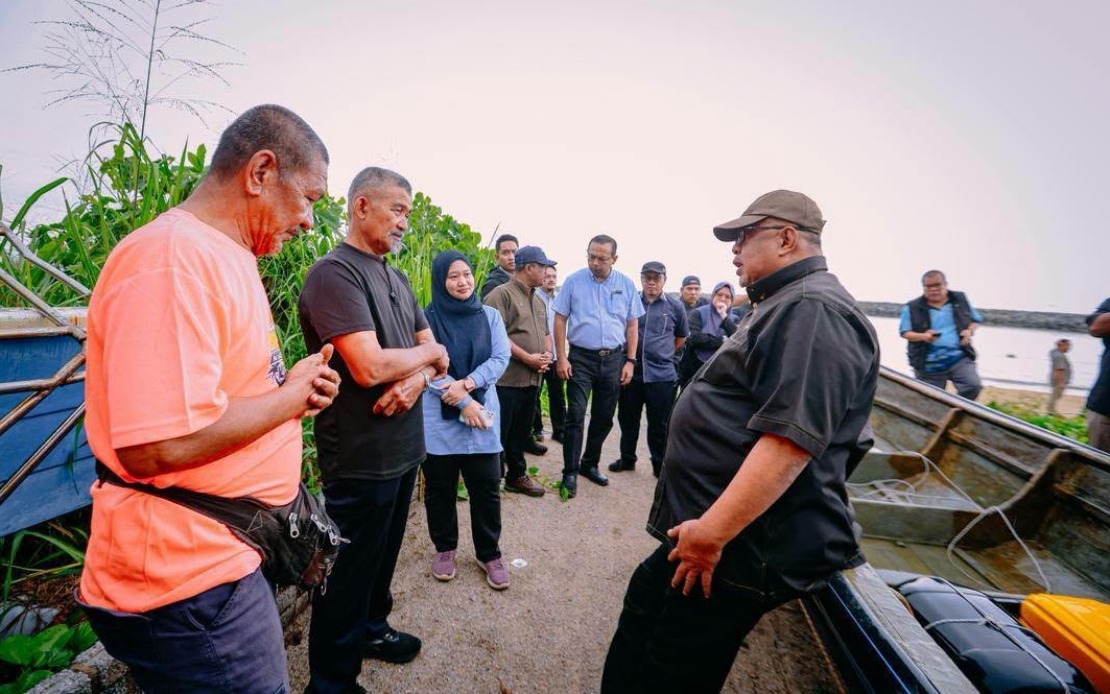
Melaka Chief Minister Datuk Seri Ab Rauf Yusoh has instructed the Public Works Department (JKR) and the Drainage and Irrigation Department (DID) to prioritise resolving challenges affecting fishermen in Pasir Gembur, Tanjung Bidara, after conducting an unannounced visit to the area to assess the new fishermen's complex project and engage directly with residents about their pressing concerns.
The directive emerged following a comprehensive review meeting that brought together stakeholders from the Alor Gajah Municipal Council and other relevant government bodies to evaluate where the development stands and determine the most effective path forward. Ab Rauf emphasised that this was not merely a ceremonial walkabout but a substantive effort to understand and address real difficulties facing the coastal community, underscoring the state administration's commitment to tackling issues with tangible results rather than empty promises.
A central component of the agreed action plan involves DID undertaking a technical feasibility assessment focused on enlarging the waterway that connects Pasir Gembur to Batu Tenggek, a measure designed to facilitate smoother maritime access for fishing vessels. Simultaneously, JKR has been assigned to identify and evaluate alternative locations for the fishermen's facility that would minimise vulnerability to saltwater intrusion and the destructive flooding that accompanies high tidal cycles, problems that currently compromise operations during peak water periods.
The state government has also instituted stricter controls over coastal development, announcing that no further private construction will be permitted within the demarcated wave-breaker zone. Critically, any existing or prospective buildings situated within the designated coastal reserve must now obtain formal authorisation in the form of a Temporary Occupation Licence (TOL) issued by the Land Administrator and must clear technical approval from relevant government departments, establishing a more rigorous regulatory framework to protect the marine environment and community safety.
For Malaysian readers, this situation reflects broader challenges facing fishing communities across the peninsula. Coastal settlements frequently struggle with infrastructure inadequacy, environmental pressures, and the competing demands of development and conservation. Melaka's proactive stance here offers a potential model for other states grappling with similar dilemmas, though success will depend on whether announced measures translate into concrete improvements rather than remaining administrative promises.
The Pasir Gembur fishermen's complex project itself represents an investment in maritime livelihoods at a time when the sector faces mounting pressures from climate change, dwindling stocks, and economic shifts toward tourism and services. A functional, well-sited facility could strengthen the community's resilience by improving market access, storage capacity, and operational efficiency. Conversely, if constructed without adequate environmental safeguards, the complex could exacerbate the very vulnerabilities it aims to address.
The emphasis on deepening navigation channels speaks to a practical understanding that fishing communities require unimpeded water access to remain economically viable. Shallow or obstructed routes force vessels to operate less efficiently, increase operational costs, and create safety hazards. Such infrastructure improvements, while sometimes overlooked in broader development narratives, represent essential enablers of productivity for maritime workers.
Ab Rauf's framing of the visit as an expression of the broader slogan "Melaka Sayang Rakyat" (Melaka Cares for the People) reflects the political currency of responsive governance in contemporary Malaysian politics. State-level administrations increasingly recognise that legitimacy derives from addressing community grievances with demonstrable action rather than symbolic gestures. For voters and residents, the test lies in whether departmental instructions translate into tangible infrastructure, resolved safety concerns, and improved economic conditions within a reasonable timeframe.
The regulatory tightening around coastal structures indicates growing awareness among policymakers of the ecological and public safety implications of uncontrolled development in sensitive zones. The requirement for Temporary Occupation Licences and technical department clearance aims to prevent ad hoc, unauthorised construction that might compromise both environmental integrity and community resilience to natural hazards. This systematic approach, if implemented with consistency and without exemptions, could protect the marine environment while clarifying rights and responsibilities for existing operators.
For Southeast Asian nations confronting similar challenges, Melaka's experience underscores the importance of integrating infrastructure development, environmental protection, and community participation. Fishing communities possess deep knowledge of local marine conditions, tidal patterns, and practical constraints that outsiders often overlook. Government bodies that engage authentically with such stakeholders before finalising technical designs tend to produce solutions that function more effectively and retain community support through implementation phases.
The involvement of multiple agencies—JKR, DID, the municipal council—reflects the cross-sectoral coordination required for coastal management. Water management, land use planning, and infrastructure development cannot be siloed; outcomes depend on genuine institutional coordination rather than parallel departmental efforts that may contradict one another. How effectively Melaka orchestrates this multidepartment engagement will significantly determine project success.
Moving forward, the critical variables involve the speed with which feasibility studies progress, the availability of alternative sites meeting necessary criteria, and the political will to enforce the new regulations equitably rather than selectively. International experience suggests that regulatory frameworks crumble when enforcement becomes discretionary or subject to pressure. Melaka's commitment to protecting the coastal wave-breaker area through consistent application of licensing and approval requirements will signal whether recent announcements reflect genuine policy shifts or temporary rhetorical gestures.
The fishing community's ultimate assessment will rest not on statements or site visits but on concrete improvements: whether channels deepen as promised, whether a relocated complex genuinely minimises flooding and saltwater damage, whether licensing requirements function transparently rather than becoming additional bureaucratic barriers. Success here would validate Melaka's approach and offer instructive lessons for other Malaysian states managing comparable tensions between development, environmental protection, and community welfare.

