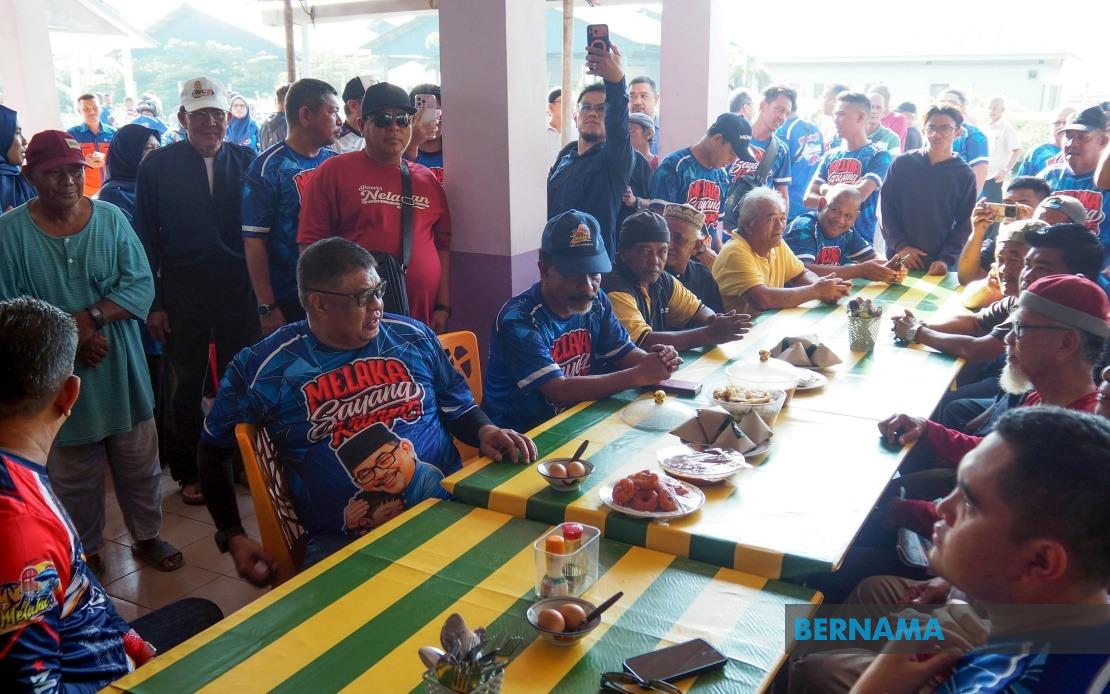
Melaka's state government has unveiled a comprehensive welfare package aimed at modernising the fishing sector and strengthening social protection for the maritime workforce. The announcement, made during a grassroots engagement tour in Jasin, signals a strategic shift toward combining traditional livelihoods with contemporary technology while ensuring adequate safety nets for one of the state's most vulnerable occupational groups.
Chief Minister Datuk Seri Ab Rauf Yusoh unveiled the dual initiative during the fifth stop of his constituency-wide 'Jelajah Ketua Menteri Sayang Rakyat' programme, an outreach effort designed to bring state leadership into direct contact with fishing communities and other stakeholder groups. The tour represents a deliberate administrative approach that prioritises ground-level consultation over office-based policymaking, allowing decision-makers to identify local challenges before formulating responses. This methodology reflects broader governance trends across Malaysian states that emphasise participatory development and responsive administration.
The cornerstones of the initiative are provision of mandatory social security coverage through the Social Security Organisation (PERKESO) for all state-registered fishermen, and distribution of fish finders—electronic devices that use sonar technology to detect schools of fish beneath the water surface. These components address distinct but interconnected challenges facing Melaka's fishing community: the lack of formal safety mechanisms for workers in inherently dangerous maritime conditions, and productivity constraints stemming from reliance on experiential knowledge rather than modern detection technology. By coupling welfare improvement with productivity enhancement, the state government frames fisheries development as both a humanitarian and economic priority.
Immediate implementation included cash assistance distributed to participating fishermen. A total of 107 registered operators each received RM200 under the 'Bantuan Jaring Nelayan' scheme, channelling RM21,400 into the community in direct financial support. Concurrently, authorities distributed 360 kilogrammes of fish valued at RM3,600 to the broader public, averaging approximately 1.5 kilogrammes per recipient. These tangible deliverables demonstrate commitment beyond policy announcement, translating governmental pledges into material benefit accessible to both participants and wider populations.
The fish finder component carries particular significance for operational efficiency. Equipment typically costs between RM1,000 and RM2,000 for private purchase—a substantial capital outlay for individual fishermen operating on thin profit margins. These devices enable operators to identify high-concentration fish zones with precision, permitting targeted net deployment rather than speculative casting based on experience and intuition. Fisherman Amirul Shah Fuad Shah, a 35-year-old maritime worker with two decades of operational experience, emphasised how this technology fundamentally alters daily work processes. The shift from experiential navigation to technology-assisted location represents modernisation that can meaningfully expand catch volumes while reducing fuel consumption and wasted effort associated with unsuccessful fishing expeditions.
The PERKESO extension addresses occupational vulnerability that has long characterised fishing as a livelihood despite its economic necessity. Maritime labour involves exposure to drowning risks, equipment injuries, weather-related hazards, and cumulative physical strain that accumulates over careers spanning decades. Formal social security membership ensures that injured workers, those incapacitated by age or accident, and surviving families of deceased fishermen receive structured financial protection through established governmental mechanisms. For an ageing workforce—Kampung Sempang Fishermen's Association chairman Md Khalil Md Jadi is 67 and noted that many community members are elderly—such coverage transforms social risk from individual burden into collectively managed responsibility.
This initiative carries broader implications for fisheries governance across Southeast Asia. Malaysia's fishing sector supports substantial populations across coastal states, yet regulatory frameworks and welfare provision often lag behind those in manufacturing or services sectors. Melaka's decision to bundle technology adoption with mandatory social security suggests recognition that sustainable maritime livelihoods require simultaneous advancement on multiple fronts: productivity, safety, welfare, and formal integration into national social protection systems. Other Malaysian states and regional governments may view this model as replicable template for upgrading smallholder fishing communities.
The technology component also signals state investment in agricultural and maritime modernisation that moves beyond simple subsidy provision. Fish finders represent capital goods that increase productivity without displacing labour or fundamentally altering catch methods. This contrasts with certain technology adoptions that risk accelerating resource depletion or marginalising traditional practices. By introducing tools that enhance precision rather than scale of operations, Melaka's approach maintains alignment with conservation principles while improving individual operator incomes—a balancing act crucial for long-term sectoral sustainability.
Community reception has been notably positive, with both fishermen and association leadership expressing gratitude and recognising meaningful difference these measures will produce. Amirul Shah's comments reflected practical understanding that equipment costs constitute real barriers to productivity improvement, while Md Khalil Md Jadi's appreciation of social security extension acknowledged state recognition of fishing as legitimate work deserving formal protection rather than informal coping. Such receptivity suggests the initiatives address genuine needs rather than imposing top-down solutions disconnected from ground realities.
The financial commitment involved—RM21,400 in direct assistance plus equipment provision—reflects state budgetary allocation toward a relatively small but economically important population segment. Such targeted spending, when combined with governance models that prioritise consultation, can generate disproportionate impact by addressing bottleneck constraints that prevent broader economic activity. For fishermen currently unable to afford fish finders or lacking social security enrollment, these barriers may suppress productivity and leave workers vulnerable to health or income shocks; removing such constraints can catalyse significant welfare improvements and productivity gains.
Looking forward, implementation effectiveness will depend on sustained commitment beyond the initial announcement phase. Fish finder distribution must include training ensuring operators can effectively utilise technology; PERKESO coverage requires clear communication regarding claims procedures and benefit entitlements; and integration of technology into established maritime practices requires time and adjustment. Monitoring outcomes through subsequent administrative cycles will indicate whether this initiative represents genuine structural improvement or symbolic gesture with limited practical consequence.
Melaka's programme also potentially informs broader Malaysian policy discussions around informal sector protection and technology-enabled rural development. Fishing represents one of several occupational groups—small-scale agriculture, street vending, household manufacturing—where workers lack formal employment arrangements and remain outside standard social protection mechanisms. Replicating the integrated approach of technology plus welfare coverage across other sectors could substantially expand national social security coverage while simultaneously improving productivity and incomes for vulnerable populations dependent on informal economic activity.

