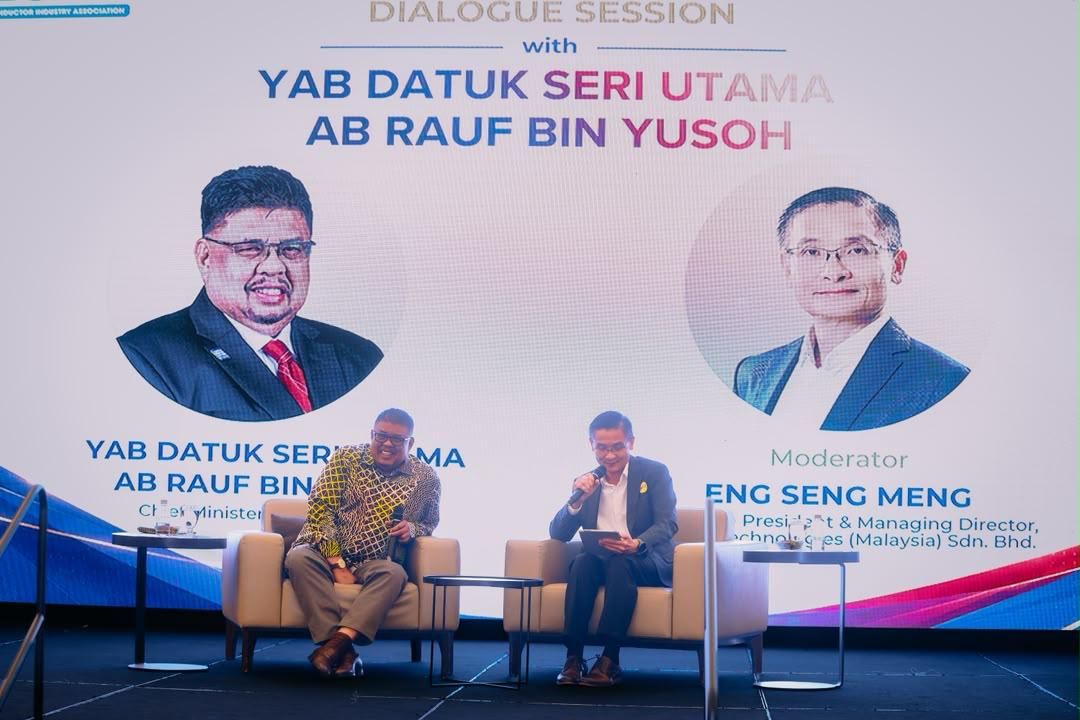
Melaka's semiconductor and electrical and electronics sector has blossomed into an economic powerhouse worth RM17.6 billion, according to Chief Minister Datuk Seri Ab Rauf Yusoh, who highlighted the sector's remarkable transformation from humble beginnings to a globally competitive industrial base. Speaking at an industry dialogue on Thursday, Ab Rauf traced the sector's origins to the early 1970s when the first major international investment took root, establishing what would become one of Malaysia's most significant technology hubs and demonstrating the long-term potential of strategic industrial positioning in Southeast Asia.
The genesis of Melaka's semiconductor dominance occurred when an international manufacturer made a daring decision to establish operations in the state, initially operating from an unconventional location at an Umno building along Jalan Hang Tuah before eventually relocating to Batu Berendam following the creation of Melaka's first Free Industrial Zone in 1976. This pioneering investment became the catalyst for exponential growth, transforming what began as a skeleton operation staffed by a handful of workers into a sophisticated, world-class manufacturing ecosystem that now drives substantial economic activity across the state and contributes meaningfully to Malaysia's global standing in semiconductor manufacturing.
The scale of Melaka's manufacturing success extends well beyond semiconductors alone. The sector now accounts for 36.1 percent of the state's total economy, with over 400 manufacturing companies distributed across 18 different industrial sectors. This diversification underscores how an initial concentration in one technological domain created the institutional knowledge, infrastructure and human capital foundation necessary to support complementary industries, creating a resilient economic structure capable of attracting diverse multinational investors seeking locations with proven manufacturing excellence and developed supply ecosystems.
The economic ripple effects throughout Melaka's population have been substantial and sustained. Beyond the multinational corporations themselves, the semiconductor and electronics ecosystem sustains local suppliers, numerous small and medium enterprises, a technically skilled workforce, and thousands of families whose prosperity depends directly or indirectly on the health of the manufacturing sector. Over five decades, this industry has effectively shifted Melaka's economic profile from a modest trading port into a modern industrial state, creating employment pathways for successive generations and establishing the state as a credible alternative to more established regional manufacturing hubs.
Ab Rauf attributed Melaka's sustained competitive advantage to three interlocking strengths that remain difficult for rival locations to replicate. The state's geographical position between Kuala Lumpur, Johor and Singapore provides investors with unparalleled access to major regional markets, deep-water ports, major airports, established supplier networks and a substantially larger talent pool than would be available in more isolated locations. Operationally, Melaka maintains compelling cost advantages relative to more developed metropolitan areas while avoiding the underdeveloped infrastructure challenges that characterise more remote alternatives, creating a genuinely balanced proposition for cost-conscious manufacturers.
Infrastructure readiness represents another significant competitive edge. Melaka currently possesses more than 2,600 hectares of serviced industrial land available for development, offering multinational manufacturers genuine flexibility to scale operations as market demand expands without the regulatory delays or land acquisition complications that plague many regional alternatives. This available capacity signals to prospective investors that expansion possibilities exist within the state, reducing the likelihood that successful operations will eventually relocate to capture growth opportunities elsewhere in the region.
The state's positioning as a technical and vocational education hub strengthens its appeal considerably, particularly as manufacturers increasingly prioritise workforce quality and industry-ready competence. Melaka now hosts 61 TVET institutions deliberately aligning curricula with the evolving technological requirements of contemporary semiconductor and electronics manufacturers, creating a virtuous cycle where industry advancement drives educational innovation, which in turn produces graduates capable of supporting further technological progress and manufacturing sophistication.
The confidence multinational corporations have demonstrated in Melaka manifests in their sustained, long-term commitment to the state. Companies from the United States, Germany, China, Japan and numerous other countries have maintained and expanded operations in Melaka for over five decades, a durability that reflects far more than historical accident. This consistency demonstrates that Melaka has successfully maintained the political stability, regulatory reliability, business-friendly governance and investment certainty that multinational enterprises prioritise when committing substantial capital and technological expertise to any location.
This investor confidence translated into unprecedented investment during 2025, with Melaka attracting RM14.68 billion across 312 separate projects, representing the highest annual investment value the state has achieved in 22 years. This recent surge indicates that despite global economic uncertainty and intensifying competition from rival manufacturing jurisdictions throughout Asia and beyond, Melaka's fundamental value proposition remains compelling to sophisticated international investors conducting rigorous site-selection analyses.
Yet Ab Rauf sounded a cautionary note regarding the defining period now confronting the semiconductor industry globally. Investment decisions made in the current environment are expected to determine the geographic location of technological development, talent concentration, supplier networks and expansion opportunities for the subsequent 10 to 20 years. This extended investment horizon means that any hesitation or competitive loss in the immediate term could translate into decades of diminished opportunity as multinational corporations embed operations in alternative locations with superior execution capabilities or faster decision-making processes.
The Chief Minister warned explicitly that complacency threatens Melaka's accumulated advantages. Should the state fail to match the pace and responsiveness demonstrated by competitor jurisdictions, global companies may redirect new investments toward locations perceived as offering faster implementation, more sophisticated technical capabilities or greater operational certainty. Beyond simply forgoing new manufacturing projects, this competitive failure could trigger the loss of expansion initiatives from existing multinational tenants, alongside corresponding contraction in supporting supplier industries and ancillary employment opportunities. Local SMEs deeply integrated into global semiconductor supply chains would face particular vulnerability, potentially excluded from future value chain opportunities if Melaka's position as a preferred manufacturing destination deteriorates.
To address these competitive imperatives, Melaka is implementing the Semiconductor Strategy 2035, explicitly designed to attract higher-value manufacturing investments, develop deeper local technological capabilities and ensure the state remains a destination of choice for multinational semiconductor players contemplating long-term regional commitments. The strategy recognises that infrastructure and financial incentives alone prove insufficient; sustained success requires demonstrating genuine government commitment to accelerating approvals, resolving operational obstacles and supporting investors through the complete project lifecycle from initial planning through commercial implementation and expansion phases.
Ab Rauf emphasised that beyond tangible infrastructure, Melaka's principal advantage resides in the complete value proposition it presents to investors: strategic geographic connectivity, genuinely competitive operating costs, access to world-class technical talent, a proven and sophisticated industrial ecosystem spanning five decades, and a state government unequivocally committed to facilitating long-term investment success. This multifaceted positioning, sustained consistently across changing global economic conditions, establishes Melaka not as a temporary manufacturing location but as a permanent feature of the global semiconductor supply chain architecture.

