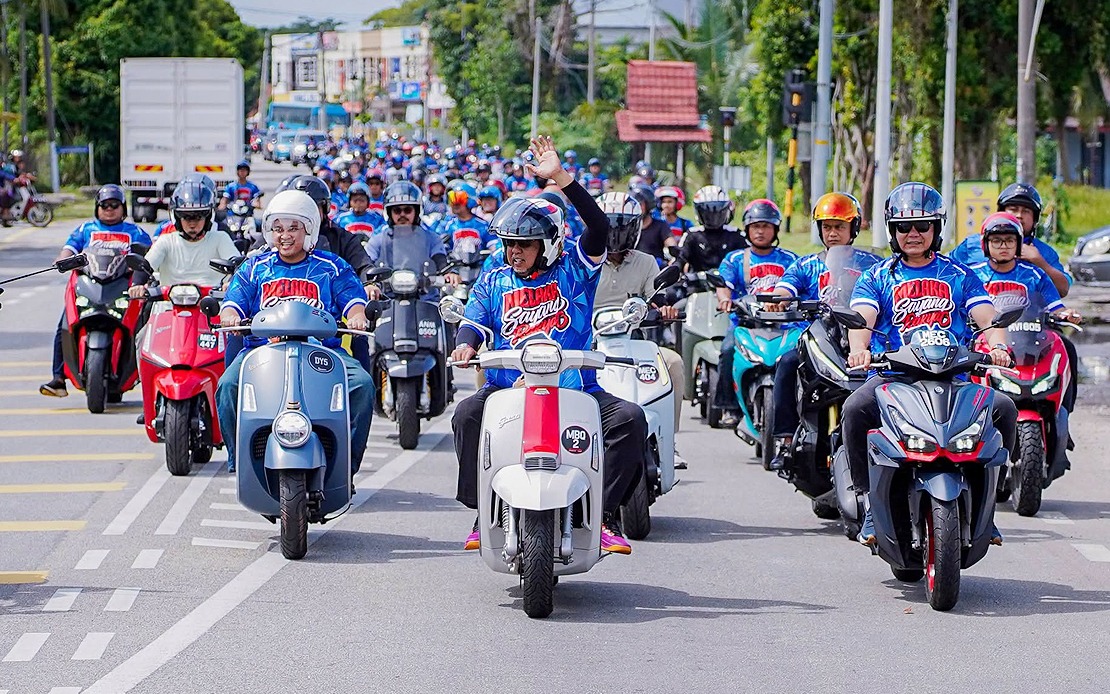
Melaka Chief Minister Datuk Seri Ab Rauf Yusoh has expanded the state's WRUR grassroots engagement programme into the Tangga Batu parliamentary constituency, launching a two-phase community outreach drive that will span the Pantai Kundor and Paya Rumput state constituencies. The initiative represents a deliberate scaling-up of direct engagement with residents across multiple demographic and economic segments, reflecting the Melaka government's commitment to sustained ground-level interaction beyond seasonal electoral cycles.
The expanded WRUR programme will encompass more than 200 distinct initiatives across a broad spectrum of community priorities. These range from welfare support and social development programmes through to education, youth engagement, and entrepreneurship promotion, complemented by targeted efforts to diagnose and resolve locally specific grievances that have accumulated among constituents. This multifaceted approach signals recognition that grassroots legitimacy requires systematic responsiveness across multiple governance domains rather than sporadic intervention.
Ab Rauf characterised WRUR not as an ad hoc campaign but as the institutionalisation of continuous ground engagement methodology refined over a two-year implementation period. This framing carries significance for understanding how Malaysian state governments are adapting their outreach strategies in an era of tighter electoral competition and rising constituent expectations around government accessibility. The programme's emphasis on consistency and systematic follow-up distinguishes it from traditional seasonal grassroots visits that typically intensify around election cycles.
Data from the initiative's 23 previous implementation series demonstrates measurable traction in complaint resolution. The programme has accumulated over 4,000 complaints from constituents across prior phases, with nearly 70 per cent achieving successful resolution. In the Tangga Batu constituency specifically, earlier implementation in the Sungai Udang and Kelebang state constituencies yielded 359 complaints, of which 328 were resolved while 31 remained under active follow-up. These figures suggest a functional complaint management system capable of converting community grievances into concrete administrative responses.
The timing of the Tangga Batu launch carries immediate contextual weight, following recent flooding that devastated parts of the parliamentary constituency. The Pantai Kundor area experienced flash flooding affecting 73 residential properties, underscoring the programme's relevance to urgent and pressing local concerns. Such natural disasters tend to expose critical gaps in infrastructure maintenance and emergency response coordination, making the WRUR programme's community-centric approach particularly pertinent to constituencies vulnerable to recurring environmental hazards.
Distribution of over RM150,000 in targeted assistance during the sixth phase of implementation reflected the programme's sectoral specificity. The allocation prioritised economically vulnerable occupational groups, including RM22,000 channelled to 220 fishermen, RM1,500 to five boat owners affected by maritime incidents, and RM14,000 in business equipment for ten SME entrepreneurs. Additional support extended to religious institutions, places of worship, students, and homeowners requiring assistance, indicating a deliberate strategy to embed support across community infrastructure and vulnerable households simultaneously.
Infrastructure remediation formed a critical concurrent strand of the initiative, directly addressing the flooding crisis that preceded the launch. The Department of Irrigation and Drainage allocated RM50,000 for cleaning and maintenance of Sungai Seberang Gajah, with completion targeted within the following week. More substantially, the department initiated procurement processes for RM100,000 in improvement works at Sungai Lereh, while the Public Works Department pursued federal approval for a RM16 million upgrade to the Jalan Tangga Batu-Tanjung Minyak crossing culvert structure.
These infrastructure commitments reveal how the WRUR programme functions as a systematic mechanism for identifying and escalating structural deficiencies to higher administrative and financial authority. The progression from routine maintenance to major capital projects suggests that complaint aggregation through grassroots engagement can create evidentiary foundations for larger development allocations that might otherwise remain unaddressed within standard budgeting cycles. This creates feedback loops between constituent concerns and state-level resource allocation.
For Malaysian readers and those observing Southeast Asian political developments, the Melaka model illustrates an emerging trend of state governments institutionalising continuous constituent engagement frameworks rather than relying primarily on periodic electoral messaging. In a regional context where electoral competition has intensified and constituent expectations around government responsiveness have risen, programmes like WRUR signal recognition that governing legitimacy increasingly depends on demonstrable systems for capturing, responding to, and resolving community grievances between elections.
The WRUR programme's emphasis on measurable outcomes—complaint tracking, resolution rates, financial disbursement documentation, and infrastructure project initiation—suggests growing governmental sophistication in translating grassroots engagement into quantifiable performance metrics. This approach offers potential lessons for other Malaysian state governments seeking to strengthen local credibility through transparent and systematic responsiveness mechanisms, particularly in constituencies experiencing economic vulnerability or environmental hazards.
The Tangga Batu expansion represents a test case for programme scalability and sustainability. With over 200 initiatives planned across two state constituencies, the administrative capacity required to manage complaints, coordinate assistance distribution, and oversee concurrent infrastructure projects will demand substantial bureaucratic coordination. The success or challenges encountered in this expanded phase will likely inform whether similar programmes proliferate across other Malaysian state administrations seeking to strengthen their legitimacy through enhanced grassroots engagement.
Looking forward, the WRUR initiative in Tangga Batu demonstrates how crisis moments such as flooding can be leveraged to strengthen broader governance legitimacy through integrated responses that combine immediate relief, grievance resolution infrastructure, and medium-term infrastructure remediation. This integrated approach reflects maturation in state-level governance strategy, moving beyond reactive emergency response toward systems that embed community-identified priorities into regular administrative processes.

