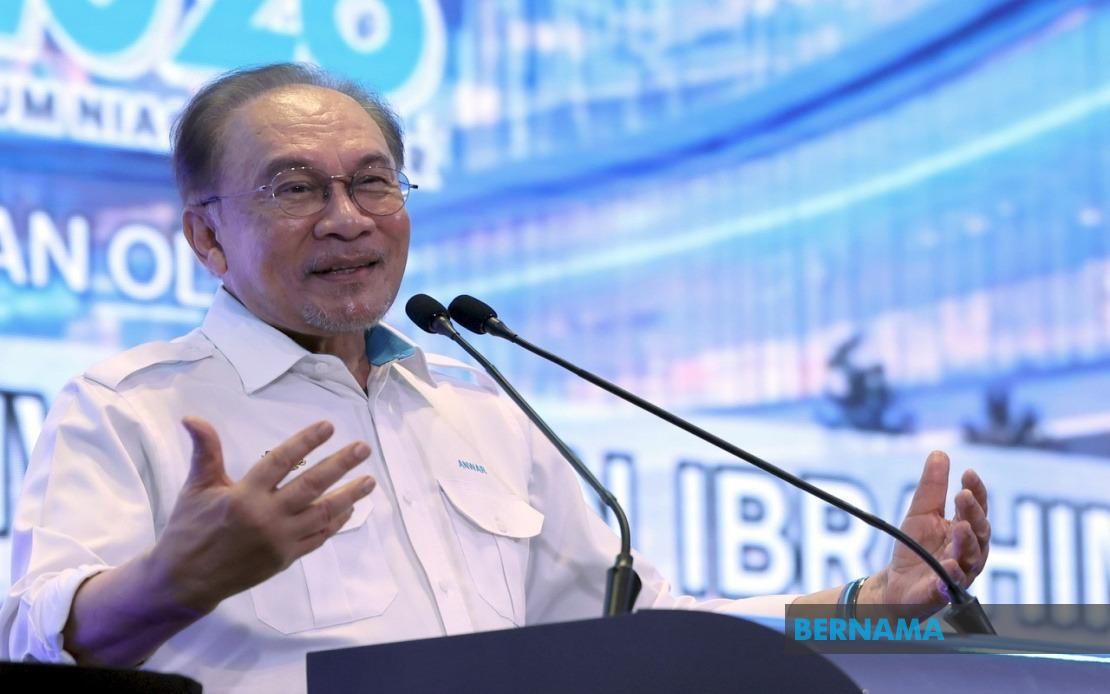
Prime Minister Datuk Seri Anwar Ibrahim has challenged conventional wisdom on how Malaysia should nurture its Bumiputera entrepreneurial class, arguing that seasoned business leaders must take the helm in guiding the next generation rather than leaving development efforts to government-directed policies. Speaking at the launch of SPaRK 2026 in Putrajaya, Anwar stressed that the most effective transfer of entrepreneurial knowledge comes from those with hands-on experience navigating Malaysia's complex commercial landscape, not from theoretical frameworks imposed from above.
The Prime Minister's remarks reflect a fundamental philosophical shift in how policymakers view entrepreneurial development. Rather than positioning government agencies as primary architects of business growth, Anwar envisioned a model where successful entrepreneurs act as mentors and guides, drawing on their accumulated wisdom about working capital management, market dynamics, and supply chain realities. He distinguished between government's supporting role—what he termed "motivators"—and the irreplaceable expertise of business practitioners who understand the granular details of operations that determine success or failure.
This perspective carries particular weight in Malaysia's context, where Bumiputera entrepreneurship has long been shaped by policy interventions and government support mechanisms. The traditional top-down approach has yielded mixed results, with some initiatives producing sustainable businesses while others have struggled to achieve their developmental goals. Anwar's critique suggests recognition that policy alone cannot substitute for the practical mentoring relationships that help entrepreneurs navigate real-world challenges such as supplier negotiations, pricing strategies, and competitive positioning.
The Prime Minister specifically encouraged successful business owners to move beyond conventional speaking engagements and instead establish deeper collaborative relationships with emerging companies. This proposal implies a structural change in how mentorship occurs—transforming it from occasional knowledge-sharing sessions into sustained partnerships where experienced entrepreneurs invest time and credibility in helping newcomers avoid costly mistakes and seize market opportunities. Such arrangements would naturally align the interests of mentors with mentees, as successful proteges reflect well on their guides.
The SPaRK 2026 platform, formally launched during the event, represents the practical vehicle for implementing these principles. Administered by Perbadanan Usahawan Nasional Bhd (PUNB), the initiative targets financing approvals totalling RM2.25 billion through 2030, a substantial commitment aimed at transforming how Bumiputera entrepreneurs access capital and development support. Rather than simply distributing funds through bureaucratic channels, the framework appears designed to create ecosystems where mentorship, financing, and commercial opportunities converge.
The R30 Strategic Framework underlying SPaRK 2026 articulates four interconnected objectives that reflect Malaysia's broader economic ambitions. Accelerating Bumiputera company growth addresses historical disparities in business ownership and wealth creation within the community. Enhancing commercial scaling capabilities tackles a persistent challenge where many Bumiputera firms plateau at modest revenue levels rather than achieving the expansion necessary for regional competitiveness. Creating quality employment opportunities aligns entrepreneurial development with broader social objectives of meaningful job creation. Strengthening supply chain participation positions Bumiputera enterprises as integral components of Malaysia's industrial ecosystem rather than peripheral players.
For Malaysian and Southeast Asian readers, Anwar's emphasis on peer mentorship versus top-down governance holds implications extending beyond Bumiputera entrepreneurship. The region's economies increasingly recognise that sustainable competitive advantage emerges from deep business ecosystems where knowledge flows freely among practitioners. Countries investing primarily in government-administered programs sometimes find that capital alone does not overcome knowledge gaps or market access barriers. By contrast, jurisdictions fostering organic mentorship networks among entrepreneurs—where successful founders actively guide newcomers—tend to generate more resilient business communities.
The timing of this initiative also reflects Malaysia's economic positioning as it seeks to diversify beyond traditional sectors and develop higher-value entrepreneurial activity. Manufacturing, services, technology, and digital commerce all require business leaders who understand contemporary market dynamics. Government policies cannot teach the intuitive decision-making that comes from managing operations during market downturns, negotiating with large customers, or pivoting when initial strategies prove unworkable. Only entrepreneurs who have navigated these experiences can credibly guide others through similar challenges.
Anwar's framing also addresses a persistent critique of Malaysia's entrepreneurship development efforts: that resources sometimes flow to connected individuals or politically favoured groups rather than to genuinely talented entrepreneurs with viable business models. A mentorship-based approach creates different accountability mechanisms. Experienced entrepreneurs staking their reputations on proteges have strong incentives to ensure those individuals possess real competence and genuine business prospects. This reputational mechanism supplements—and potentially improves upon—government evaluation criteria for capital allocation.
The financing commitment under SPaRK 2026 merits scrutiny regarding implementation. RM2.25 billion spread across five years represents approximately RM450 million annually for Bumiputera entrepreneurial development. Whether these resources flow efficiently to viable businesses or become dispersed across marginal ventures will significantly influence the program's ultimate impact. The success criteria should include not merely disbursement targets but measures of business survival, revenue generation, and employment creation among funded enterprises.
Looking forward, the effectiveness of Anwar's mentorship-centred approach depends on cultivating genuine participation from Malaysia's most accomplished entrepreneurs. Building such engagement requires incentive structures—whether through recognition, networking opportunities, or formal recognition of mentorship contributions—that motivate successful business leaders to invest time in developing others. Without such incentives, even well-designed programs may struggle to attract the calibre of mentors necessary for transforming Bumiputera entrepreneurial capabilities.
The Prime Minister's vision ultimately reflects maturation in how Malaysia approaches entrepreneurial development. Rather than viewing government as the primary architect of business success, this approach acknowledges that governments excel at creating enabling conditions—access to financing, regulatory frameworks, infrastructure—while entrepreneurs themselves drive actual business creation and growth. For Malaysia's Bumiputera community, this reorientation could generate more sustainable competitive advantages than previous policy iterations, provided the initiative succeeds in mobilising Malaysia's entrepreneurial talent as mentors and guides for the next generation of business builders.

