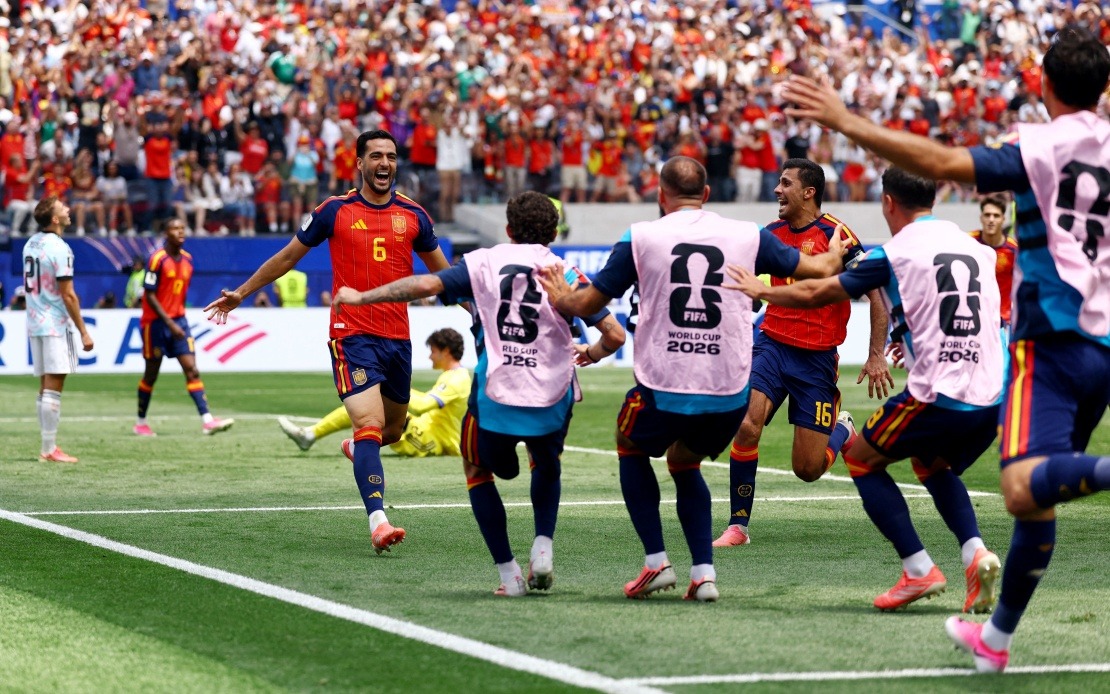
Spain has secured a berth in the World Cup semi-final by defeating Belgium 2-1 at a venue in Los Angeles County on Friday, setting up a highly anticipated clash with tournament favourites France. The European champions demonstrated their superiority throughout the match, with substitute Mikel Merino providing the decisive moment late in proceedings when he converted from close range after Belgian goalkeeper Senne Lammens failed to handle a long-range attempt from Pau Cubarsi.
Fabián Ruiz had opened the scoring for Spain in the 30th minute, establishing an early advantage that underscored the Spanish side's control of play. However, Belgium mounted a response through Charles De Ketelaere's equaliser, which came as a significant moment for the Belgians as it marked the first goal conceded by Spain's goalkeeper Unai Simón across two consecutive World Cup tournaments, ending a remarkable streak of 649 minutes without conceding.
Belgium's performance was substantially hampered by the absence of key personnel in their midfield. Captain Youri Tielemans was forced to withdraw during the warm-up phase due to an apparent hamstring issue, compounding the absence of midfielder Amadou Onana, who had suffered a knee ligament tear in earlier proceedings. These personnel losses meant Belgium operated at diminished capacity, unable to maintain the midfield control required to compete with Spain's possession-based approach.
Further complications emerged for Belgium when their experienced goalkeeper Thibaut Courtois sustained an injury in the 71st minute and had to leave the pitch. His replacement, Manchester United's Lammens, proved vulnerable during a critical moment when facing Spain's intensified attacking play in the final stages. The goalkeeper's error directly led to Merino's decisive goal, illustrating how substitute players entering the match can become pivotal factors in tournament football.
Merino's impact exemplifies the Spanish squad's depth and tactical flexibility. The Arsenal midfielder, who similarly came off the bench to determine Spain's previous knockout match against Portugal in the last-16 stage, demonstrated the value of quality substitutes in high-pressure environments. His positioning and finishing ability allowed Spain to convert their dominant territorial control into a winning margin.
The forthcoming encounter with France represents one of the tournament's most compelling semi-final matchups. The meeting near Dallas on Tuesday will constitute a rematch of the Euro 2024 semi-final, which Spain won decisively. France enters the contest as tournament favourites despite their challenging path, having reached the semi-finals as runners-up in the 2022 World Cup when Argentina claimed the title. The French side won the World Cup in 1998 and 2018, establishing themselves as one of football's elite nations.
Spain's trajectory demonstrates why they must be regarded as serious contenders for the tournament. Beyond their Euro 2024 success, the Spanish side's sole World Cup triumph came in 2010, representing a 14-year absence from the sport's pinnacle achievement. Their return to the semi-final stage suggests the current generation possesses the quality and maturity to pursue their second World Cup crown.
France's awareness of Spain's credentials is evident in their acknowledgment that they will face their most formidable opposition to date. Spain's comprehensive dominance over Belgium, despite the Belgian side's injury complications, showcases the Spanish approach to tournament football: methodical possession, patient build-up play, and clinical conversion when opportunities emerge. France's attack-minded capabilities will need to be balanced against the need to contain Spain's creative midfield orchestration.
The semi-final presents fascinating tactical contrasts. Spain's demonstrated ability to recover from conceding, combined with their ability to maintain possession and control tempo, contrasts sharply with France's tradition of flexibility and counterattacking prowess. Both nations have proven tournament winners, and both possess players capable of delivering decisive moments under extreme pressure. The veteran goalkeeper Unai Simón will likely be seeking to extend his continental record, while France's attacking arsenal continues to pose significant threats to any defensive arrangement.
Belgium's elimination marks another World Cup campaign where the nation's ambitions have fallen short of expectations, a pattern that has characterised their recent tournament experiences. The injury toll on their squad, particularly the loss of Tielemans and Onana, prevented them from demonstrating their full capabilities against an increasingly dominant opponent. Their inability to press Spain's goalkeeper into errors until too late in the match proved costly.
For Malaysian and Southeast Asian football observers, the Spain-France semi-final represents the tournament's highest quality at this stage, showcasing the depth of talent and tactical sophistication within European football. Spain's consistency in retaining possession and dictating match tempo provides instructive examples for developing football nations seeking to improve their strategic approaches. The semi-final will determine whether Spain can finally return to a World Cup final or whether France's experience and depth will prevail in what promises to be an engaging contest.

