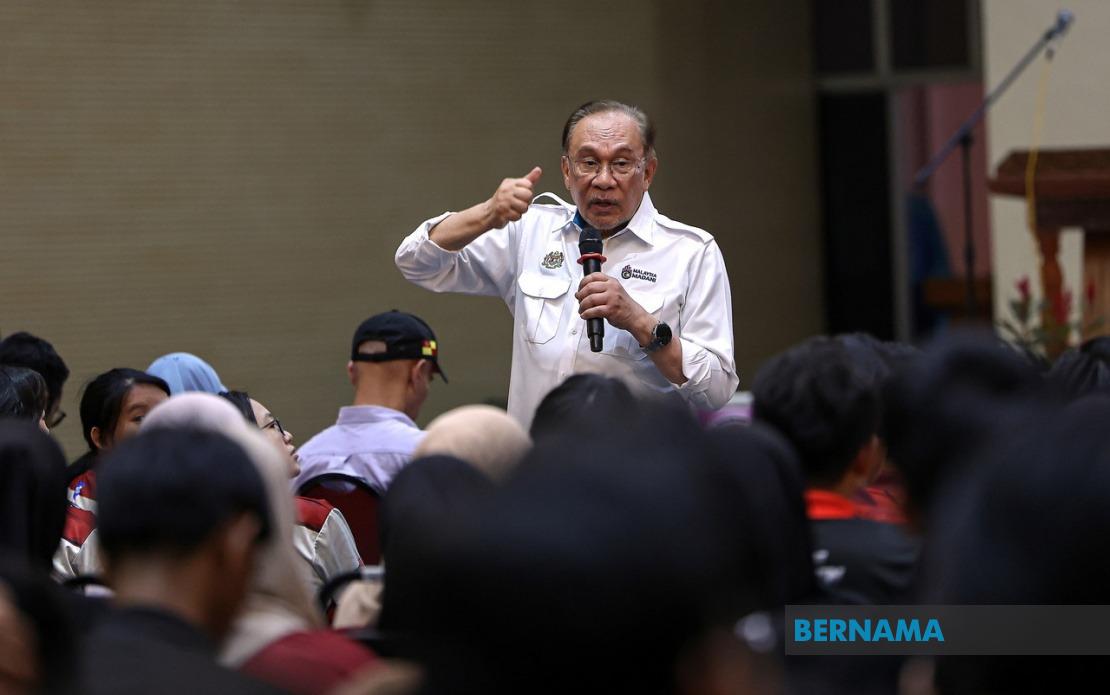
Prime Minister Datuk Seri Anwar Ibrahim has set out a nuanced vision for matriculation admissions that seeks to reconcile two competing priorities: recognising exceptional academic achievement and ensuring educational opportunities reach Malaysia's most marginalised communities. Speaking at the Jelajah Rakan Muda programme in Seremban on Monday, Anwar articulated an approach that eschews a purely merit-based system in favour of one that considers both talent and circumstance.
At the heart of the government's strategy lies an automatic entry mechanism for students who achieve the highest academic distinction. Any pupil who secures ten A's in the Sijil Pelajaran Malaysia examination will gain guaranteed admission to matriculation programmes, irrespective of ethnic background. This represents a significant commitment to identifying and nurturing Malaysia's brightest young minds, sending a clear signal that excellence—wherever it originates—will be recognised and rewarded. The removal of racial barriers for top performers signals an important shift towards recognising individual achievement as the primary determinant of advancement for those who have demonstrated exceptional capability.
Yet Anwar was equally emphatic about preserving mechanisms designed to support students from disadvantaged backgrounds. The Bumiputera quota system will remain in place, he stressed, acknowledging its role in addressing demographic realities and assisting communities that face structural barriers to educational access. This quota serves a distinct purpose beyond simple numerical representation: it targets students from rural areas, interior regions, and the East Malaysian states of Sabah and Sarawak—territories where educational infrastructure remains underdeveloped and where family income levels are often insufficient to provide private tutoring or supplementary education.
The dual approach reflects a recognition that merit alone cannot address educational equity in a nation with pronounced regional disparities. While SPM results provide an objective measure of academic preparation, they do not capture the additional obstacles faced by rural students who may attend schools with fewer resources, less experienced teachers, or limited access to examination preparation materials. The matriculation system, as Anwar has framed it, attempts to balance the legitimate desire to identify capable students with the social imperative to prevent excellence from becoming concentrated among the already advantaged.
This policy stance carries particular significance for Southeast Asian education systems grappling with similar tensions. Malaysia's approach—explicit acknowledgment of both meritocratic and equity principles—offers a middle path between pure academic selection and purely quota-based systems. For neighbouring countries managing their own tensions between access and excellence, the Malaysian model provides a template worth studying, demonstrating that these principles need not be mutually exclusive.
The announcement came during an official engagement with youth, with Youth and Sports Minister Dr Mohammed Taufiq Johari present at the Paroi Youth and Sports Complex. This venue choice itself signals the government's commitment to youth development beyond formal education structures, positioning the matriculation policy within a broader narrative about investing in young Malaysians across multiple dimensions.
For parents and students nationwide, the policy offers clarity on two fronts. High achievers can pursue top-tier tertiary education without facing quotas or demographic eligibility requirements, providing genuine incentive for academic excellence. Simultaneously, students from underrepresented regions and communities will continue to have structured pathways into prestigious programmes, preventing a scenario where concentrated advantage perpetuates across generations. This dual guarantee attempts to address both social mobility aspirations and equity concerns.
The preservation of Bumiputera quotas in matriculation admissions also reflects practical acknowledgment of Malaysia's constitutional framework and historical social compacts. Rather than presenting these as relics requiring dismantling, Anwar has reframed them as legitimate policy tools serving contemporary educational equity goals. This rhetorical repositioning may help resolve long-standing debates by emphasising function over tradition—the quota exists not primarily to protect privilege but to counteract demonstrable disadvantage.
However, the policy's effectiveness will ultimately depend on implementation details not yet fully disclosed. How are students from rural areas identified? What happens when top performers are unevenly distributed geographically? Do quotas apply flexibly depending on applicant pools, or remain rigid regardless of qualification levels? These operational questions will determine whether the policy achieves genuine balance or creates new inequities through administrative rigidity.
The matriculation system itself serves as a crucial funnel into Malaysia's universities, making intake policies consequential for entire career trajectories. With limited places available, decisions about allocation directly shape who enters professional classes and leadership pipelines. By maintaining that both academic excellence and equitable access matter, Anwar has staked out political territory acknowledging that education policy cannot be purely technical—it must also respond to social expectations about fairness and opportunity.
For international observers and policy researchers, Malaysia's matriculation approach exemplifies how middle-income nations attempt to pursue simultaneous goals of world-class performance and inclusive opportunity. The genuine challenge lies not in policy announcement but in managing inevitable tensions when quotas compete with top-tier places, or when demographic targeting conflicts with identifying the absolute highest achievers. Success requires sustained commitment to data-driven refinement and willingness to acknowledge when policy adjustments become necessary.

