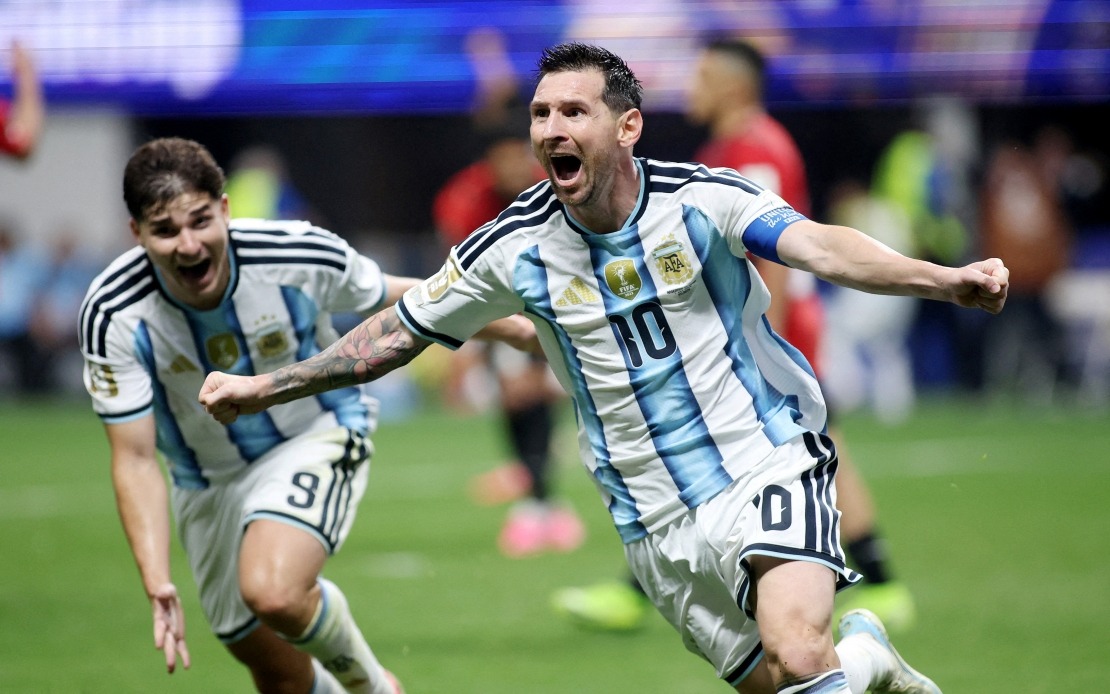
Argentina's Lionel Messi stands on the brink of another World Cup milestone as he prepares to face England in Atlanta on Wednesday, aiming to add another chapter to one of sport's most decorated careers. The 39-year-old's presence in North America this summer has already defied expectations and rewritten several records, cementing his status as arguably the greatest player of his generation despite being well into what many assumed would be his final years as a professional.
Messi's 2022 triumph in Qatar represented what appeared to be a fairytale conclusion to his World Cup odyssey. Leading Argentina to the championship at age 35, he netted seven goals including two decisive strikes in the final, as the South American nation overcame France in a penalty shootout. That victory felt particularly poignant, given the squad's evident determination to secure the crown before their talismanic captain retired. Yet the script has deviated sharply from that expected denouement, with Messi not only returning but once again proving himself a central force in Argentina's campaign.
The statistical narrative this tournament tells is remarkable. Messi has matched France's Kylian Mbappé at the top of the scoring charts with eight goals, though Mbappé retains a technical advantage through superior assist numbers and minutes played. England's Harry Kane and Jude Bellingham trail with six goals each, while other challengers have fallen away—notably Erling Haaland, whose early elimination from the tournament has cleared a potential rival from contention. The competition for the Golden Boot has crystallised into a two-horse race between the Argentine and French stars, a rivalry that has come to define modern international football at its highest level.
What elevates Messi's current performance beyond mere statistics is the accumulation of lifetime records he continues to accumulate. His tally of 21 World Cup goals stands as a monument to his consistency across multiple tournaments, though Mbappé lurks dangerously close with 20, poised to surpass him in the coming years if he maintains his trajectory. The pair have decisively eclipsed Miroslav Klose's previous benchmark of 16 goals, a feat that underscores how the modern game's elite have transcended earlier standards. Harry Kane, at 14 goals, has also climbed the all-time rankings with surprising speed, suggesting that the upper echelon of international goalscoring has fundamentally shifted.
Beyond the goal tallies, Messi and Cristiano Ronaldo achieved an unprecedented distinction by becoming the first male players to appear in six World Cup tournaments. Both have surpassed Lothar Matthaus's previous record of 25 appearances in the competition. Messi's trajectory through these tournaments offers instructive perspective: a single goal on his debut in 2006, followed by a blank tournament in 2010, then four goals in 2014 when Argentina fell just short in Brazil, one goal in 2018, and then the explosive seven-goal haul four years ago. This arc illustrates not a linear decline but rather fluctuating consistency punctuated by moments of devastating impact.
Messi's 2022 performance, despite his advancing age, merits particular examination for what it reveals about his adaptability. At an age when most outfield players consider retirement, he rediscovered a prolific edge that had eluded him in previous tournaments, scoring more goals in Qatar than in his four prior World Cups combined. The 2022 tally benefited considerably from penalty conversions—four successful spot-kicks from eight attempts—a dimension that highlights how his influence extends beyond open play. Yet this apparent strength contains a worrying weakness that has resurfaced in North America, where he has already squandered opportunities from the penalty mark against Austria and Egypt, reducing his conversion rate to just four successes from eight tournament penalties overall, excluding shootout scenarios.
The distinction between regular play and penalty shootouts reveals a nuance in Messi's record that deserves emphasis. While his conversion rate from open penalties remains imperfect, he has demonstrated ice-cold composure in the highest-pressure moments, succeeding in all three World Cup penalty shootouts his country has contested. His performance against the Netherlands in both 2014 and 2022, as well as the decisive final victory over France, showcased his mental fortitude precisely when nations' dreams hung in the balance. This ability to deliver in sudden-death scenarios provides Argentina with a psychological advantage that transcends his regular statistics.
The broader context for Malaysian and Southeast Asian observers involves understanding what Messi's continued prominence signifies for international football. At 39, his participation challenges prevailing assumptions about athlete longevity and the supposed inevitable physical decline that accompanies age. His sustained excellence raises questions about the role of technique, intelligence, and experience in mitigating the advantages of youth and athleticism—themes particularly resonant in a region where many nations are still developing robust football infrastructure and talent identification systems. The standards that Messi continues to set provide both inspiration and a cautionary tale about the dedication required to maintain elite status.
As Messi pursues his second World Cup championship, he remains within plausible reach of a second Golden Ball award, the honour bestowed upon the tournament's outstanding performer. Such an achievement would furnish him with additional validation of his influence beyond pure goal-scoring prowess. Yet the ascendancy of Mbappé and the emergence of younger talents like Bellingham suggests that Messi's era, while still formidable, exists within a transitional moment in international football where generational change presses steadily forward. His continued excellence represents less a reversal of inevitable decline than a remarkable postponement of it, executed with the technical mastery and competitive hunger that have defined his career.
The England match looms as more than a quarter-final encounter—it represents an opportunity for Messi to advance his candidacy for tournament honours while maintaining Argentina's bid for a second consecutive World Cup title. Whether measured by goals, appearances, or intangible qualities like resilience and mental strength, the Argentine captain's 2024 campaign has already secured its place in World Cup lore, validating his improbable return and inspiring a generation of footballers to reconsider what is possible in sport's later chapters.

