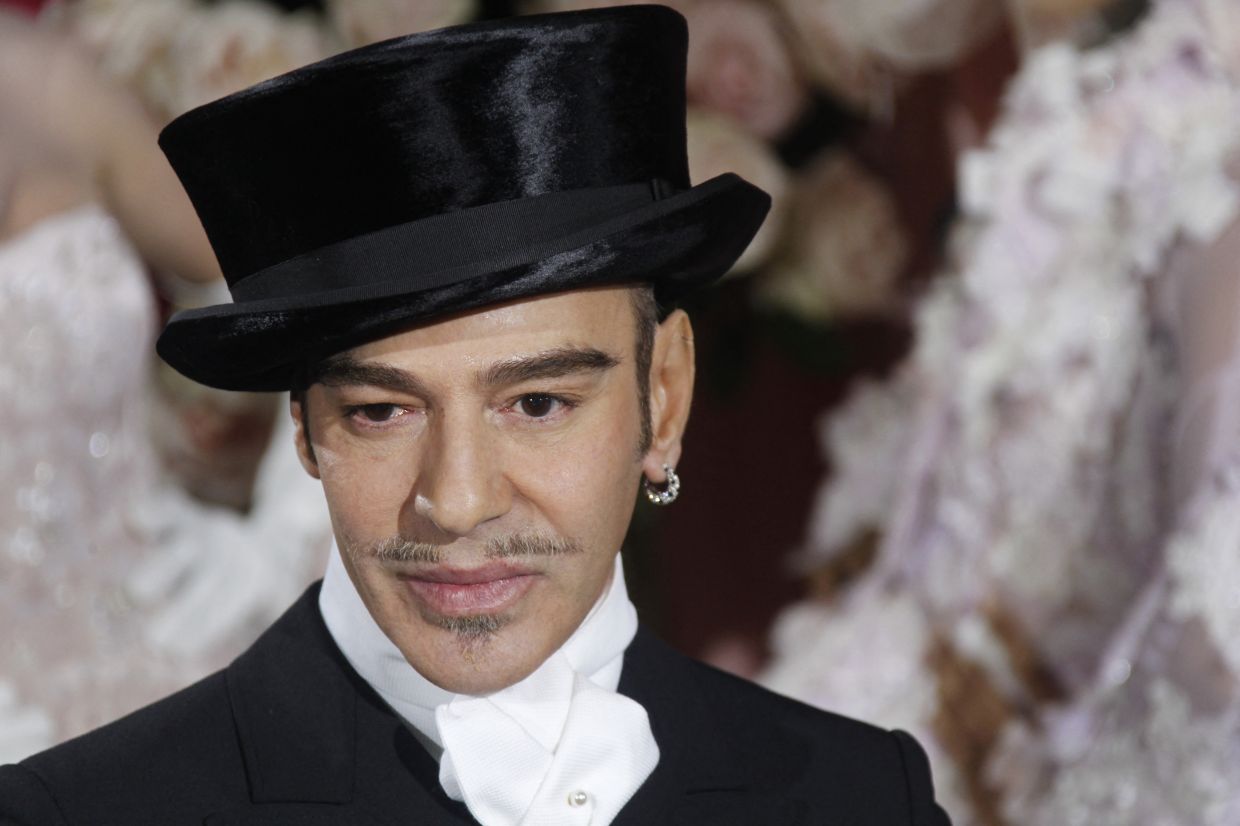
The Costume Institute at the Metropolitan Museum of Art will dedicate its 2025 spring exhibition to British designer John Galliano, positioning him as only the third living designer to receive a solo retrospective at one of the fashion world's most prestigious institutions. The decision to celebrate Galliano represents a complex reckoning with artistic genius and personal accountability, presenting the museum with the delicate challenge of honouring creative achievement whilst acknowledging the grave ethical lapses that fractured his professional standing and public reputation.
Galliano's trajectory within the fashion industry reads as a narrative of extraordinary ascent followed by catastrophic decline. For nearly fifteen years, he served as creative director at Christian Dior, one of the most coveted positions in global fashion, during which he established himself as a visionary capable of transforming the house's aesthetic whilst maintaining its legacy of elegance and innovation. His designs became synonymous with theatrical grandeur and meticulous craftsmanship, earning him recognition amongst collectors and fashion historians as one of the contemporary era's most influential stylists.
This prominence evaporated in 2010 and 2011 when Galliano made a series of inflammatory antisemitic and racist remarks that circulated widely through social media and digital platforms. The statements, including a video of him declaring "I love Hitler" in a bar setting, provoked international condemnation and prompted swift professional consequences. Dior terminated his employment, and he faced legal proceedings in Paris resulting in conviction for public insults based on race, religion, ethnicity, and national origin. The scandal effectively erased him from mainstream fashion discourse virtually overnight, demonstrating the industry's capacity for sudden and total rejection.
Following his dismissal, Galliano underwent a period of considerable personal reckoning that included treatment for substance addiction and sustained efforts towards rehabilitation. The process, conducted across both public forums and private consultations, extended across several years during which his professional future remained profoundly uncertain. This interregnum established a narrative arc that museum curators and fashion analysts have recognised as potentially instructive regarding concepts of accountability, redemption, and the possibility of professional reintegration following serious transgression.
In 2014, Galliano secured appointment as creative director at Maison Margiela, the Paris-based fashion house, where he remained for a decade. His tenure there, whilst garnering considerable critical acclaim, proceeded with far less mainstream visibility than his Dior years, reflecting the lasting reputational damage stemming from his earlier conduct. Yet within fashion circles, many acknowledged that his technical abilities and conceptual innovation remained undiminished, suggesting a more nuanced assessment of his contributions beyond the scandal.
The museum's decision to mount a retrospective necessarily involves confronting this contested legacy directly. Museum leadership, including chief curator Andrew Bolton and Editor-in-Chief of Vogue Anna Wintour, engaged in preliminary consultations with Jewish community leaders in New York to navigate the sensitivity surrounding the exhibition's framing. These discussions reflected recognition that presenting Galliano's work required explicit acknowledgment of harm caused rather than relegation to footnotes or omission. The approach signals an institutional shift towards integrating ethical considerations into curatorial decisions, rather than compartmentalising artistic merit from personal conduct.
The exhibition structure reflects this commitment to complexity through three distinct thematic sections. The first segment, titled "Bearings", directly confronts the rupture created by his antisemitic, racist, and anti-Asian remarks, his subsequent termination from Christian Dior, his legal conviction in Paris, and his engagement with addiction recovery. Rather than minimising or contextualising these events, this section positions them as foundational to understanding Galliano's subsequent trajectory. The curatorial statement emphasises that "the exhibition will address the derogatory conduct that fundamentally altered his career and public reception", establishing a framework whereby artistic achievement must be examined alongside ethical accountability.
The second section, designated "Horizons", examines the intellectual and aesthetic sources animating Galliano's design philosophy. This portion explores how history, geography, art, storytelling, and performance traditions informed his creative vision. By investigating the conceptual architecture underlying his work, the exhibition moves beyond surface-level analysis towards understanding how his technical innovations and visual language emerged from sustained engagement with cultural and artistic traditions spanning centuries and continents.
The concluding segment, "Atlas Of Transformation", concentrates specifically upon his technical mastery, experimental methodologies, and innovations in garment construction and design processes. This section documents his evolution as a craftsperson and technician, examining how his approach to fabrication, draping, and silhouette influenced contemporary fashion practice. By dedicating substantial curatorial attention to his technical achievements, the museum positions these contributions as worthy of serious study independent of biographical controversy.
For Malaysian and Southeast Asian fashion observers, the exhibition carries particular significance given the region's substantial engagement with international luxury fashion markets and growing influence within global design discourse. The retrospective model presented by this exhibition—balancing artistic legacy against ethical failings—offers a template for how institutions might address complex figures whose contributions merit recognition whilst their actions demand accountability. The exhibition opens during May 2025, coinciding with the Met Gala red carpet event that has become increasingly significant for international fashion commentary and trend-setting.
The museum's determination to avoid minimising either Galliano's creative accomplishments or his serious misconduct reflects evolving institutional standards regarding the integration of ethical considerations into cultural programming. Rather than presenting these dimensions as contradictory, curators have structured the exhibition to examine how personal conduct, its consequences, and shifting cultural values have fundamentally reshaped interpretations of his work. This approach acknowledges that artistic merit and ethical accountability need not be mutually exclusive categories, though tension between them inevitably persists.

