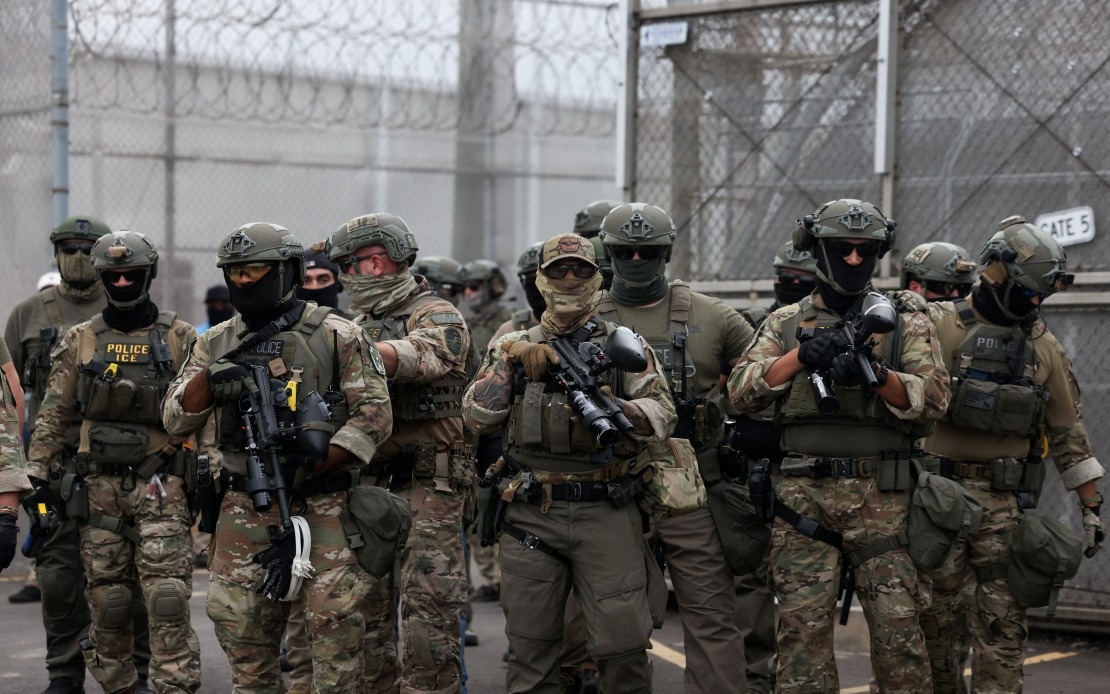
A Mexican national has been fatally shot by a United States Immigration and Customs Enforcement officer in what authorities describe as a confrontation involving aggressive vehicle maneuvers, marking another high-profile law enforcement incident that will likely intensify ongoing scrutiny of federal operations at the border. The Department of Homeland Security disclosed the shooting through a social media announcement on Tuesday, indicating that the deceased had allegedly entered the country unlawfully and resisted officers' commands while seated in his vehicle during the early morning operation.
According to the official account provided by Homeland Security, the escalation unfolded when the suspect first struck a vehicle operated by federal agents and subsequently attempted to collide with an officer, actions that prompted the officer to discharge his firearm. The injured driver was transported to a hospital where he succumbed to his wounds. The identity of the deceased has been confirmed as Lorenzo Salgado Araujo, though Homeland Security has not publicly explained the circumstances that led authorities to believe he was present in the country illegally or what initially prompted the federal operation.
The shooting has immediately activated multiple investigative channels reflecting institutional concerns about potential misconduct. Homeland Security has initiated an internal inquiry into the officer's actions, while the Federal Bureau of Investigation's Houston office has begun a separate investigation focused on whether a federal officer was attacked, a distinction that matters considerably for potential criminal charges. This bifurcated investigative approach illustrates how seriously federal agencies treat allegations involving violence against their personnel, though it remains to be seen whether comparable rigor will be applied to scrutinizing the officer's use of lethal force.
A critical dimension of this incident involves the availability of documentary evidence from multiple sources. NBC News reported that several witnesses captured photographs and video recordings of the confrontation, a development that carries substantial significance given historical patterns in similar cases. Transparency advocates and civil liberties organizations have consistently noted that video documentation has frequently contradicted official law enforcement narratives regarding the circumstances and necessity of shootings, creating a gap between initial departmental statements and evidence that subsequently emerges in the public record.
The timing of this incident carries additional weight when placed within the broader context of recent federal operations. In January, officers from federal agencies opened fire and killed two United States citizens, Renée Good and Alex Pretti, during separate enforcement operations. Those incidents provoked considerable public backlash and fueled national conversations about the intensity and appropriateness of federal law enforcement tactics, particularly in situations where suspects might be armed or perceived as presenting threats. For many Americans, the January shootings crystallized concerns about escalation protocols and whether alternatives to lethal force are being adequately considered by officers in high-stress situations.
For Malaysian and Southeast Asian observers, such incidents underscore fundamental questions about democratic governance, civilian oversight of security forces, and the mechanisms through which federal systems maintain accountability. The United States, as a developed democracy with extensive constitutional protections, faces considerable challenges in maintaining public confidence in law enforcement agencies when multiple incidents involving fatalities accumulate within compressed timeframes. These patterns can erode institutional legitimacy and necessitate reforms in training, de-escalation protocols, and the circumstances under which officers are authorized to use deadly force.
The investigation into this specific shooting will likely examine several key variables: the distance between the vehicle and the officer when the gun was discharged, whether less lethal alternatives were available or considered, the training and experience level of the officer involved, and the specific threat assessment that justified the use of deadly force. Equally important will be examination of how the initial confrontation was initiated and whether proper procedures were followed in terms of identifying the officer's authority and providing clear, understandable commands before the situation deteriorated into violence.
The availability of witness recordings creates the possibility that public understanding of this incident may eventually diverge substantially from the Homeland Security account. In previous similar cases, video evidence has revealed details that contradicted official statements, suggesting officers' accounts cannot automatically be accepted as complete or accurate without independent corroboration. This reality has gradually transformed public consciousness about the necessity of recording law enforcement interactions and about the limits of institutional credibility when agencies are investigating their own personnel.
The implications of this shooting extend beyond the immediate case. Each fatal incident involving federal enforcement officers contributes to broader political conversations about immigration policy, border security, use-of-force standards, and the appropriate balance between security imperatives and respect for human life. For regions like Southeast Asia that maintain immigration enforcement relationships with the United States, the manner in which American agencies conduct operations and account for their use of force carries symbolic importance regarding the standards and practices that might be expected in cooperative arrangements.
As the investigations proceed, attention will likely focus on whether Homeland Security will release the witness recordings and other documentation, a transparency measure that has become increasingly expected in controversial police shootings. The agency's responsiveness to demands for disclosure will partially determine whether public confidence can be maintained or whether the incident further contributes to broader skepticism about federal law enforcement accountability. The coming weeks will reveal whether the internal and FBI investigations produce findings that either vindicate the officer's actions or identify deficiencies in judgment, training, or procedure that contributed to a lethal outcome.

