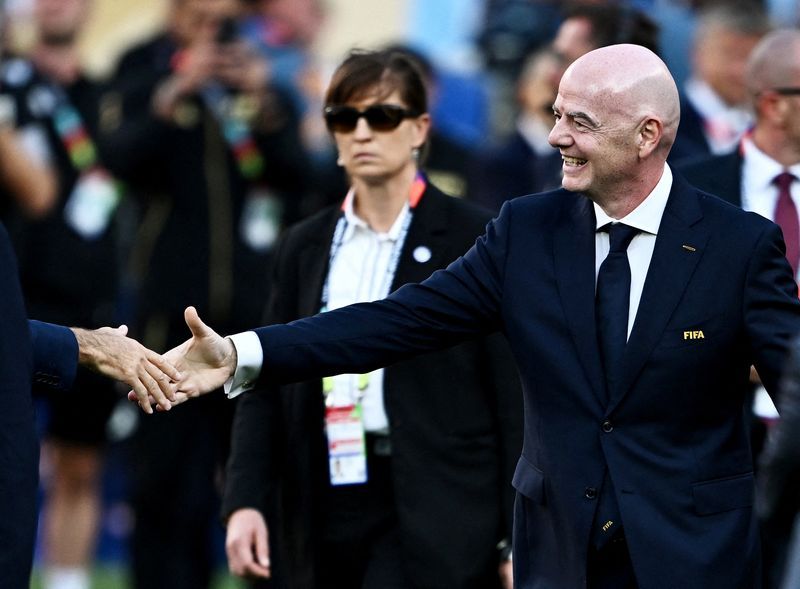
FIFA President Gianni Infantino's grip on global football governance faces a critical test as the world soccer body splinters into opposing camps over his leadership, with Mexico and Argentina's football associations becoming crucial allies in his fight for reelection at March's Congress in Morocco. The Mexican Football Federation and Argentina's football association have each issued public statements of support for Infantino, reversing earlier institutional pressure from their regional bodies and providing the embattled Swiss administrator with backing from two of South America and North America's most influential footballing nations.
The split within world football's hierarchy has become starkly apparent, with Infantino's fate now hanging on alliances that defy traditional geographic and institutional lines. The Confederation of African Football threw its unanimous weight behind Infantino on Thursday, whilst Europe's governing bodies remain firmly opposed. UEFA has pledged to boycott FIFA competitions including the World Cup, and Asia's confederation expressed solidarity with the European stance. Yet South America's CONMEBOL, the continent housing some of world football's most prestigious leagues and nations, rejected any attempt to remove Infantino without a vote involving all 211 FIFA member associations—a procedural hurdle that effectively shields him from immediate removal.
Mexico's position represents a particularly significant rupture within regional football governance, as the Mexican Football Federation has publicly broken ranks with CONCACAF, its own confederation, which had called for a comprehensive reckoning with Infantino's presidency. This divergence illustrates how the World Cup commercial rights controversy has fractured traditional institutional loyalty, forcing individual nations to calculate their own strategic interests rather than follow confederation-wide directives. The FMF's statement emphasised that it would neither recognise nor approve any process to remove or challenge Infantino that fell outside FIFA's formal institutional framework, effectively endorsing his position that only a vote of all member associations could legitimately alter his status.
The underlying dispute centres on Infantino's now-abandoned proposal to sell portions of the World Cup's commercial rights, a move that generated extraordinary backlash from confederations, national associations, and player representatives. In a letter to Infantino, Argentina's football association acknowledged that the proposal had created far greater uncertainty than confidence and that procedural errors had occurred, yet it argued for continuity under FIFA's leadership rather than upheaval. The AFA praised what it characterised as ten years of work focused on developing football globally and strengthening institutional governance through transparent mechanisms, suggesting that the remedy for Infantino's misstep lay in better communication and process reform rather than leadership change.
Contrast this with the growing roster of nations withdrawing support. Croatia's football federation cited a thorough reassessment prompted by recent developments surrounding the 2026 World Cup and discussions within its governing bodies, joining England and Albania in withdrawing endorsement. Additionally, FIFPRO, representing players globally, characterised Infantino's proposal not as a simple administrative failure but as a profound abuse of presidential authority, framing the dispute in more existential terms than merely procedural disagreement.
CONMEBOL's earlier statement reveals a telling tension: whilst rejecting any unconstitutional removal process, it simultaneously condemned what it described as repeated unilateral actions taken without genuine dialogue, and stressed the importance of transparency reforms that FIFA had ostensibly introduced over a decade ago. This suggests that even Infantino's South American supporters harbour serious reservations about his management style, yet prefer the stability of working within established institutional channels to the chaos of leadership upheaval during an Olympic year and with the 2026 World Cup approaching.
For Malaysian and Southeast Asian readers, this crisis carries particular significance because Asia's confederation has aligned firmly with UEFA and CONCACAF in opposition to Infantino, positioning the Asian Football Confederation alongside Europe's boycott threats. This stance may reflect concerns within Asian football leadership that Infantino's centralisation of power and willingness to make sweeping decisions about competition structures and commercial arrangements threatens the interests of smaller confederations. The regional boycott threat—however symbolic—demonstrates that even peripheral footballing powers feel empowered to challenge FIFA's executive authority when institutional governance appears threatened.
The transformation of Infantino's political position over recent months has been remarkable. Two months ago, his reelection seemed assured, a formality rather than a competitive contest. Now, whilst no serious challenger has emerged and he retains crucial support from Africa and South America, the ground beneath him has shifted considerably. The absence of an obvious alternative candidate paradoxically works in his favour, yet also suggests that opposition forces remain fragmented and lack either the unity or the institutional leverage to mount a coordinated challenge.
FIFA's response to the crisis has attempted to balance accountability with continuity. The organisation apologised for mistakes surrounding the commercial rights proposal and pledged to review the processes that generated the controversy, whilst simultaneously insisting that all actions complied with FIFA regulations and that failures related to process and communication rather than substantive governance breaches. This distinction matters legally and institutionally, potentially shielding Infantino from claims of formal misconduct whilst acknowledging political damage from poor execution.
The March Congress in Morocco will ultimately determine whether Infantino secures a fourth term and continues reshaping world football according to his vision, or whether the accumulated weight of institutional dissatisfaction finally materialises into electoral rejection. Until that moment, the current configuration—with African and South American support offset by European, Asian, and growing individual nation defections—suggests a deeply polarised football world where Infantino's authority, whilst still formally intact, has been fundamentally compromised by questions about his judgment, his willingness to bypass consultation, and his apparent belief that commercial innovation justifies institutional risk.

