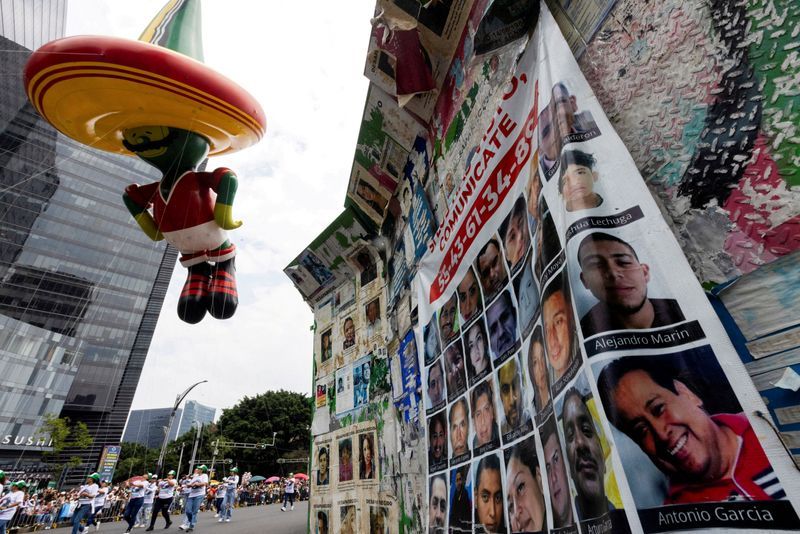
Mexico City's grand avenues glitter with World Cup promotional displays as the nation prepares for crucial knockout-stage football, yet the festive imagery conceals a troubling undercurrent running through Mexican society. Positioned alongside the screens celebrating the team's unbeaten group-stage performance are stark reminders of a humanitarian crisis: posters depicting Mexico's more than 135,000 missing people, a devastating figure that has accumulated steadily since 2006 when former President Felipe Calderon initiated his aggressive campaign against drug trafficking organisations. The juxtaposition of tournament euphoria and missing-person appeals creates a jarring visual metaphor for a nation attempting to reconcile sporting achievement with the weight of unresolved social trauma.
The capital's main thoroughfare, Paseo de Reforma, has become an unexpected stage for competing narratives about Mexico's present condition. Beyond the World Cup festivities, the street has frequently been closed not solely for celebration but for organised protests reflecting deeper grievances within the population. Teachers' unions have established encampments blocking entire roads whilst demanding the government honour election pledges to repeal pension reforms implemented in 2007 and provide salary increases for public-sector workers. These demonstrations underscore how the tournament, rather than uniting the country in simple patriotic expression, has become a backdrop against which longstanding political disputes continue to demand attention.
Carlos Mendoza, a prominent podcaster and journalist based in Mexico City, articulated this psychological tension candidly during interviews with international media. He observed that national sporting success generates what he termed a "national dopamine rush" that temporarily permits citizens to suppress uncomfortable realities, including documented allegations of collusion between ruling Morena party politicians and criminal drug organisations. Yet Mendoza cautioned that this psychological reprieve proves temporary; once tournament excitement fades, the underlying structural problems and governance failures remain unchanged, awaiting resolution.
Economic hardship compounds the emotional conflict facing ordinary Mexicans. Though inflation figures showed modest improvement in early June, the core inflation rate continues to exceed the Bank of Mexico's established target of three percent, meaning purchasing power erosion remains a lived reality for households across income levels. The World Cup has inadvertently exacerbated this economic burden by establishing prohibitively expensive ticket prices for matches being hosted across Mexico, the United States, and Canada—costs reaching thousands of dollars and effectively excluding working-class supporters from attending their national team's games. This pricing structure represents what Mendoza characterised as one of the tournament's most egregious failures, as it has transformed stadium attendance from a matter of ticket scarcity to one of financial accessibility.
Mexico's footballing achievements, whilst genuinely impressive—particularly their first World Cup knockout-stage victory in four decades against Ecuador—carry their own tragic shadow. Celebrations surrounding that victory resulted in four deaths on Reforma, a sobering reminder that even moments of collective joy can turn dangerous in a society marked by underlying tensions and instability. Anti-World Cup graffiti continues to mark walls throughout the city and around the Azteca Stadium, physical expressions of residual protest from the tournament's early days when multiple organised groups aired grievances about the tournament's timing, expense, and the government's prioritisation of sporting spectacle over fundamental social issues.
Local politician Rodrigo Cordera attempted to articulate an intellectual framework for holding multiple contradictory emotional responses simultaneously, arguing on social media that citizens possess the capacity to feel excitement about ninety minutes of football while simultaneously maintaining anger toward FIFA's governance, scepticism about the Mexican government's organisational competence, and broader concerns about the country's political direction. His intervention reflected a broader intellectual current among Mexico's educated classes—the recognition that mature citizenship requires resisting simple emotional narratives and embracing complexity.
President Claudia Sheinbaum's political position, meanwhile, remains relatively secure despite these cross-currents of dissatisfaction. An El Financiero newspaper poll published during the tournament indicated her approval rating had recovered to sixty-nine percent, reversing a marginal decline that began in March. The government has publicly committed to locating Mexico's missing persons as a national priority, though cynical observers question whether the tournament's euphoria might provide convenient political cover for delayed action on this and other urgent matters.
Alejandra Gonzalez, a Mexico City resident interviewed about the broader implications of the World Cup moment, offered perhaps the most measured assessment of the tournament's social function. She suggested that while the competition does not resolve Mexico's troubles, it does temporarily subordinate them within public consciousness, potentially allowing government authorities to defer difficult political decisions whilst riding the wave of patriotic sentiment. Yet Gonzalez also articulated a cautionary note about the importance of maintaining critical perspective even amid celebratory moments, emphasising that genuine national progress requires citizens and institutions to simultaneously acknowledge both positive developments and persistent inequalities.
As Mexico's World Cup campaign continues, the nation faces an internal balancing act unlike that of many other participating nations. Citizens must navigate the psychological permission that sporting success provides to feel national pride whilst resisting the temptation to allow that pride to obscure fundamental governance failures, economic hardship, and the haunting reality of 135,000 missing citizens. The tournament's ultimate legacy for Mexico may depend less on football results than on whether the nation can channel the unity and energy that sport generates toward addressing the deep structural challenges waiting beyond the final whistle.

