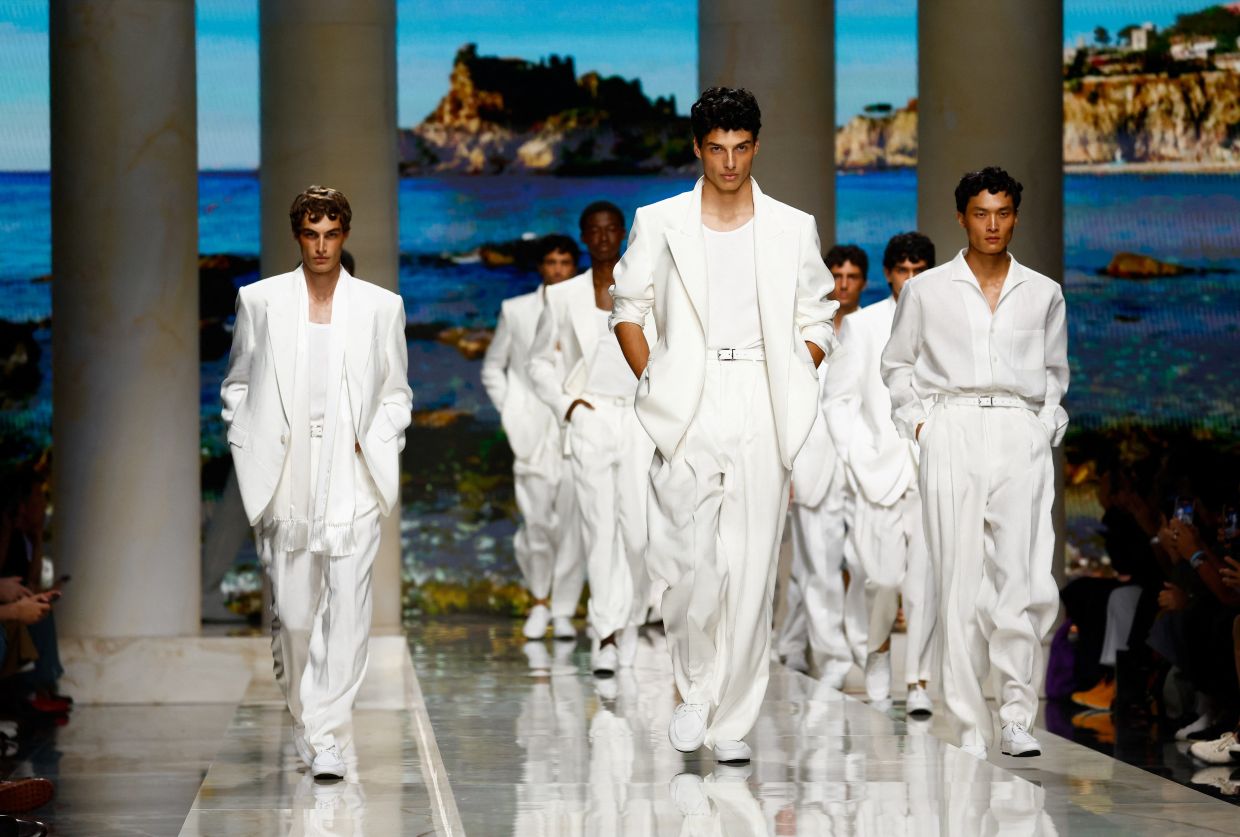
Milan's menswear designers have responded to a world of mounting tensions and economic apprehension by embracing restraint and refinement. The Spring/Summer 2027 collections that closed on Monday revealed a consistent preference for pared-down aesthetics, clean proportions and stripped-to-essentials silhouettes—a marked departure from the voluminous, oversized styles that have dominated recent seasons. Rather than adding layers of embellishment or amplifying scale, the fashion establishment's most influential voices have chosen to return to fundamentals, reinterpreting familiar garments through the lens of proportion, fabrication and deliberate simplicity. This shift suggests that luxury menswear is moving toward a more considered, less-is-more philosophy that mirrors the cautious mood gripping both consumers and the broader economy.
Prada established the season's intellectual framework through co-creative directors Miuccia Prada and Raf Simons, who mounted a compelling case for clarity and restraint. The collection centred on familiar wardrobe essentials reimagined through unexpected proportions and material innovations—an approach that allowed for complexity without visual clutter. Prada's signature contribution came in the form of leather combinations conceived as a contemporary evolution of denim's five-pocket blueprint. Slim tailored trousers paired with cropped, flat-pocketed jackets that functioned simultaneously as shirts created a cohesive visual language rooted in accessible design principles. This methodology—taking everyday garments and elevating them through precision cutting and material quality—reflected a broader Milan consensus that sophistication now resides in restraint rather than exuberance.
Yet practicality and luxury entered into productive tension across Milan's runways, with designers confronting a fundamental challenge: how to maintain sartorial formality whilst accommodating temperatures that made traditional menswear feel impractical. The persistent presence of leather on the catwalks exemplified this tension. Designers deployed woven and perforated leather techniques, creating breathable variations on a material traditionally associated with density and structure. The technical innovation allowed leather to feature prominently in summer collections without rendering garments unwearable in actual heat. This willingness to reconsider material application rather than abandon materials altogether suggests a fashion industry determined to maintain its own traditions whilst acknowledging environmental and practical realities.
The silhouette conversation in Milan centered on a decisive return to body-conscious tailoring after years of oversized proportions dominating menswear. Rather than the baggy, deliberately unstructured cuts of recent seasons, designers broadly embraced closer-to-the-body dressing that emphasizes form without reverting to aggressive tightness. This represents a nuanced middle ground—garments that acknowledge the male physique without fetishizing it. Dolce & Gabbana pushed this philosophy furthest with provocatively brief microshorts that displayed the leg, whilst other brands experimented with exposed torsos and strategically unbuttoned shirts. The trend reflects a generational shift in how contemporary menswear navigates masculinity, moving toward transparency and bodily visibility rather than the protective bulk that historically defined formal dress.
Ventilation emerged as perhaps the season's most practical innovation, with designers rethinking how air circulates through formal garments. Dress shirts appeared unbuttoned as integral design elements rather than construction failures, whilst some pieces rendered shirting transparent or omitted it entirely. Long trousers remained dominant—Milan's designers showed little appetite for shorts as legitimate formal wear—but the construction methodology shifted toward relaxed, breathable tailoring. Designers opened necklines, softened internal structuring and selected fabrics with inherent porosity, creating garments that maintain formality's visual language whilst accommodating actual human comfort. This pragmatic approach suggests that fashion's elite recognise that aspiration without wearability becomes mere costume.
Thom Browne's return to Milan after a fifteen-year absence signalled broader shifts in the menswear establishment. Under Zegna ownership, the American designer presented layered suiting constructed from seersucker and featured men's pleated skirts—pieces aligned with summer practicality whilst remaining faithful to his maximalist design vocabulary. Browne's integration into Milan alongside established houses suggests the city's menswear authority remains sufficiently flexible to accommodate diverse creative voices, provided they offer coherent perspectives on how men should dress. His presence underscored that whilst the season favoured restraint, Milan retained space for designers with distinctive points of view.
However, restraint did not achieve hegemonic status across Milan's menswear calendar. Philipp Plein presented crystal-encrusted denim requiring days of handwork, whilst Dolce & Gabbana leaned unapologetically into beaded embellishment and coral-inspired ornamentation. These collections positioned themselves as counterarguments to Prada's reductionist vision, offering maximalism and declarative glamour as legitimate responses to contemporary uncertainty. The coexistence of minimalism and maximal decoration across a single fashion week suggests that menswear audiences now encompass sufficiently diverse aesthetics that the industry need not enforce uniform direction. Some men, clearly, prefer restraint; others embrace conspicuous display.
A lighter Milan calendar—the event's duration was curtailed—created unexpected opportunities for emerging designers to secure prominent attention alongside international heavyweights. Copenhagen-based Martin Quad made his Milan debut with unconventional tailoring techniques that had already generated interest in his home market, whilst Domenico Orefice presented a co-ed collection emphasising leather and richly textured woven materials. These emerging voices proved capable of competing for critical and commercial attention, suggesting that Milan's menswear ecosystem retains sufficient permeability to nurture new talent. Japanese designer Shinya Kozuka's Shinyakozuka label delivered perhaps the season's most poetically calibrated summer collection, exemplified by a bare-chested model in a billowing teal sheer coat worn with oversized white trousers—an image that captured the season's spirit of studied ease and proportion-driven elegance.
For Malaysian fashion consumers and the wider Southeast Asian menswear market, Milan's emphasis on lightweight construction, breathable materials and proportional precision carries particular relevance. The region's tropical climate renders many European menswear conventions fundamentally impractical without considerable modification. Milan's designers have effectively legitimised the pursuit of formal elegance through ventilation and proportion rather than traditional construction, providing a template for how Asian menswear can develop sophisticated aesthetic vocabularies adapted to local climate realities. The season's technical innovations in perforated leather, open-necked shirting and relaxed tailoring offer Malaysian and regional designers permission to reimagine formality on terms suited to their geographic and cultural contexts.
The broader Milan consensus—that economic uncertainty and geopolitical turbulence call for sartorial clarity and deliberate proportion rather than visual excess—resonates beyond fashion circles. In contexts of instability, clarity becomes commodity. Designers responded by eliminating superfluous elements and returning to fundamental questions about how clothes function, fit and feel. This intellectual approach to menswear design suggests that fashion, when it engages seriously with its own traditions and current circumstances, can offer more than surface-level aesthetic pleasure. Milan 2027 menswear collections articulated a vision of masculinity that values precision, practicality and considered elegance—qualities unlikely to diminish in relevance regardless of how global circumstances evolve.