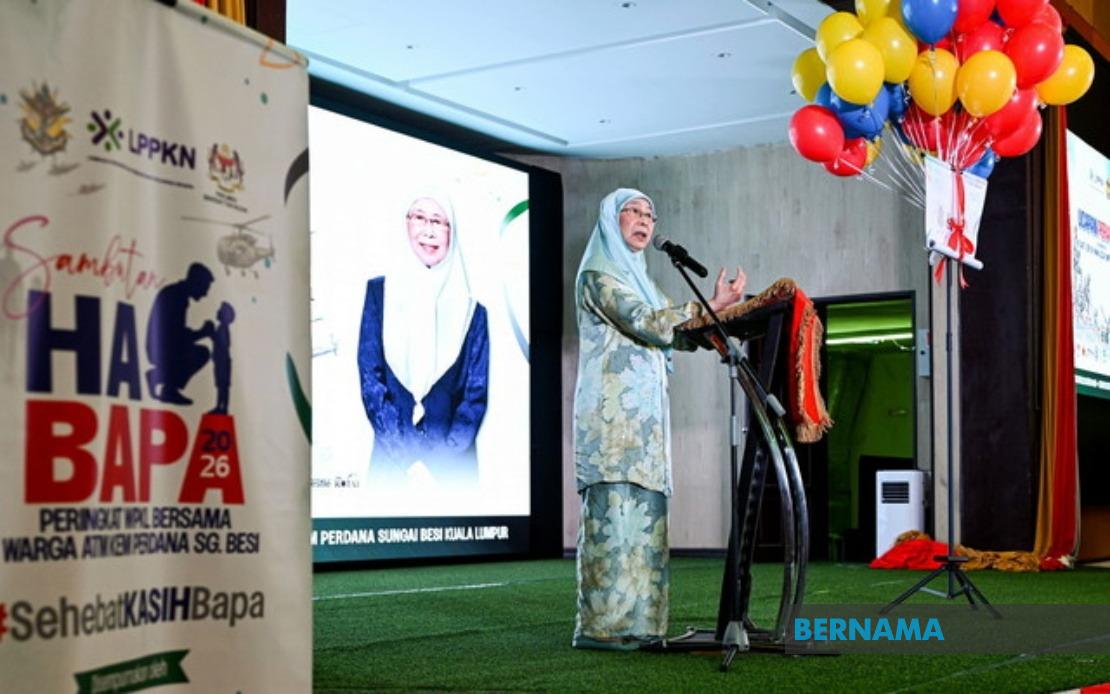
Dr Wan Azizah Wan Ismail, wife of the Prime Minister and Member of Parliament for Bandar Tun Razak, has called for sustained empowerment measures to support fathers serving in the Malaysian Armed Forces, recognising both their unique sacrifices and their vital role within family structures. Her remarks came during the officiating of the 2026 Federal Territory of Kuala Lumpur Father's Day Celebration, an event jointly organised by the National Population and Family Development Board (LPPKN) and the MAF that drew approximately 500 participants including military personnel, their spouses, and children.
The emphasis on empowering military fathers addresses a distinctive challenge within the armed forces: the recurring necessity for personnel to be separated from their families for extended periods while fulfilling their constitutional duty to defend national sovereignty. Unlike civilian fathers who generally maintain stable household presence, military fathers navigate the dual burden of maintaining family cohesion and emotional bonds while stationed away from home, often in demanding or hazardous circumstances. This separation can strain paternal relationships and complicate the execution of parenting responsibilities that modern fathers are increasingly expected to shoulder.
Dr Wan Azizah articulated the connection between targeted policy support and effective paternal engagement, specifically highlighting the National Family Compassion Policy (DKKN) as an institutional mechanism designed to enable military fathers to fulfil their domestic responsibilities despite occupational demands. Such policies represent a shift in national perspective, acknowledging that military service and active fatherhood need not be mutually exclusive when appropriate structural support exists. By anchoring policy frameworks to the actual lived experiences of armed forces personnel, the government signals recognition that military readiness and family stability are complementary rather than competing national interests.
The occasion also served as a platform for amplifying broader messaging about the foundational importance of paternal leadership within Malaysian families. Dr Wan Azizah emphasised that strengthening societal appreciation for the father's role as a primary family pillar extends beyond symbolic recognition; it requires deliberate institutional commitment to normalising paternal involvement in child-rearing and household leadership. This perspective aligns with evolving demographic and social research suggesting that active paternal engagement correlates with improved child outcomes across educational, behavioural, and psychological domains.
The LPPKN has operationalised this commitment through two primary initiatives designed to build paternal capability and community. The Fatherhood Module curriculum targets the practical dimensions of parenting, equipping fathers—whether military or civilian—with evidence-based strategies for navigating contemporary parenting challenges. This structured approach reflects recognition that fatherhood in modern Malaysia involves navigating changing gender dynamics, educational expectations, and social pressures that differ substantially from previous generations' paternal experiences.
Complementing the curriculum-based approach is the Men Empowerment Network (MEN), a community-building initiative that creates peer support structures for fathers navigating similar challenges. Such networks address a documented gap in Malaysian male social engagement; many men historically lacked formalised platforms for discussing family responsibilities, emotional wellbeing, and parenting concerns. By creating space for such conversations, particularly among military personnel who often operate within hierarchical, male-dominated institutional cultures, the network potentially reduces isolation and normalises vulnerability around family matters.
The selection of military fathers as a focus group for this celebration reflects deliberate strategic prioritisation. Armed forces personnel represent a cohort with particularly acute family separation challenges, offering a concentrated population where policy interventions and awareness campaigns can demonstrate measurable impact. Success in supporting military families may subsequently inform broader civilian-sector applications, creating a cascading effect across Malaysian society.
For the broader Southeast Asian context, Malaysia's explicit commitment to military father empowerment signals shifting regional attitudes toward work-life integration within defence establishments. Historically, military cultures across Southeast Asia have sometimes treated family considerations as secondary to operational requirements. By contrast, contemporary framing positions family stability as integral to military effectiveness and personnel retention, acknowledging that overextended, emotionally disconnected service members face elevated risks of burnout, attrition, and reduced operational performance.
The DKKN and supporting frameworks also address economic dimensions often overlooked in paternal support discussions. Military families, particularly those of junior-ranked personnel, frequently navigate financial strain during deployments or postings to remote locations. Compassion policies that provide tangible relief—whether through childcare assistance, family allowances, or flexibility arrangements—directly translate to reduced household stress and improved capacity for long-distance parental engagement through technology and scheduled leave periods.
Dr Wan Azizah's public articulation of this support reflects broader institutional recognition within Malaysia's government apparatus that family-friendly policies constitute neither luxury amenities nor threats to military discipline, but rather essential infrastructure for sustained force effectiveness and personnel wellbeing. This positioning challenges lingering assumptions that military service demands stoic emotional compartmentalisation incompatible with active paternal involvement.
The evolution of military culture toward greater recognition of family concerns also carries implications for recruitment and retention. As younger generations of Malaysian men increasingly prioritise work-life balance and active parenting, defence force recruitment messaging that acknowledges rather than minimises family separation challenges positions the military as a realistic employer rather than an institution demanding wholesale sacrifice of civilian life. This transparency potentially attracts personnel with greater awareness of and commitment to managing dual roles.
Moving forward, the sustainability of these initiatives depends upon consistent resource allocation, regular programme evaluation, and ongoing dialogue between military leadership, family support organisations, and personnel themselves. The 2026 celebration represents a public commitment, but translating ceremonial acknowledgment into systemic change requires institutional persistence and willingness to adapt policies as feedback accumulates from implementation experience among diverse military cohorts and family structures.

