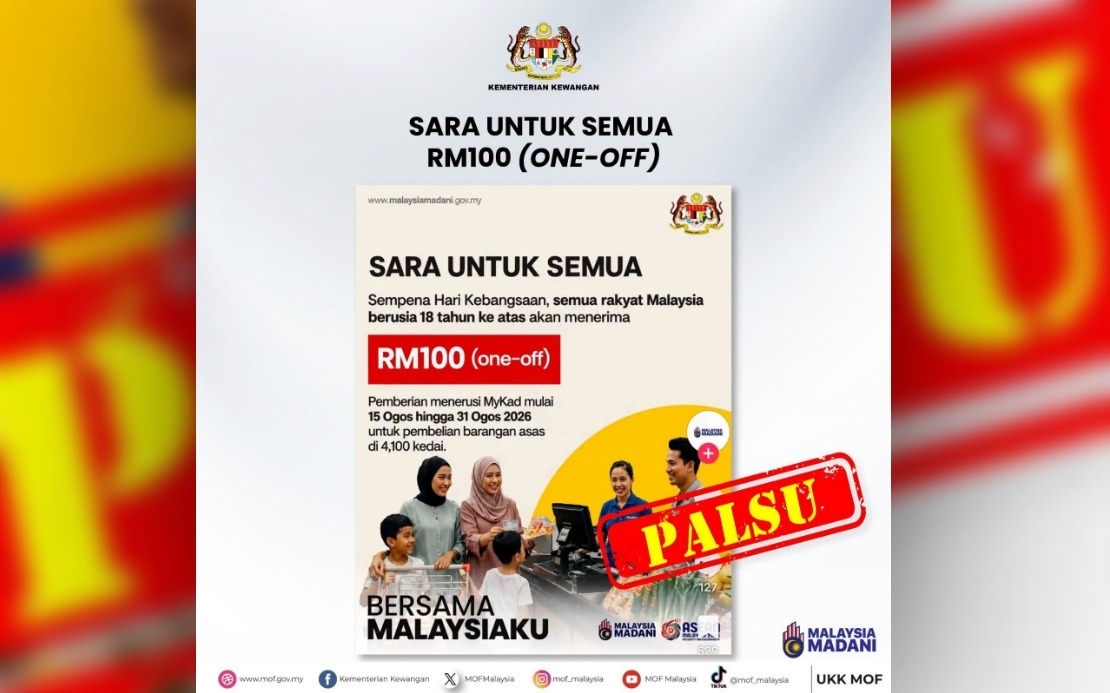
The Ministry of Finance moved swiftly to counter a misleading assertion circulating across social platforms, denying that all Malaysian citizens aged 18 years and older will receive a one-time RM100 Sumbangan Asas Rahmah payment in connection with the nation's Independence Day celebrations. The ministry issued a direct statement labelling the poster as fabricated and called upon the public to disregard the claim entirely.
The false posting represents another instance of misinformation targeting Malaysians during a festive period, potentially designed to capitalise on goodwill and heightened patriotic sentiment associated with National Day. Such deliberate falsehoods underscore the persistent challenge authorities face in combating the rapid spread of unverified claims through digital channels, where emotionally appealing content often circulates faster than official corrections can be disseminated.
In its formal response, the Ministry of Finance emphasised the critical distinction between verified government announcements and unsubstantiated social media posts. The ministry stressed that no official pronouncement regarding any additional SARA payment had been made through legitimate channels, making clear that the viral poster lacked any governmental endorsement or basis in policy. This deliberate clarification serves to establish a clear evidentiary record and protect the credibility of actual government communications.
The Sumbangan Asas Rahmah scheme itself remains a genuine initiative aimed at providing financial assistance to lower-income Malaysians. However, the parameters and timing of such assistance are determined through formal government channels and announced through official statements, not through unverified social media graphics. The ministry's swift denial attempts to prevent citizens from being misled about their entitlements while maintaining public confidence in legitimate assistance programmes.
The ministry has advised all Malaysians to exercise critical judgment when encountering financial claims purporting to originate from government sources. Citizens are encouraged to verify such information exclusively through official Ministry of Finance platforms, including its website and authenticated social media accounts, rather than relying on second-hand posts or screenshots that lack verifiable sources. This guidance reflects broader public education efforts to enhance digital literacy and reduce susceptibility to deliberate falsehoods.
The proliferation of misinformation regarding government payments and assistance schemes poses particular challenges because such claims tap into genuine public expectations and financial concerns. Vulnerable populations, including lower-income households and elderly citizens who might benefit from assistance programmes, may be especially susceptible to such false promises. Consequently, the ministry's emphasis on directing citizens toward authoritative sources serves a protective function for those most at risk of being deceived.
For Malaysian residents, particularly those monitoring developments in social welfare policy, the incident underscores the importance of maintaining healthy scepticism toward unverified financial claims. The National Day period, typically marked by heightened social media activity and festive announcements, provides fertile ground for false information to propagate rapidly. The ministry's immediate response demonstrates an awareness of this vulnerability and a commitment to clearing the record before misconceptions become too entrenched.
The broader context of government assistance in Malaysia reveals genuine efforts to support vulnerable populations through programmes such as SARA. However, the mechanics of such assistance—eligibility criteria, application processes, payment schedules—are invariably communicated through formal channels with proper documentation. Distinguishing between legitimate assistance and fabricated promises becomes increasingly important as digital communication becomes the primary medium through which misinformation spreads.
Regional observers will note that Malaysia is not alone in experiencing challenges with government-impersonating misinformation. Throughout Southeast Asia, similar false claims about financial assistance, stimulus payments, and welfare distributions have emerged, often timed to coincide with national celebrations or festivals when emotional engagement peaks. The Malaysian ministry's transparent response provides a model for how authorities can address such challenges while maintaining public trust in genuine government communications.
The ministry's final recommendation—that citizens obtain verified information exclusively through official channels before sharing content—addresses the amplification mechanism underlying viral misinformation. Each time an unverified post is shared, it gains credibility through apparent consensus, even when the original source remains dubious. By appealing directly to citizens' responsibility as information sharers, the ministry engages the public as partners in combating the spread of falsehoods rather than positioning citizens as passive victims of deception.
Moving forward, the incident highlights the necessity for Malaysians to develop and apply consistent verification practices when encountering claims about government payments or policy announcements. The Ministry of Finance has provided clear guidance on acceptable sources of information, and citizens who follow this guidance protect themselves while simultaneously reducing the velocity at which false information propagates through their networks. In an era of sophisticated digital communications, such individual vigilance becomes as important as institutional efforts to combat misinformation at its source.

