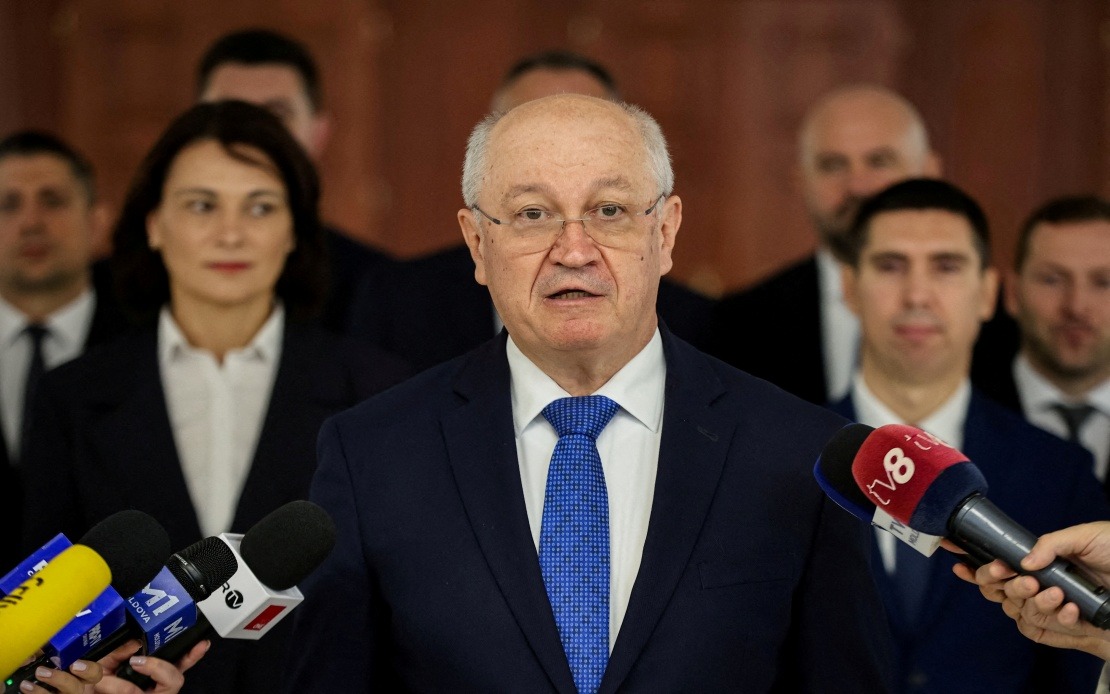
Alexandru Munteanu stepped down as Moldova's Prime Minister on Friday, ending a tenure that lasted roughly eight months. The announcement came via social media, where the departing leader offered a terse explanation centred on irreconcilable differences between his personal principles and the demands of the office he had held since November 2025.
Munteanu's departure marks another chapter in Moldova's volatile political landscape, a nation of roughly 2.6 million people wedged between Romania and Ukraine that has grappled with institutional instability, geopolitical pressure, and competing visions for its future. The prime ministerial turnover underscores the fragility of governing coalitions in Chişinău, where consensus has often proved elusive and ideological fault lines have frequently triggered Cabinet reshuffles.
The resignation statement, posted on social media platform X, was notably sparse on specifics. "Today, my term as Prime Minister comes to an end," Munteanu wrote. "The moment I realised that I could no longer carry out my mandate in accordance with my principles and convictions, I chose to step down." This vagueness immediately raised questions about what policy disputes or governance disagreements had prompted the decision, leaving analysts and political observers to speculate about tensions within the governing coalition or between the executive and other power centres.
For Malaysian readers and Southeast Asian observers tracking European political developments, Munteanu's exit illustrates a broader pattern affecting smaller states navigating complex external pressures. Moldova has faced sustained Russian military aggression in neighbouring Ukraine, European Union accession negotiations, and internal disputes over NATO alignment—challenges that create intense psychological and institutional strain on leadership. The prime minister's reference to acting "in accordance with principles and convictions" suggests a clash between personal political philosophy and operational compromises required to govern.
The timing and manner of the resignation also merit scrutiny. Eight months constitutes a relatively short tenure by European standards, suggesting either a fundamental miscalculation about what the role would entail or a deterioration of circumstances impossible to navigate. Munteanu's departure without detailed justification may reflect either an attempt to preserve relationships within his government or a recognition that transparent explanation might prove politically costly.
Moldova's political environment has been characterised by volatile coalition dynamics. The country's electoral system, constitutional framework, and geographic vulnerability to external interference have all contributed to recurring governmental instability. Prime ministers have previously departed under pressure from parliamentary factions, internal security crises, or irreconciable policy disagreements with the president or legislative blocs. Understanding Munteanu's departure requires familiarity with Moldova's fractious coalition arithmetic and the ideological divisions separating pro-European, pro-Russian, and pragmatist political camps.
The resignation now creates a succession question in Chişinău, with potential candidates likely emerging from existing parliamentary factions or technocratic backgrounds. The incoming premier will inherit both the ongoing geopolitical challenges stemming from Ukraine's conflict and the domestic agenda surrounding EU integration prospects. These twin imperatives have strained every recent Moldovan government, often creating impossible choices between Western-oriented reforms and maintaining economic ties with Russia or Transnistria.
For the European Union, Munteanu's departure arrives as Moldova pursues full membership negotiations. The bloc has made stable governance and anti-corruption reforms preconditions for accession, meaning any subsequent administration must demonstrate capacity to implement reforms while managing parliamentary coalitions. The leadership vacuum, however temporary, may complicate Brussels' assessment of Moldovan institutional reliability and commitment to the membership pathway.
Regionally, the resignation occurs amid broader European anxiety about autocratisation, democratic backsliding, and the security implications of state fragility near NATO's eastern frontier. Moldova's stability affects not only its citizens but also Romanian security concerns, Ukrainian strategic calculations, and broader European deterrence postures. A premature prime ministerial departure raises questions about whether governance challenges in Chişinău are manageable or whether deeper institutional dysfunction is metastasising.
The lack of substantive explanation from Munteanu paradoxically raises his departure's profile. Observers will scrutinise his subsequent statements, parliamentary testimony, or media interviews for clarification about whether he clashed with the president, coalition partners, or confronted insurmountable policy gridlock. His silence may constitute either a diplomatic courtesy toward his government or a calculated decision that detailed criticism would destabilise his nation.
For Moldova's international partners and domestic stakeholders, the immediate priority involves identifying a successor capable of commanding confidence across governing factions while advancing EU integration agendas and maintaining stability during acute geopolitical uncertainty. Munteanu's departure, whatever its underlying causes, reveals the continued fragility of executive leadership in states navigating simultaneous security crises and transformational institutional reform.

