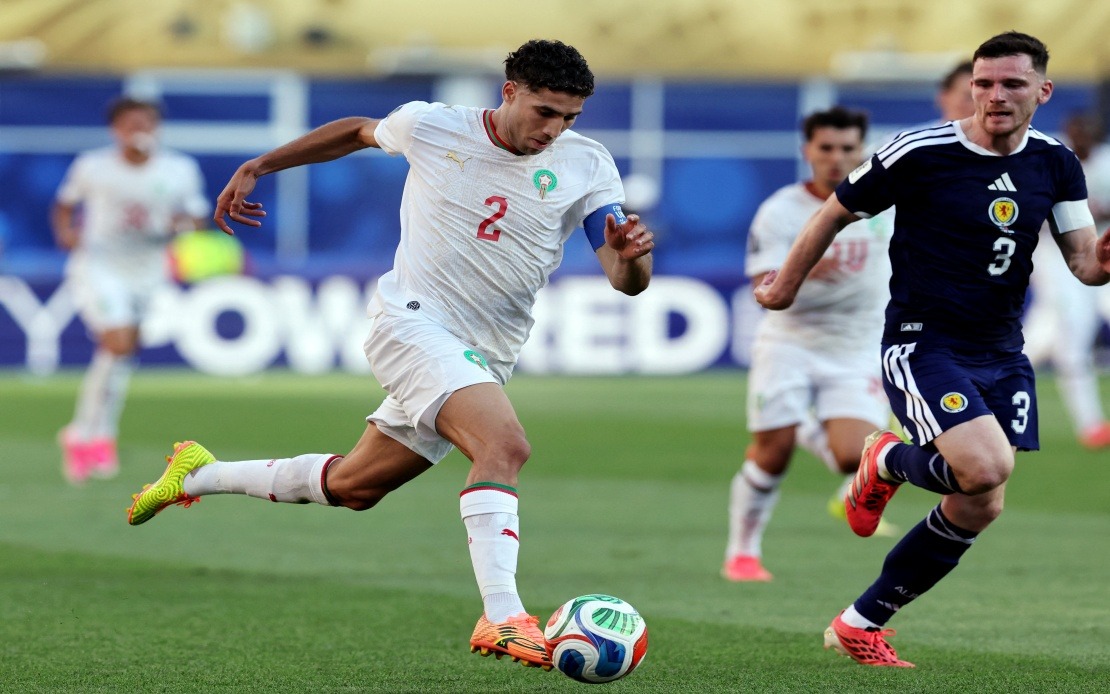
Mohamed Ouahbi, the Morocco national team coach, has rallied around his captain Achraf Hakimi in the face of considerable public hostility that erupted during the team's 1-0 victory over Scotland in Foxborough, Massachusetts on Friday. The incident occurred mere hours after a French court announced that the Paris Saint-Germain defender must face trial on rape allegations, creating an unprecedented backdrop for the player's participation in what should have been a straightforward World Cup fixture. Ouahbi's measured response demonstrated his commitment to preserving team unity while the international spotlight fell sharply upon one of his key players at a critical juncture in the tournament.
The atmosphere surrounding Hakimi deteriorated markedly from the moment the official team sheet was read out. Sections of the crowd began whistling and jeering when his name was announced, setting an uncomfortable tone that persisted throughout the match. Whenever the right-back made contact with the ball, similar expressions of disapproval reverberated through the stadium, creating an intimidating environment for the player to execute his duties on the pitch. Such public displays during a World Cup match represent a rare occurrence and underscore the intensity of feeling generated by the legal proceedings that had unfolded in Paris just hours earlier.
The timing of the court announcement and the match created a collision between sports and serious legal matters that few observers could have predicted. A court in Versailles had declared that Hakimi must stand trial on charges of allegedly raping a 24-year-old woman at his residence in 2023. The decision came after the Paris Saint-Germain player had challenged an earlier ruling from an investigating judge, seeking to overturn or modify the decision to proceed to trial. French legal authorities had apparently determined that sufficient evidence existed to warrant formal trial proceedings, a development that garnered immediate international media attention and inflamed public sentiment.
Ouahbi consciously steered clear of engaging with the legal dimensions of the situation when discussing his captain's performance. Instead, the coach chose to concentrate exclusively on the sporting narrative, framing Hakimi's contributions to Morocco's victory in purely football-related terms. This strategic approach reflected an understanding that the coaching staff's role was to protect the player's professional environment and allow him to focus on competing at the highest level, regardless of personal circumstances unfolding away from the pitch. The coach's refusal to be drawn into commentary about the trial announcement demonstrated a degree of discipline and professionalism in handling an inherently complex situation.
In his remarks, Ouahbi articulated robust confidence in his player's character and abilities. He stated that the Morocco squad remained steadfastly supportive of Hakimi and maintained expectations that the defender would demonstrate his world-class credentials during the tournament. The coach suggested that recent events had not diminished his assessment of Hakimi's potential or his value to the national team's prospects. By positioning the player within the context of elite defenders globally, Ouahbi sought to reframe the narrative around Hakimi's contribution to Morocco's campaign, emphasizing his sporting credentials rather than the controversy surrounding him.
Ouahbi further noted that Hakimi had delivered a strong performance despite the challenging circumstances he faced during the Scotland match. The coach's assessment suggested that neither the crowd hostility nor the looming trial proceedings had visibly impacted the player's ability to execute his tactical responsibilities. Ouahbi also emphasized that both he and Hakimi appeared relaxed about the situation, a statement intended to project calm and stability within the camp during a turbulent period. This message appeared designed both for internal team morale and for external consumption by media outlets and supporters questioning whether the player could effectively concentrate on football.
The squad's broader response to the developments reflected a desire to maintain focus on competitive objectives. Teammates of Hakimi declined to comment directly on the legal case, suggesting either that team management had discouraged public discussion or that players recognized the sensitivity and complexity of the matter. This collective restraint indicated an organizational culture within the Morocco camp that prioritized sporting mission over engagement with off-field controversies. The approach mirrored standard protocols employed by professional teams when players face external challenges unrelated to on-field performance.
Hakimi himself had addressed the court's decision through social media, indicating that he looked forward to finally having the opportunity to present his account publicly. The player's statement suggested anticipation for the trial process, which would allow him to address the allegations formally and comprehensively. His message conveyed a tone of determination rather than resignation, implying that he welcomed the prospect of vindicating himself through the legal system. The statement also signaled that he intended to continue his professional activities while the trial proceedings unfolded, refusing to be sidelined by the accusation.
The incident raises complex questions about the intersection of professional sports, legal accountability, and the role of public opinion in situations involving high-profile athletes. The crowd's reaction at Foxborough reflected genuine public concern and disapproval regarding serious allegations, yet also complicated the player's ability to perform his professional responsibilities without facing sustained hostility. The episode demonstrates how global sports events can become entangled with criminal justice matters, creating unprecedented pressures on all involved.
For Malaysian and Southeast Asian observers, the situation highlights the challenges international sports organizations face when managing player conduct and reputational matters across borders and different legal jurisdictions. The World Cup, as football's premier global tournament, inevitably attracts participants whose personal circumstances may extend beyond the sport itself. Ouahbi's principled defense of his player reflects a broader institutional reality that sports teams must navigate between supporting their members and acknowledging serious legal processes unfolding in various countries where their players operate professionally.

%22%2F%3E%3C%2Fpattern%3E%3C%2Fdefs%3E%3Crect%20width%3D%22100%25%22%20height%3D%22100%25%22%20fill%3D%22url(%23ph1ejxxg)%22%2F%3E%3Crect%20width%3D%22100%25%22%20height%3D%22100%25%22%20fill%3D%22url(%23ph1ejxxp)%22%2F%3E%3Ctext%20x%3D%2250%25%22%20y%3D%2250%25%22%20text-anchor%3D%22middle%22%20dominant-baseline%3D%22central%22%20fill%3D%22rgba(255%2C255%2C255%2C0.95)%22%20font-family%3D%22Georgia%2C%20'Times%20New%20Roman'%2C%20serif%22%20font-weight%3D%22700%22%20font-size%3D%22320%22%20letter-spacing%3D%22-0.02em%22%3EMMC%3C%2Ftext%3E%3C%2Fsvg%3E)