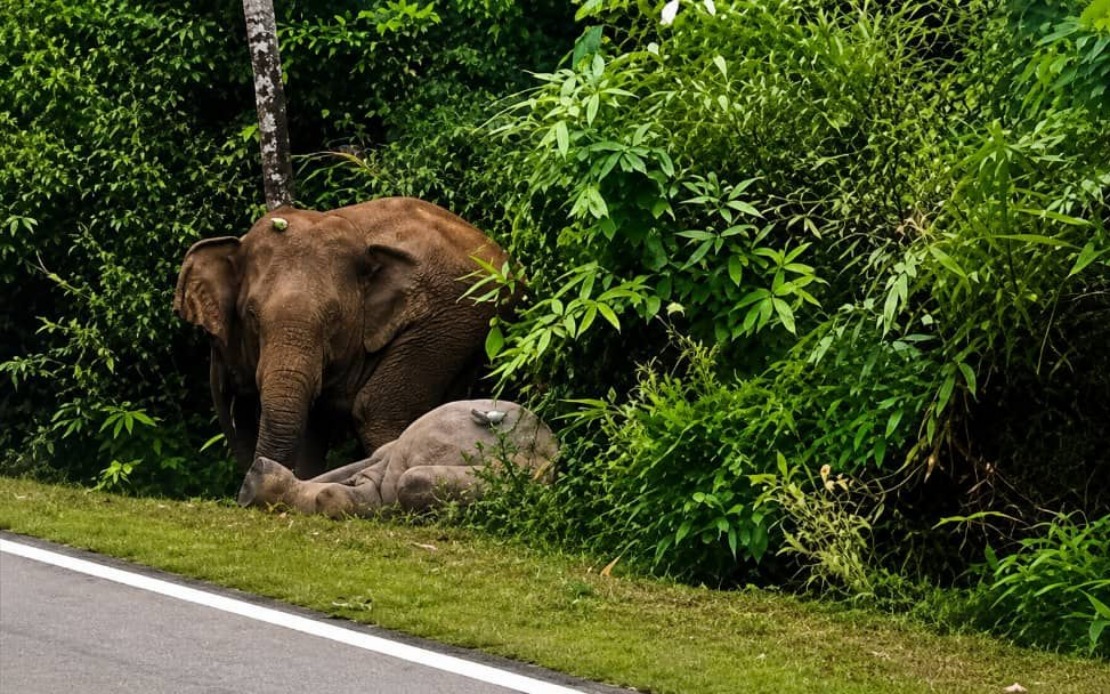
A distressing incident unfolded in Mersing, Johor, when a young elephant calf was fatally struck by a vehicle early Sunday morning, prompting its mother to remain vigilant at the scene for seven hours. The tragedy, captured in viral social media footage, has drawn uncomfortable parallels to the Gerik incident on Mother's Day last year, when another young elephant died under similarly tragic circumstances, sparking nationwide concern about the mounting tensions between wildlife and human activity in Malaysian regions.
The incident occurred at approximately 2.28 am along Jalan Felda Nitar when a Perodua Bezza collided with the juvenile elephant. Johor Department of Wildlife and National Parks (Perhilitan) received initial reports around 8.30 am and immediately despatched four personnel to investigate. Upon arrival, officers discovered the deceased calf, identified as a female roughly five years of age measuring approximately 150 centimetres in body length, with the adult female elephant—believed to be the mother—standing guard nearby. The young animal bore no tusks and exhibited front footprints measuring 11 inches in width and rear footprints of 14 centimetres.
The calf belonged to the Jamaluang-Mersing identification group, one of several elephant populations tracked by authorities across the peninsula. Separate investigations by the Fire and Rescue Department revealed that the vehicle's driver, a 31-year-old man, sustained leg injuries when his car crashed into the elephant calf and subsequently plunged into a five-metre-deep ravine alongside the roadway. The dual nature of the accident—involving both the animal and human casualty—underscores the complex and dangerous nature of human-elephant encounters that increasingly plague Malaysian highways and settlements bordering wildlife habitats.
The mother elephant's refusal to abandon her deceased offspring struck an emotional chord with observers, reflecting the deep maternal bonds within elephant herds that conservationists have long documented. This behaviour, while demonstrating the emotional intelligence of these creatures, also created immediate concern regarding the animal's vulnerability and psychological well-being. Perhilitan's Elephant Capture Unit from the Johor Elephant Sanctuary intervened to carefully guide the grieving mother back into the forest, while authorities subsequently arranged for the calf's carcass to be buried near the incident site. The decision to leave the carcass in proximity rather than removing it entirely reflects a pragmatic approach intended to minimise additional stress to the distressed animal.
Authorized personnel conducted intensive monitoring operations throughout the evening and following day to track the mother elephant's movements and ensure she did not return to the accident location, which would have exposed her to further vehicular hazards. Perhilitan confirmed that warning signage indicating elephant crossing zones had been previously installed along the roadway, though authorities acknowledged that the area's poor lighting conditions and remote nature continue to pose significant risks to both drivers and wildlife. The road's designation as an established elephant crossing corridor indicates that authorities recognise the region as a critical habitat corridor, yet infrastructure improvements and driver awareness campaigns appear insufficient to prevent such tragedies.
The Mersing incident inevitably invokes memories of the Gerik tragedy from May 11 last year, which captured the nation's collective anguish when a container lorry struck a juvenile elephant and the mother was observed attempting to push the massive vehicle in what observers interpreted as a desperate rescue effort. That incident catalysed renewed public discourse surrounding human-elephant conflict and raised uncomfortable questions about development patterns in elephant habitat regions. The repetition of such tragedies within little more than a year demonstrates that systemic issues remain unresolved despite the emotional impact and media attention generated by previous incidents.
Human-elephant conflict represents a persistent challenge across peninsular Malaysia, where expanding agricultural zones, residential developments, and transportation networks increasingly fragment elephant habitats and force these megafauna into dangerous proximity with human activity. The Mersing and Gerik incidents reflect broader patterns of ecosystem disruption where elephants, requiring vast territorial ranges, find their traditional migration routes severed by infrastructure projects and human settlement. Conservation experts have long warned that roadways cutting through elephant habitats create particularly hazardous situations, particularly during breeding seasons when maternal elephants may traverse greater distances.
The involvement of a Perodua Bezza—a compact sedan widely used across Malaysia—highlights that elephant strikes are not limited to heavy vehicles but occur across vehicle categories. Drivers traversing elephant crossing zones during low-visibility periods face genuine risks of sudden encounters with these large animals, particularly when elephants move through landscape corridors at night. Enhanced lighting, improved signage visibility, speed restrictions in identified crossing zones, and public awareness campaigns targeting drivers constitute potential mitigation strategies that warrant urgent implementation along accident-prone routes.
For Malaysian policymakers and environmental stakeholders, the Mersing incident represents a critical moment to reassess current strategies for managing human-elephant coexistence. The emotional response generated by viral social media footage of the grieving mother elephant demonstrates that public sentiment increasingly demands stronger protective measures and habitat preservation initiatives. Beyond immediate incident response protocols, systemic changes addressing habitat connectivity, infrastructure planning, and land-use policies will prove essential for reducing such tragedies and enabling elephant populations to persist within Malaysian ecosystems alongside human communities.

