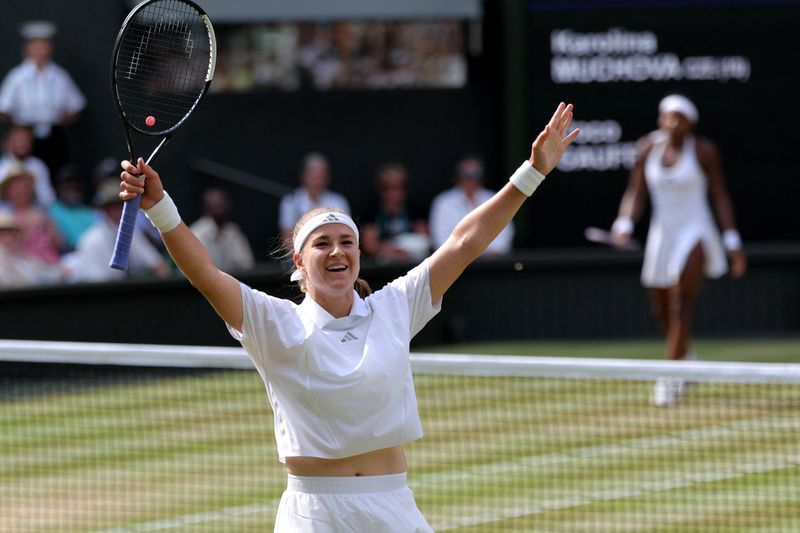
Karolina Muchova secured her maiden Wimbledon final appearance with a dramatic 6-2 1-6 7-6 victory over American seventh seed Coco Gauff on Centre Court, producing one of the tournament's most gripping contests. The 28-year-old Czech player recovered from the brink of defeat, saving a match point in the deciding set to advance past the seemingly unstoppable Gauff, who had navigated her way through four consecutive three-set matches to reach the semi-finals. The result sets the stage for a potentially historic championship, with compatriot Linda Noskova positioned to face Ukrainian Marta Kostyuk in Thursday's other semi-final, a pairing that could lead to the first all-Czech Grand Slam final in tennis history.
The significance of Muchova's breakthrough extends beyond personal achievement. A Czech champion would mark the third title for the nation in four years, following Marketa Vondrousova's triumph in 2023 and Barbara Krejcikova's victory in 2024. This remarkable run reflects a broader transformation in women's tennis, where the Czech Republic has emerged as a genuine powerhouse on grass—one of the sport's most demanding surfaces. For Malaysian and Southeast Asian tennis enthusiasts, the Czech surge underscores how consistent investment in player development and the ability to produce versatile competitors across multiple surfaces has become increasingly important in elite-level competition.
Muchova's path to the final carries an unusual element of adversity that makes her progression even more compelling. The Czech player requires substantial pharmaceutical and medical intervention simply to compete on grass, including medication, sprays, and eyedrops to manage an allergic reaction to the surface. This personal struggle against her own biology adds a layer of determination to her performance, transforming technical excellence into something approaching triumph against the odds. Despite these physical constraints, she demonstrated sophisticated grasscourt tactics that exposed Gauff's vulnerabilities in the opening set, breaking the American's serve in the third and fifth games with clinical precision. A 111-mile-per-hour ace capped the first set at 6-2, establishing Muchova's dominance in conditions where her opponent appeared temporarily overwhelmed.
Gauff, however, typified the American's characteristic refusal to surrender, even when positioned unfavorably. Having already survived four grueling three-set encounters to reach the semi-finals, the seventh seed showed no inclination to accept defeat passively. After struggling to convert any of her first eight break points, Gauff finally achieved the breakthrough on her ninth opportunity to establish a 3-1 lead in the second set. Her mother's visible celebration in the player's box marked the turning point psychologically, and Gauff's subsequent run to 5-1 looked to have fundamentally shifted momentum. The American's recovery to level the match demonstrated the mental fortitude that has characterized her recent performances at the All England Club.
The third set transformed into an absorbing examination of both players' technical abilities and mental resilience under pressure. Having played two contrasting sets—the first dominated by Muchova's grasscourt craftsmanship, the second seized by Gauff's aggressive recovery—both competitors elevated their ball-striking in the decider. Ferocious forehands and devastating backhand passes flew across the net as the two engaged in a back-and-forth battle that captivated spectators on a sweltering Centre Court afternoon. The tactical chess match intensified as critical moments approached, with both players acutely aware that a single lapse could prove decisive in determining who would advance to Saturday's final.
The climactic moment arrived when Gauff secured two break-point opportunities at 4-4, threatening to establish the 5-4 advantage that could have fundamentally altered the trajectory of the match. However, Muchova demonstrated the composure to escape this danger, executing the kind of high-pressure recovery that separates champions from contenders. Once the crisis had passed, Muchova gained ascendancy, eventually forcing a match tiebreak where the deciding moments would be played out. The psychological momentum shift proved decisive, as Muchova's superior court positioning and touch became increasingly evident as the contest entered its final phase.
The tiebreak itself showcased Muchova's complete grasscourt arsenal, featuring an audacious diving volley winner and a perfectly executed lob that left Gauff stranded. These shot selections demonstrated not merely technical proficiency but also tactical boldness—the willingness to attempt high-risk plays when the occasion demanded. When Muchova earned her first match point, spectators believed the outcome was determined, yet Gauff's resilience nearly forced a reversal. The American's forehand error on Muchova's second match point, sending the ball into the net, finally ended the 2-hour, 35-minute encounter and confirmed the Czech's passage to the championship match. For Malaysian observers, this victory reinforces how sustained excellence in women's professional tennis increasingly rewards not just baseline consistency but also the mental toughness and technical variety that can overcome adversity.
Muchova's achievement carries broader implications for the competitive landscape heading into the final. Her injury management strategies and the demonstrated ability to perform at elite level despite significant physical limitations offers lessons for athletes globally managing chronic conditions or environmental sensitivities. The fact that she has reached a Grand Slam final despite these obstacles underscores that professional success depends not solely on natural physical gifts but equally on determination, adaptation, and the willingness to confront genuine adversity. For readers in Southeast Asia, where athletes frequently contend with challenging environmental conditions and sometimes limited medical support infrastructure, Muchova's triumph represents an inspiring case study in overcoming systemic obstacles through preparation and mental fortitude.
The potential all-Czech final would represent an extraordinary moment in Grand Slam history, but Muchova must first navigate Saturday's championship match. Regardless of the outcome, her semi-final victory represents a watershed moment in her career—proof that sustained effort and technical mastery can overcome both external obstacles and formidable opponents. The match itself will be remembered as one of Wimbledon's memorable encounters, a contest that ebbed and flowed with sufficient drama to captivate even casual observers. As the tennis world now awaits Thursday's second semi-final between Noskova and Kostyuk, the possibility of an unprecedented all-Czech championship has suddenly become tangible, transforming what began as an unlikely narrative into genuine competitive reality.

